
长三角科技创新共同体

Search documents
上海人大工作触角遍及城市发展每一个角落 立良法强监督 通民心促善治 用脚步丈量民情 以行动诠释担当
Jie Fang Ri Bao· 2026-02-02 01:35
Group 1 - The Shanghai Municipal People's Congress has passed 24 local regulations and conducted 32 supervisory activities over the past year, engaging over 13,000 representatives in community outreach and collecting more than 9,900 suggestions [1] - The legislative work has focused on connecting legislation with reform decisions, promoting scientific, democratic, and lawful legislation, and ensuring that local legislation includes more innovative and breakthrough points [2] - The establishment of the Yangtze River Delta Technology Innovation Community has been facilitated by collaborative legislative practices among Shanghai and neighboring provinces, aiming to enhance the integration of technological and industrial innovation [3] Group 2 - The supervisory work of the Shanghai Municipal People's Congress has emphasized urban governance, with notable inquiries into healthcare resource distribution and the implementation of public space regulations, aiming for a more refined urban management [4][5] - The Congress has innovated its supervisory methods, including simultaneous reviews of intellectual property judicial protection, enhancing collaboration between judicial and administrative sectors [5] - The engagement of representatives with the public has been deepened through various outreach activities, collecting over 5,400 suggestions for the "14th Five-Year Plan" and facilitating improvements in community infrastructure [6][7]

制度创新打通要素壁垒 长三角科创共同体再升级|“十五五”开局新气象
证券时报· 2026-01-23 00:17
Core Viewpoint - The article emphasizes the significant advancements in technological innovation and industrial collaboration in the Yangtze River Delta region during the 14th Five-Year Plan period, highlighting the importance of institutional innovation and collaborative frameworks for future development [1][3][4]. Group 1: Institutional Innovation and Collaboration - The Yangtze River Delta has enhanced its regional innovation system through institutional innovation, platform co-construction, and element interconnectivity, with the implementation of the "Decision on Promoting Collaborative Technological Innovation in the Yangtze River Delta" starting September 1, 2025 [3][4]. - Key initiatives include organizing joint projects annually, exploring mechanisms like "pay after use" for patents, and establishing a joint fund for basic research [3][4]. - The collaborative innovation community in the Yangtze River Delta has made significant progress, with 24 innovation alliances entering the pilot construction phase by the end of the 14th Five-Year Plan [3][4]. Group 2: Development of World-Class Industrial Clusters - The G60 Science and Innovation Corridor, which connects nine cities, has been established as a collaborative industrial network, enhancing the international influence of industrial clusters [6][7]. - The G60 corridor has evolved into a "nine-city linkage" model, facilitating a division of labor where research and development are concentrated in core areas while manufacturing occurs in surrounding regions [6][7]. - For instance, the localization rate of large aircraft manufacturing has increased from 10% to 60%, with significant contributions from various cities in the region [6][7]. Group 3: Future Industry Development - The Yangtze River Delta is pursuing an integrated approach to develop future industries, focusing on low-altitude economy infrastructure and cross-regional cooperation [7]. - Recent measures aim to enhance low-altitude infrastructure collaboration across the region, promoting efficient linkage between technology research, equipment manufacturing, and application scenarios [7]. Group 4: Deepening Integration and Overcoming Barriers - The 15th Five-Year Plan will focus on deepening integration in technological innovation, with Shanghai positioned as a resource organizer for regional innovation [9][10]. - Despite notable achievements, challenges remain due to administrative barriers that hinder deeper collaboration, particularly in talent evaluation and cross-regional cooperation [9][10]. - The goal is to transition from "institutional integration" to "deep symbiosis," ensuring a robust system for original innovation and industrial collaboration [10].

中国区域科技创新报告出炉:上海、北京、江苏等6地领先
Di Yi Cai Jing· 2025-09-21 04:27
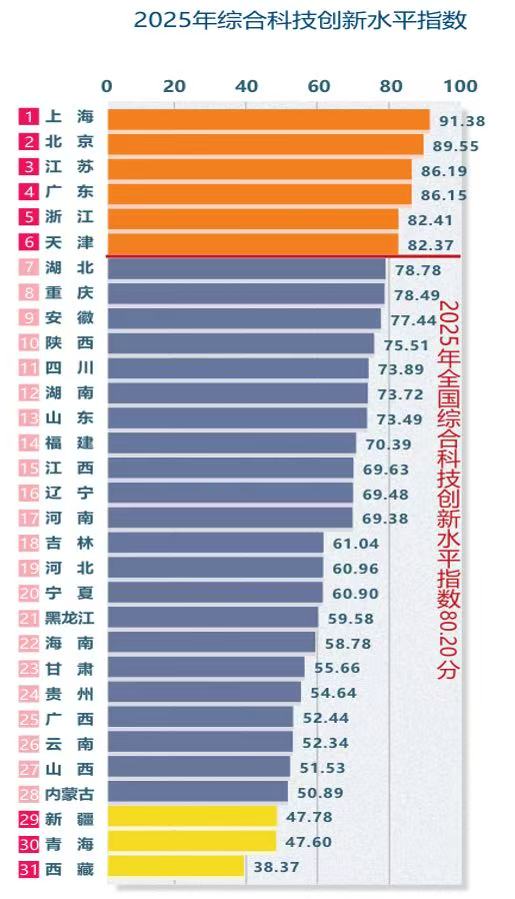
Core Insights - The report indicates that China's overall technological innovation level has improved, scoring 80.20, an increase of 1.77 from the previous year, with growth in innovation input, output, and high-tech industries [1][4] Group 1: Regional Innovation Levels - The report categorizes 31 regions into three tiers based on their innovation scores: - First tier includes Shanghai, Beijing, Jiangsu, Guangdong, Zhejiang, and Tianjin, all above the national average [5] - Second tier includes regions like Hubei, Chongqing, and Anhui, scoring above 50 but below the national average [6] - Third tier includes Xinjiang, Qinghai, and Tibet, scoring below 50 [6] Group 2: Key City Clusters - The Beijing-Tianjin-Hebei region shows significant collaborative innovation, with Beijing ranking second nationally in innovation level and first in innovation environment [7] - The Yangtze River Delta is strengthening its innovation community, with Shanghai ranking first nationally and Jiangsu third, both showing improvements in R&D investment [8] - The Guangdong-Hong Kong-Macau Greater Bay Area maintains strong innovation momentum, with Guangdong ranking fourth nationally and leading in innovation promotion [8] Group 3: Regional Development and Performance - The Yangtze River Economic Belt has seen continuous improvement in innovation capabilities, with Hubei rising to seventh and Chongqing to eighth in innovation rankings [9]
优化生态打造长三角科创共同体
Jing Ji Ri Bao· 2025-06-12 22:06
Core Insights - The 2025 Yangtze River Delta (YRD) regional leaders' conference emphasized enhancing regional innovation capabilities to drive high-quality development [1] - Significant growth in industrial and service robots, as well as new energy vehicles, indicates a strong push towards becoming a national hub for original innovation and high-end industries [1] - The YRD aims to establish a globally influential technology innovation community, with substantial contributions from various research institutions and universities [1][2] Group 1: Innovation Growth - In Q1, industrial robot production in Hangzhou and Ningbo increased by 62.7% and 63.2% respectively, while Suzhou's service robot production surged by 165% [1] - New energy vehicle production in Hefei and Wuhu grew by 74.9% and 114.2% respectively, showcasing the region's commitment to technological advancement [1] - Shanghai's AI manufacturing output rose by 13.2%, further highlighting the region's innovation capabilities [1] Group 2: Policy Framework - A series of policy documents have been introduced to accelerate the construction of the YRD technology innovation community, aiming for a modern and international community by 2025 and a globally leading one by 2035 [2] - The "Science and Technology Innovation + Industry" initiative aims to establish a cross-regional collaborative innovation mechanism [2] Group 3: Regional Strategies - Shanghai focuses on building an international technology innovation center, while Jiangsu emphasizes organized research and transformation [3] - Zhejiang promotes enterprises as the main drivers of the entire innovation chain, and Anhui leverages its comprehensive national science center for new industrial cluster development [3] Group 4: Future Directions - Future efforts will focus on optimizing collaborative innovation mechanisms and establishing a legal framework to support cross-regional technology innovation [4] - A negative list for the circulation of innovation elements in the YRD will be proposed to enhance resource integration [4] Group 5: Regional Ecosystem - The YRD will strengthen its innovation hubs, particularly in Shanghai and Anhui, to support regional technology innovation centers [5] - Specialized and international technology intermediary service organizations will be cultivated to enhance the innovation cycle from research to commercialization [5]