长期业绩

Search documents
在公司官方账号发文,“金融女神”李蓓公开怒怼前夫,还披露大量私人纠葛细节!私募大佬但斌发声:投资还是长期业绩说话
Mei Ri Jing Ji Xin Wen· 2026-02-09 14:43
Core Viewpoint - The recent public dispute between Li Bei, founder of Banxia Investment, and her ex-husband Liang Wentao, founder of Honghu Asset, has drawn significant attention in the investment community, highlighting the tension between personal conflicts and professional performance in the finance industry [2][4]. Group 1: Performance and Criticism - Li Bei's article titled "Why Not Look at Li Bei's 5-Year Performance?" directly addresses criticisms regarding her investment performance, particularly focusing on the use of a three-year performance period by critics to undermine her credibility [2][4]. - As of January 31, 2026, Banxia's flagship funds reportedly reached new net asset value highs, with the Banxia Macro Hedge Fund III showing a one-year performance of 39.75% and a five-year performance of 100.75%, while the three-year performance was only 4.83% [4]. - The debate centers around the contrasting performance metrics, with critics often highlighting the weaker three-year performance to challenge Li Bei's overall investment capabilities [4]. Group 2: Industry Reactions - The incident has prompted responses from industry leaders, including Dan Bin, chairman of Dongfang Gangwan, who emphasized the importance of long-term performance in investment, suggesting that all discussions should ultimately return to the core of sustained performance [4]. - Dan Bin's comments reflect a broader sentiment in the industry that while personal narratives may attract attention, the focus should remain on the professional achievements and long-term results of investment managers [4]. Group 3: Public vs. Private Discourse - The contrasting tone of Banxia Investment's official communications, shifting from a professional analysis of the real estate market to a personal dispute, raises questions about the boundaries between private matters and public discourse in the investment sector [5][6]. - The incident illustrates the delicate balance that investment firms must maintain between building a professional brand and engaging in personal conflicts, which can blur the lines of credibility and trust with clients and investors [5][6]. - The situation serves as a reminder for the industry to continuously evaluate the impact of personal conflicts on professional integrity and the importance of maintaining a clear distinction between personal and institutional narratives [6].

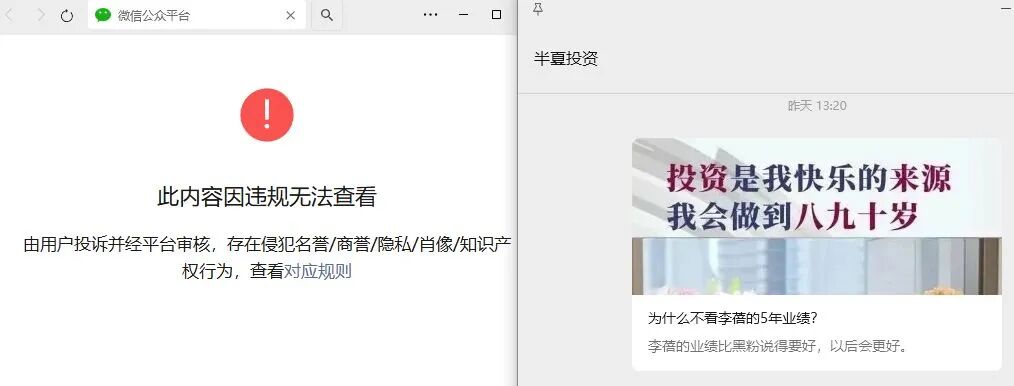
炸锅!李蓓发文怒怼前夫梁文涛,但斌点评:长期业绩说话
Mei Ri Jing Ji Xin Wen· 2026-02-09 12:37
Core Viewpoint - The recent public dispute between Li Bei, founder of Banxia Investment, and her ex-husband Liang Wentao, founder of Honghu Asset, has raised questions about the boundaries between personal and professional conduct in the investment industry, highlighting the importance of long-term performance over personal controversies [1][4][7]. Group 1: Personal Dispute and Performance Claims - Li Bei published a strongly worded article criticizing Liang Wentao, accusing him of leveraging their past relationship for marketing purposes and revealing personal details about their history [2][4]. - In her defense, Li Bei emphasized the strong performance of Banxia's flagship funds, showcasing a one-year return of 39.75% and a five-year return of 100.75%, while noting that the three-year performance was only 4.83% [2][3]. - The article's aggressive tone and personal nature contrast sharply with Banxia's previous calm analysis of the real estate market, indicating a shift in the company's public communication strategy [7]. Group 2: Industry Reactions and Implications - Industry figures, such as Dan Bin from Dongfang Hongyuan, commented on the situation, stressing that investment success ultimately relies on long-term performance rather than personal disputes [4][6]. - The incident has sparked discussions about the role of public communication channels for investment firms, questioning whether they should focus on delivering professional insights or engage in personal narratives [7]. - The contrasting messages from Banxia's official communications raise concerns about the firm's internal governance and the clarity of its brand identity in the market [7].
关乎基金经理工资怎么发的新规终于落地了
Xin Lang Cai Jing· 2025-12-06 13:58
Core Viewpoint - The newly released draft of the "Performance Assessment Management Guidelines for Fund Management Companies" emphasizes that the interests of fund investors must always come first, leading to extensive discussions within the industry [1][6]. Group 1: Long-term Performance Focus - The new regulations prioritize long-term performance, requiring that at least 80% of the assessment metrics for fund investment returns be based on performance over three years or more, discouraging short-term manipulations by fund managers [2][8]. Group 2: Compensation Structure - Fund company executives, including the chairman and senior management, must use at least 30% of their performance pay to invest in their own funds, while fund managers are required to invest over 40% of their performance pay in the funds they manage [3][9]. - The deferred payment period for performance pay is set to a minimum of three years, with at least 40% of the deferred payment for core personnel [5][12]. Group 3: Accountability and Salary Adjustments - Fund managers' salaries are now directly linked to their performance, with a tiered adjustment system based on the past three years' performance. A salary reduction of up to 30% can occur if performance is significantly below benchmarks [4][13]. - If a fund's performance lags the benchmark by more than 10 percentage points and incurs losses, the performance pay must be reduced by at least 30% [5][13]. Group 4: Enhanced Accountability Measures - The new guidelines introduce stricter accountability measures, including the ability to withhold or reclaim salaries if employees fail to meet their responsibilities, even after leaving the company [10][13]. - There is a focus on employee retirement benefits, encouraging fund companies to establish corporate pension plans and support participation in personal pension schemes [10][13].
A股热点轮番“表演”,什么样的公司,才能让股东富起来?
Zheng Quan Shi Bao· 2025-09-13 23:42
Group 1 - The core viewpoint emphasizes that understanding the intrinsic value of companies is more important than short-term market trends [1] - Companies that cannot provide cash returns to shareholders are deemed unsustainable, regardless of their short-term performance [2][3] - Historical examples illustrate that companies requiring continuous capital investment for growth often fail to deliver real shareholder value [2][3] Group 2 - Short-term performance can lead to inflated valuations, but sustainable growth is essential for long-term investment success [5][6] - The risk of valuation decline and unsustainable growth is highlighted, as seen in past market trends [5][6] - Investors should focus on companies with stable historical performance and consistent cash flow to mitigate risks associated with short-term volatility [8]
A股热点轮番“表演”!什么样的公司,才能让股东富起来?
券商中国· 2025-09-13 23:36
Core Viewpoint - The article emphasizes the importance of evaluating the intrinsic value of companies rather than focusing solely on short-term performance, highlighting that sustainable growth and cash returns to shareholders are crucial for long-term investment success [2][3]. Group 1: Market Sentiment and Company Performance - Recent trends in the A-share market show a warming sentiment, with various hot topics emerging, leading to a focus on the question of "value" rather than just market direction [1]. - Companies often release positive earnings reports during periods of high market enthusiasm, which can serve as a window for major shareholders to reduce their stakes or raise funds [2]. Group 2: Long-term vs. Short-term Performance - Companies that fail to provide cash returns to shareholders are deemed "hollow," and investors should focus on companies with strong fundamentals, such as capital structure and business model [2][3]. - Historical examples illustrate that companies requiring continuous capital investment for growth, like AT&T, often fail to deliver shareholder value, while those with stable cash flows, like Thompson Publishing, succeed in enriching their shareholders [3]. Group 3: Risks of Short-term Focus - The article warns against the risks associated with short-term performance evaluations, citing past instances where high-growth stocks faced significant declines due to unsustainable growth expectations [5][6]. - High-growth stocks are particularly vulnerable to valuation drops if growth expectations are not met, leading to severe price corrections [6][7]. Group 4: Investment Strategy Recommendations - Investors are advised to focus on companies with a stable historical performance and a track record of consistent dividend payments, ideally over a 20-year period [7]. - Defensive investors should be cautious of high-growth stocks due to their inherent uncertainties and risks, suggesting that more stable, reasonably valued large companies may be better suited for the average investor [7].