半夏宏观对冲三期

Search documents
炸锅!李蓓发文怒怼前夫 但斌点评:长期业绩说话
Mei Ri Jing Ji Xin Wen· 2026-02-10 03:30
Core Viewpoint - The recent public dispute between Li Bei, founder of Hanxia Investment, and her ex-husband Liang Wentao, founder of Honghu Asset, highlights the blurred lines between personal and professional conduct in the investment industry, raising questions about the integrity of investment institutions' public communications [1][2][10]. Group 1: Performance and Criticism - Li Bei's article titled "Why Not Look at Li Bei's 5-Year Performance?" directly criticizes Liang Wentao for leveraging their past relationship for marketing purposes while defending her investment performance [2][4]. - As of January 31, 2026, Hanxia's flagship funds reached new net asset value highs, with the Hanxia Macro Hedge Fund III showing a one-year return of 39.75% and a five-year return of 100.75%, although the three-year performance was only 4.83% [4][5]. - The performance data indicates that critics often focus on the weaker three-year period to challenge her credibility, which has become a focal point of the ongoing debate [4][5]. Group 2: Industry Reactions - The article sparked significant attention from industry leaders, including Dan Bin, chairman of Dongfang Gangwan, who emphasized the importance of long-term performance in investment, suggesting that transient issues do not withstand the test of time [7][9]. - Dan Bin's comments aimed to redirect public focus from personal disputes back to the core professional metrics of investment performance [9]. Group 3: Public vs. Private Boundaries - Just weeks prior, Hanxia Investment's official WeChat account published a calm analysis of the real estate market, indicating a significant shift in tone and focus within a short period [10]. - This duality in communication raises concerns about the governance and decision-making independence of investment institutions, as personal conflicts can overshadow professional integrity [10]. - The incident serves as a reflection of the broader industry challenge in balancing influence and professionalism, questioning whether institutions prioritize intellectual contributions or sensationalism [10].

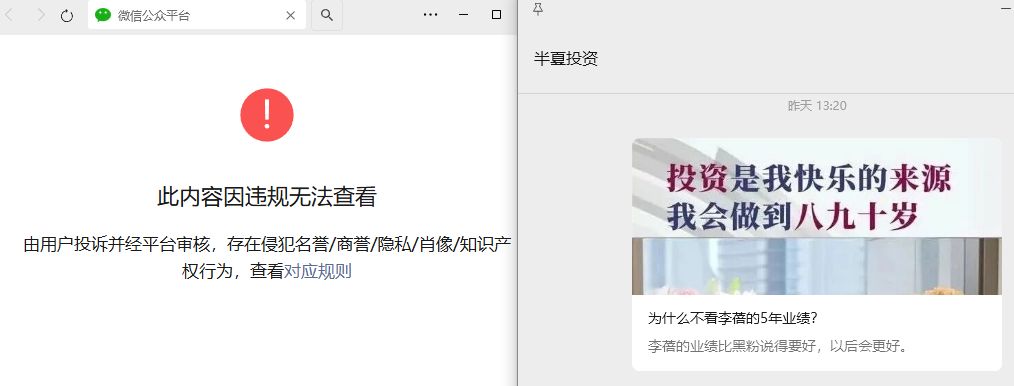
在公司官方账号发文,“金融女神”李蓓公开怒怼前夫,还披露大量私人纠葛细节!私募大佬但斌发声:投资还是长期业绩说话
Mei Ri Jing Ji Xin Wen· 2026-02-09 14:43
Core Viewpoint - The recent public dispute between Li Bei, founder of Banxia Investment, and her ex-husband Liang Wentao, founder of Honghu Asset, has drawn significant attention in the investment community, highlighting the tension between personal conflicts and professional performance in the finance industry [2][4]. Group 1: Performance and Criticism - Li Bei's article titled "Why Not Look at Li Bei's 5-Year Performance?" directly addresses criticisms regarding her investment performance, particularly focusing on the use of a three-year performance period by critics to undermine her credibility [2][4]. - As of January 31, 2026, Banxia's flagship funds reportedly reached new net asset value highs, with the Banxia Macro Hedge Fund III showing a one-year performance of 39.75% and a five-year performance of 100.75%, while the three-year performance was only 4.83% [4]. - The debate centers around the contrasting performance metrics, with critics often highlighting the weaker three-year performance to challenge Li Bei's overall investment capabilities [4]. Group 2: Industry Reactions - The incident has prompted responses from industry leaders, including Dan Bin, chairman of Dongfang Gangwan, who emphasized the importance of long-term performance in investment, suggesting that all discussions should ultimately return to the core of sustained performance [4]. - Dan Bin's comments reflect a broader sentiment in the industry that while personal narratives may attract attention, the focus should remain on the professional achievements and long-term results of investment managers [4]. Group 3: Public vs. Private Discourse - The contrasting tone of Banxia Investment's official communications, shifting from a professional analysis of the real estate market to a personal dispute, raises questions about the boundaries between private matters and public discourse in the investment sector [5][6]. - The incident illustrates the delicate balance that investment firms must maintain between building a professional brand and engaging in personal conflicts, which can blur the lines of credibility and trust with clients and investors [5][6]. - The situation serves as a reminder for the industry to continuously evaluate the impact of personal conflicts on professional integrity and the importance of maintaining a clear distinction between personal and institutional narratives [6].
炸锅!李蓓发文怒怼前夫梁文涛,但斌点评:长期业绩说话
Mei Ri Jing Ji Xin Wen· 2026-02-09 12:37
Core Viewpoint - The recent public dispute between Li Bei, founder of Banxia Investment, and her ex-husband Liang Wentao, founder of Honghu Asset, has raised questions about the boundaries between personal and professional conduct in the investment industry, highlighting the importance of long-term performance over personal controversies [1][4][7]. Group 1: Personal Dispute and Performance Claims - Li Bei published a strongly worded article criticizing Liang Wentao, accusing him of leveraging their past relationship for marketing purposes and revealing personal details about their history [2][4]. - In her defense, Li Bei emphasized the strong performance of Banxia's flagship funds, showcasing a one-year return of 39.75% and a five-year return of 100.75%, while noting that the three-year performance was only 4.83% [2][3]. - The article's aggressive tone and personal nature contrast sharply with Banxia's previous calm analysis of the real estate market, indicating a shift in the company's public communication strategy [7]. Group 2: Industry Reactions and Implications - Industry figures, such as Dan Bin from Dongfang Hongyuan, commented on the situation, stressing that investment success ultimately relies on long-term performance rather than personal disputes [4][6]. - The incident has sparked discussions about the role of public communication channels for investment firms, questioning whether they should focus on delivering professional insights or engage in personal narratives [7]. - The contrasting messages from Banxia's official communications raise concerns about the firm's internal governance and the clarity of its brand identity in the market [7].
卖课比投资更赚钱?李蓓投资课2天卖258万,旗下基金跑输大盘20%
Sou Hu Cai Jing· 2025-12-29 10:21
Core Viewpoint - Li Bei, founder of Banxia Investment, has launched a series of investment courses priced at 12,888 yuan, promising a long-term annualized return of over 10% [3][4]. Group 1: Course Launch and Reception - The investment course consists of four sessions and is marketed as a way to teach ordinary people how to invest effectively [4]. - The announcement of the course led to skepticism within the financial community, with many criticizing it as a move to profit from selling courses rather than genuine investment advice [3][6]. - Despite the criticism, the course quickly sold out, generating approximately 2.58 million yuan in revenue within two days [3][6]. Group 2: Li Bei's Justification and Charitable Intent - Li Bei stated that the course was not part of a planned business strategy and that all proceeds would go to a charity fund to support university students [3][6]. - She emphasized her experience in identifying market scams and her intention to educate others on how to avoid them [4][6]. Group 3: Performance of Banxia Investment - Banxia Investment has faced challenges, with its funds underperforming compared to the benchmark index, the CSI 300, over the past three years [7][9]. - The performance of Banxia's macro hedge fund has been notably poor, with returns of 3.49% and -1.47% over three years, significantly lagging behind the CSI 300's returns of 21.66% and 19.33% respectively [7][9]. - The firm, once a hundred billion yuan private equity, has seen its assets drop below that threshold, currently ranging between 5 billion and 10 billion yuan [9]. Group 4: Industry Context and Competitors - Other financial professionals have also entered the knowledge payment sector, with notable figures like Hong Hao and Liu Yuhui achieving significant subscription revenues [3][9]. - The trend of financial experts offering paid courses reflects a growing market for knowledge sharing, despite concerns about the quality and effectiveness of such offerings [6][9].
李蓓回应12888元卖课
财联社· 2025-12-27 11:30
Core Viewpoint - The article discusses the recent move by renowned fund manager Li Bei to launch a paid investment course, highlighting the growing trend of knowledge monetization in the financial industry and the mixed reactions it has generated among investors and the media [3][4][8]. Group 1: Course Details - Li Bei announced a two-day offline course titled "Li Bei Closed-Door Sharing Session," priced at 12,888 yuan, aimed at teaching ordinary people how to achieve over 10% annualized returns [3][4]. - The course consists of four sessions, each lasting 2 hours for thematic sharing and 1 hour for interactive Q&A, with the option to purchase sessions individually at 3,888 yuan each [4]. - The course is limited to 200 participants, with potential revenue of approximately 2.58 million yuan if fully booked [7]. Group 2: Li Bei's Background and Performance - Li Bei is the founder of Banxia Investment, a private equity firm that focuses on macro-hedging strategies, and she became the first female manager of a fund exceeding 10 billion yuan [8]. - The performance of her fund "Banxia Stable" saw a remarkable return of 258% in 2020, ranking first among similar funds, but has faced significant challenges in recent years, with a return of -20.49% in 2023 [9][10]. - Li Bei's investment predictions have been criticized, particularly her bullish stance on the A-share market and real estate stocks, which did not materialize as expected [10]. Group 3: Industry Reactions and Trends - The announcement of Li Bei's course sparked discussions about the profitability of selling courses compared to investment performance, with some suggesting that it indicates a shift in focus for fund managers [7][12]. - Other financial professionals, including former chief economists and analysts, have also entered the knowledge monetization space, indicating a broader trend within the industry [12][13]. - Concerns have been raised regarding the sustainability of this trend, as the market is saturated with free high-quality financial content, and the potential legal risks associated with using proprietary research for commercial courses [18].

明汯人气跃居首位!幻方重磅消息引关注!但斌、李蓓发声!11月私募人气榜揭晓
私募排排网· 2025-12-03 03:44
Core Viewpoint - In November 2025, A-shares experienced a collective pullback across the three major indices, with the Shanghai Composite Index hitting a ten-year high before declining, ending the month down 1.67%, thus breaking a six-month winning streak. The ChiNext Index and Shenzhen Component Index also fell by 4.23% and 2.95%, respectively. Sectors such as Hainan Free Trade Port, New Energy, and Commercial Aerospace showed localized market activity [2]. Fund Performance - The average return for subjective products faced a pullback, while some quantitative products saw a recovery in excess returns. CTA strategy products performed well and attracted significant investor attention [3]. - The total number of products in various strategies includes 5522, with an overall average return of 27.98% and an average excess return of 12.70% [3]. Popular Private Equity Firms - Among the top 20 popular private equity firms, 14 are quantitative, while 3 are subjective, and 2 are mixed (subjective + quantitative). Firms with over 10 billion in assets account for 80% of the total [4]. - The top five firms by popularity are Mingcong Investment, Ningbo Huansheng Quantitative, Ridao Investment, Guoyuan Xinda, and Jiukun Investment. Mingcong Investment saw a rise in popularity from 5th to 1st place compared to October [5][6]. Popular Fund Managers - The top five popular fund managers are Dan Bin, Wu Yuefeng, Lin Yuan, Li Bei, and Liang Hong, with subjective managers dominating the list. Nine of the top fund managers are from firms with over 10 billion in assets [10]. - Dan Bin's firm, Dongfang Gangwan, has 69 products with an average return of ***% this year [13]. Li Bei's products include "Banxia Balanced Macro Hedge" and "Banxia Macro Hedge Phase III," with returns of ***% [13]. Popular Private Equity Products - The top five popular funds are from Mingcong Investment, Hainan Shengfeng Private Equity, Ningbo Huansheng Quantitative, and Jiuzhang Asset. The top five funds by performance this year are from Longhui Xiang Investment, Guanglong (Shenzhen) Investment, Luyuan Private Equity, Longqi Technology, and Mingcong Investment [15][16].
宏观策略业绩爆发!泓湖私募梁文涛狂揽亚军!李蓓今年强势逆袭!
私募排排网· 2025-10-15 09:00
Core Insights - The A-share market continued its strong performance in September, with all three major indices rising, while gold prices surged due to multiple factors including the onset of the Federal Reserve's rate cut cycle and central bank gold purchases [2] - Despite the strong market performance, the subjective long/short and quantitative long strategies underperformed in September, with average returns of 3.11% and 1.37% respectively, while macro strategies excelled with an average return of 4.08% [2] - Over a longer time frame, macro strategies have shown superior performance, with average returns of 22.45% and 75.33% over the year and the past three years respectively, highlighting their flexibility in capturing asset rotation opportunities [2] Strategy Performance Summary - **Macro Strategy**: 218 products, average return of 4.08% this year, 22.45% over the year, and 75.33% over three years [3] - **Subjective Long/Short**: 2120 products, average return of 3.11% this year, 34.08% over the year [3] - **Quantitative Long**: 862 products, average return of 1.37% this year, 36.94% over the year [3] - **Other Derivative Strategies**: 16 products, average return of 5.17% this year, 18.77% over the year [3] Top Macro Strategy Products - For products with over 5 billion in assets, the top three macro strategies over the past three years are managed by 久期投资 and 泓湖私募, with average returns of 69.86% [4][5] - The leading product in the 10-50 billion category is "路远睿泽稳增" managed by 路文韬, with significant returns [9] - In the 0-10 billion category, "石泉宏观对冲" managed by 孙旭 leads with impressive returns [12] Notable Fund Managers - 梁文涛 from 泓湖私募 is recognized for his strong performance and has a background in macro strategies [4] - 李蓓 from 半夏投资 has shown a significant rebound in performance this year after previous underperformance [6] - 路文韬 from 路远私募 has focused on gold and military sectors, indicating a strategic shift in asset allocation [9]

但斌迎来“新身份”!李蓓、林园均买入“小登资产”?三季度私募人气榜出炉!
私募排排网· 2025-10-11 03:23
Core Viewpoint - The A-share market showed strong performance in Q3 2025, with the ChiNext Index leading with a 50.4% increase, followed by the Shenzhen Component Index at 29.25% and the Shanghai Composite Index at 12.73% [1][2]. Group 1: Popular Private Fund Managers - The top five popular private fund managers in Q3 2025 are Dan Bin, Lin Yuan, Li Bei, Wu Yuefeng, and Zhu Xiaokang, with half of the top 20 being managers of funds over 10 billion [1][3]. - Dan Bin's funds have shown significant performance, with 75 products averaging ***% returns this year, and he has increased his focus on overseas investments, particularly in AI-related stocks [5][6]. - Lin Yuan, ranked second, has shifted to invest in a batch of Sci-Tech Innovation Board stocks, despite previously stating he would avoid tech stocks, indicating a strategic pivot [7][8]. - Li Bei, ranked third, manages products that have also performed well, with a focus on macro hedging strategies [8]. Group 2: Popular Private Fund Companies - The top private fund companies in Q3 2025 include Longqi Technology, Japan Investment, and Ningbo Huafang Quantitative, with a significant number of quantitative funds [9][10]. - Ningbo Huafang Quantitative has been recognized for its strong performance, with 11 products averaging ***% returns this year [13]. - Guoyuan Xinda, ranked 11th, has also performed well with its composite strategy products entering the top 20 for popularity [13]. Group 3: Popular Private Fund Products - The most popular private fund products are dominated by quantitative long products, with the top five managed by various fund managers, including Zou Kai from Hunan Zijin Private Fund and Shi Jianghui from Guoyuan Xinda [14][15]. - Hunan Zijin Private Fund's product has shown exceptional performance, leading the rankings for returns this year [15][17].

私募界的“她业绩”揭晓!浩坤昇发李佳佳第1!紫阁投资徐爽看好创新药!半夏李蓓热度飙升!
私募排排网· 2025-09-05 05:39
Core Viewpoint - The article highlights the rise of female fund managers in the traditionally male-dominated private equity sector, showcasing their unique resilience, insights, and rigorous risk control, which have led to impressive returns in the investment landscape [1]. Group 1: Overview of Female Fund Managers - As of August 29, 2025, there are 185 female private equity fund managers with performance records on the platform, with the majority (110) from subjective private equity, 38 from quantitative private equity, and 37 from mixed strategies [2]. - The geographical distribution shows that 34.05% of female fund managers are based in Shanghai, followed by Shenzhen (26), Beijing (24), Hangzhou (15), and Guangzhou (9) [2]. - In terms of core strategy, over 50% (95) of female fund managers employ stock strategies, while 23 use multi-asset strategies, 22 focus on futures and derivatives, and 19 on bonds [2]. Group 2: Experience and Company Size - Among the female fund managers, 99 have over 10 years of experience, and 18 have over 20 years [3]. - More than 50% (97) of female fund managers are from private equity firms with assets under 500 million, while 30 are from firms with over 2 billion, with only 4 from top-tier firms (over 5 billion) [3]. Group 3: Notable Female Fund Managers - The top female fund managers include Li Bei from Banxia Investment, He Ruilin from Qianhai Bopu Asset, Lin Xue from Jiupeng Asset, and Jia Yiming from Chengyi Private Equity, all managing funds between 5 billion to 10 billion [4][5]. - Li Bei, known as the "private equity witch," has over 10 years of experience and manages two products with a total scale of approximately 304 million, achieving significant returns [6][11]. - He Ruilin, with a master's degree from Xiamen University, has a focus on sectors like new energy and technology, managing three products totaling approximately 322 million [7][12]. Group 4: Performance Rankings - The article lists the top 20 female fund managers based on their performance this year, with Li Jiajia from Haokun Shengfa Asset leading with an average return of ***% across four products [11][13]. - The average return for the top 32 female fund managers this year is ***%, with a total product scale of approximately 11.55 billion [7][13]. - In the past year, Li Jiajia also ranks first among female fund managers, with her products achieving an average return of ***% [12][15].

李蓓、吴悦风业绩反攻!龙旗人气跃升至第1!孝庸新晋头部量化!私募排排网7月人气榜出炉
私募排排网· 2025-08-05 04:33
Core Viewpoint - The article discusses the performance of major stock markets in July 2025, highlighting the upward trends in A-shares, Hong Kong stocks, and US stocks, along with the popularity of certain private equity fund managers and companies based on user searches on the platform [1][2]. Market Performance - In July, the A-share market saw the Shanghai Composite Index, Shenzhen Component Index, and ChiNext Index increase by 3.74%, 5.2%, and 8.14% respectively, with the Shanghai Composite Index surpassing 3600 points for the first time since October 8, 2024 [1]. - The Hong Kong market's three major indices also rose over 2%, with the Hang Seng Index leading at 2.91% [1]. - All three major US stock indices recorded gains, with the Nasdaq Index achieving the highest increase of 3.7% [1]. Popular Fund Managers - The top three popular fund managers in July are Dan Bin, Lin Yuan, and Wu Yuefeng, with Dan Bin's popularity rising significantly [1][3]. - Dan Bin's average return for the year reached ***% as of July, with a near 3-month rebound of ***% [6]. - Wu Yuefeng's fund "Jia Yue Monthly Wind Investment Genesis" reported a return of ***% for the year, with a near 3-month return close to ***% [7]. Popular Private Equity Companies - The top three private equity companies are Longqi Technology, Shanghai Xiaoyong Private Equity, and Mengxi Investment, all showing significant increases in popularity [9][11]. - Longqi Technology's average return for its 16 products this year is ***%, with the "Longqi Technology Innovation Selected No. 1 C Class" achieving the highest return of ***% [14]. - Shanghai Xiaoyong Private Equity has seen its company scale increase from 20-50 billion to over 50 billion, marking its rise as a leading quantitative private equity firm [14]. Popular Private Equity Products - The top five popular private equity products include those managed by Hainan Shengfeng Private Equity, Longqi Technology, and Road Far Private Equity, with Longqi Technology having two products in the top five [16][18]. - The product "Longqi Stock Quantitative Multi-Head No. 1" managed by Zhu Xiaokang is among the top performers [18].