长短期记忆网络(LSTM)

Search documents
谷歌AI往事:隐秘的二十年,与狂奔的365天
3 6 Ke· 2025-11-27 12:13
Core Insights - Google has undergone a significant transformation in the past year, moving from a state of perceived stagnation to a strong resurgence in AI capabilities, highlighted by the success of its Gemini applications and models [2][3][44] - The company's long-term investment in AI technology, dating back over two decades, has laid a robust foundation for its current advancements, showcasing a strategic evolution rather than a sudden breakthrough [3][6][45] Group 1: Historical Context and Development - Google's AI journey began with Larry Page's vision of creating an ultimate search engine capable of understanding the internet and user intent [9][47] - The establishment of Google Brain in 2011 marked a pivotal moment, focusing on unsupervised learning methods that would later prove essential for AI advancements [12][18] - The "cat paper" published in 2012 demonstrated the feasibility of unsupervised learning and led to the development of recommendation systems that transformed platforms like YouTube [15][16] Group 2: Key Acquisitions and Innovations - The acquisition of DeepMind in 2014 for $500 million solidified Google's dominance in AI, providing access to top-tier talent and innovative research [22][24] - Google's development of Tensor Processing Units (TPUs) was a strategic response to the limitations of existing hardware, enabling more efficient processing of AI workloads [25][30] Group 3: Challenges and Strategic Shifts - The emergence of OpenAI and the success of ChatGPT in late 2022 prompted Google to reassess its AI strategy, leading to a restructuring of its AI teams and a renewed focus on a unified model, Gemini [41][42] - The rapid development and deployment of Gemini and its variants, such as Gemini 3 and Nano Banana Pro, have positioned Google back at the forefront of the AI landscape [43][44] Group 4: Future Outlook - Google's recent advancements in AI reflect a culmination of years of strategic investment and innovation, reaffirming its identity as a company fundamentally rooted in AI rather than merely a search engine [47][48]

告别机器人“手残”!中国团队研发六自由度机械臂 GL-Robot ,能捏鸡蛋还能举哑铃!
机器人大讲堂· 2025-11-06 09:47
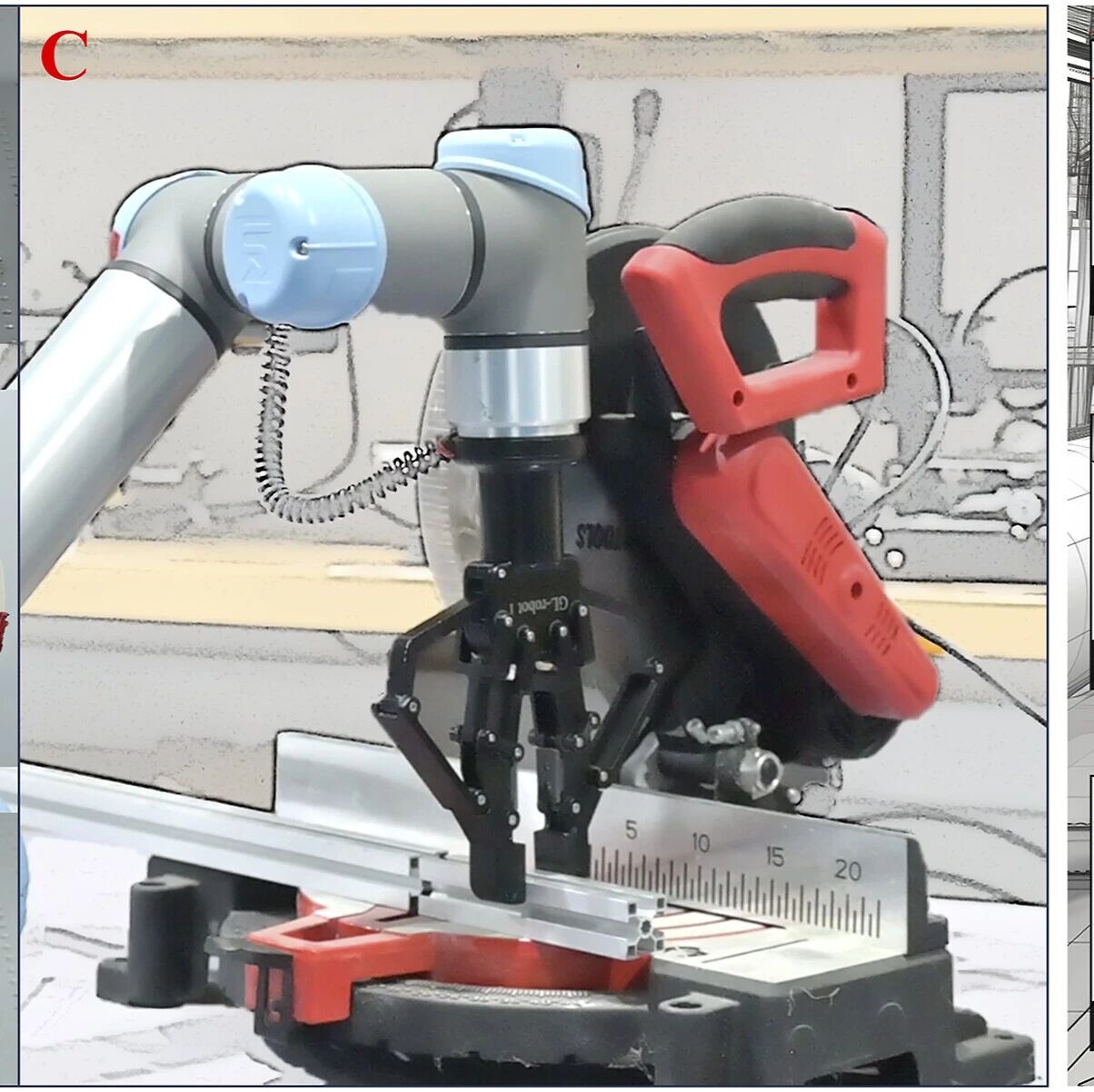
Core Viewpoint - The article highlights the innovative capabilities of the GL-Robot, a dual-finger robotic arm developed by Zhejiang University, which combines strong gripping power with delicate touch sensitivity, overcoming traditional limitations in robotic grasping technology [3][20]. Group 1: Technical Innovations - GL-Robot features a unique design with each finger having three joints, providing a larger contact area for stable and secure gripping, similar to human hand functionality [4][6]. - The internal "stacked four-bar mechanism" allows the fingers to intelligently switch between two grasping modes based on the object being handled, enhancing adaptability [8]. - The robot employs a "sensor-free" force perception method by analyzing the current signals from the driving motor, which correlates with the load and external environment, thus eliminating the need for expensive sensors [9][10]. Group 2: Grasping Modes and Performance - GL-Robot operates in two distinct modes: a precision operation mode for delicate items like eggs, achieving force control as low as 0.1 N, and a heavy-duty mode for larger objects, capable of handling loads up to 350 N [13][17]. - The robot's design allows it to grasp a wide range of objects, from thin coins to large cubes, demonstrating superior stability and adaptability in various scenarios [19]. Group 3: Commercial Potential - The absence of costly force sensors in GL-Robot not only enhances its performance but also significantly reduces production costs, indicating strong commercial viability in industrial and logistics applications [19][20].

中国团队利用AI提升南山射电望远镜大气修正精度
Huan Qiu Wang Zi Xun· 2025-10-22 02:51
Core Insights - The research addresses the significant issue of tropospheric delay in electromagnetic wave propagation due to variations in air density and water vapor content, which affects Very Long Baseline Interferometry (VLBI) and Global Navigation Satellite Systems (GNSS) positioning [1][3] - A hybrid deep learning model combining Gated Recurrent Unit (GRU) and Long Short-Term Memory (LSTM) networks has been developed to accurately predict zenith tropospheric delay (ZTD) [1][3] Research Findings - The team conducted spectral analysis on years of GNSS observations from the Nanshan station, revealing that ZTD changes exhibit clear annual and semi-annual cycles, with higher values in summer and lower in winter, closely related to temperature and water vapor content [3] - The hybrid neural network model effectively captures both short-term fluctuations and long-term trends in atmospheric delay, achieving a prediction error of approximately 8 millimeters and a correlation coefficient of 96%, outperforming traditional statistical models and single neural networks [3] Applications and Implications - High-precision predictions of tropospheric delay can significantly enhance the atmospheric phase correction accuracy in VLBI observations, improving radio source positioning and baseline calculation results [3] - The research demonstrates the potential of artificial intelligence in atmospheric correction for radio telescopes, laying a technical foundation for the future operation of the QTT 110-meter telescope and multi-station interferometric observations in high-frequency bands [3]