集中式能源系统

Search documents
特朗普破大防,不如中国?美国AI电力遥遥领先,都要归功于我
Sou Hu Cai Jing· 2025-12-12 13:32
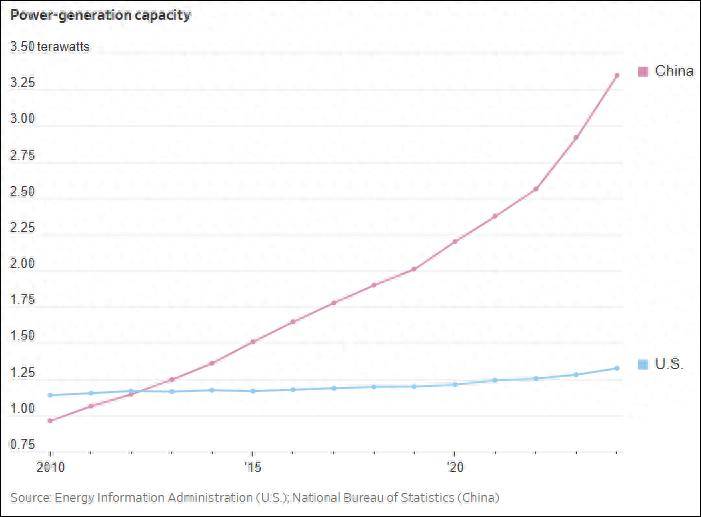
Core Viewpoint - The article discusses China's dominance in AI-related electricity production, contrasting it with the U.S. response led by former President Trump, highlighting the competitive landscape between the two nations in the AI sector and the underlying energy infrastructure needed to support it [1][6]. Group 1: China's Strengths in AI and Energy - China's electricity generation has significantly outpaced other regions, with growth from 2010 to 2024 exceeding the total growth of the rest of the world [6]. - In 2022, China's electricity generation was more than double that of the U.S., and the electricity costs for data centers in China are less than half of those in the U.S. [8]. - Inner Mongolia's "Grassland Cloud Valley" has become a hub for data centers, with over 100 centers either operational or under construction, and a total investment exceeding 160 billion yuan [8]. Group 2: U.S. Response and Challenges - Trump's claims about the rapid construction of AI factories and self-built power facilities in the U.S. were met with skepticism, especially as the U.S. Energy Secretary emphasized AI as a top priority for the government [4][10]. - The U.S. faces significant challenges in electricity reliability, particularly in the Midwest and Southwest, where summer power shortages are common [12]. - The slow progress on infrastructure projects, such as the "Southern Spirit" transmission project in Texas, highlights the difficulties the U.S. faces in meeting the growing energy demands of the AI industry [12][14]. Group 3: Long-term Planning and Future Outlook - Morgan Stanley predicts that China's investment in grid projects will reach $560 billion by 2030, with Goldman Sachs estimating that China's backup power capacity could be three times the expected global data center electricity demand [10]. - The article suggests that the competition in AI and energy will continue, with China's centralized energy system and ongoing policy investments providing a distinct advantage over the U.S.'s fragmented and aging infrastructure [14][16].