集装箱

Search documents
港A异动丨中集集团逆势走强 H股大涨约12% A股涨停创逾7个月新高!
Ge Long Hui· 2025-11-14 07:12
Core Viewpoint - CIMC (China International Marine Containers) has shown strong performance in the stock market, with significant increases in both A-shares and H-shares, driven by share buybacks and positive developments in its business segments [1][2]. Group 1: Stock Performance - CIMC's A-shares (000039.SZ) surged to a limit-up price of 8.94 RMB, marking a new high in over seven months, with a market capitalization of 48.2 billion RMB [1]. - CIMC's H-shares (2039.HK) rose by 11.83% to 8.13 HKD, achieving a new high in over a month, with a market capitalization of 43.5 billion HKD [1]. Group 2: Share Buybacks - Recently, CIMC has been actively repurchasing its shares, spending 20 million RMB to buy back 2.46 million A-shares at prices between 8.12 and 8.14 RMB per share [1]. - On the same day, the company also repurchased 280.5 thousand H-shares for 20 million HKD, with prices ranging from 6.98 to 7.27 HKD per share [1]. Group 3: Energy Storage Sector - CIMC is enhancing its energy storage capabilities, covering various systems including power generation, grid-side, and commercial energy storage, and has established strong partnerships with major overseas wind power operators [1]. - Since 2020, CIMC's subsidiary, Shijiazhuang Anruike, has made significant advancements in gas storage, leading the industry with solutions for compressed air, hydrogen, and carbon dioxide storage [1]. Group 4: Container and Marine Engineering Business - In the first three quarters of this year, CIMC's container dry box sales exceeded expectations [2]. - UBS has upgraded CIMC's rating to "Buy," anticipating that the marine engineering segment will contribute approximately 1.9 billion RMB in incremental gross profit from 2026 to 2027, supported by stable growth in China's exports and global trade [2].


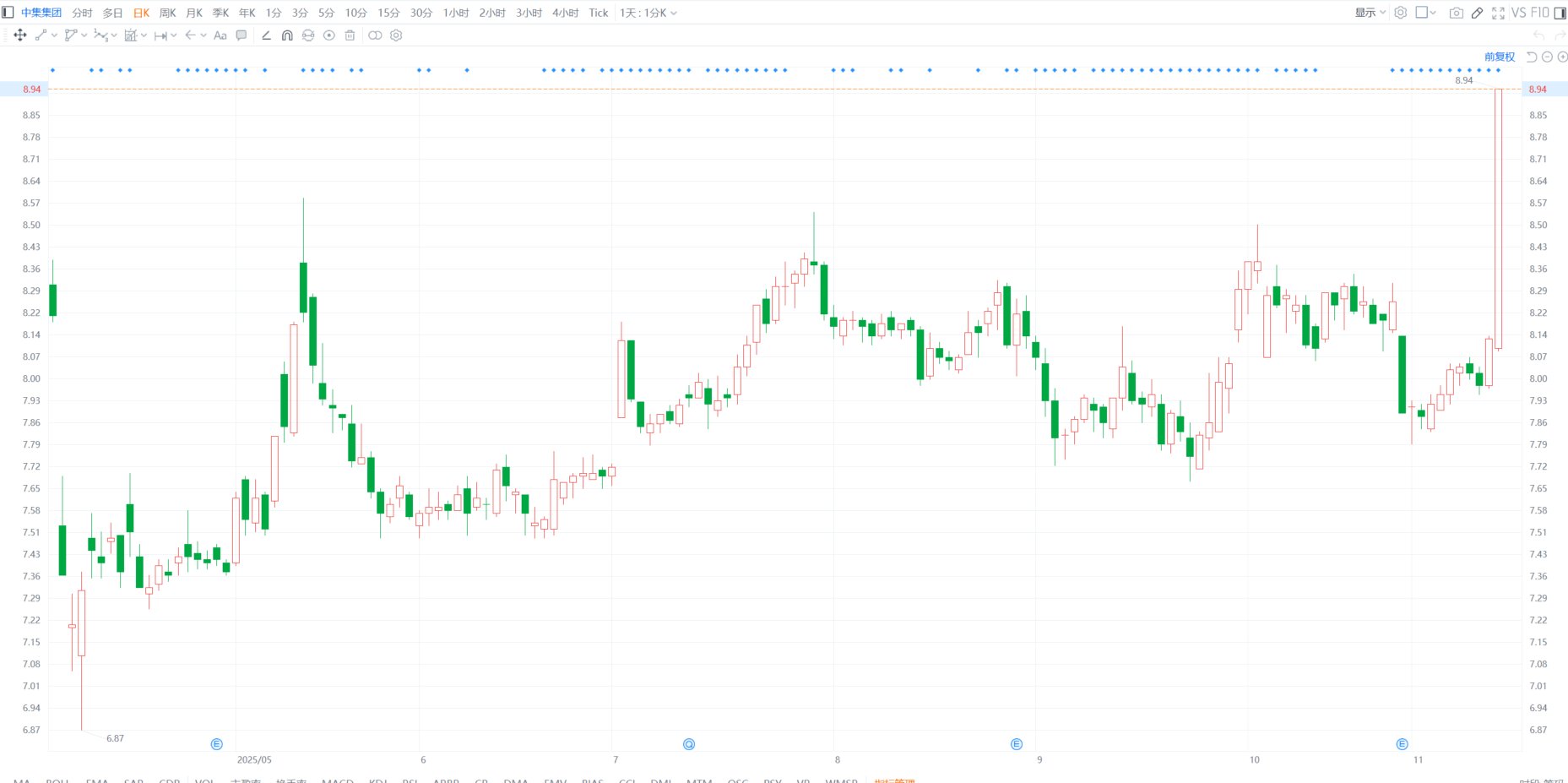
中集集团逆势走强 H股大涨约12% A股涨停创逾7个月新高!
Ge Long Hui· 2025-11-14 07:09
Group 1 - CIMC's A-shares surged to a new high of 8.94 yuan, with a market capitalization of 48.2 billion yuan, while H-shares rose by 11.83% to 8.13 HKD, with a market capitalization of 43.5 billion HKD [1] - The company has been actively repurchasing shares, spending 20 million RMB to buy back 2.46 million A-shares at prices between 8.12-8.14 RMB per share, and 20 million HKD to repurchase 280.5 thousand H-shares at prices between 6.98-7.27 HKD per share [1] - CIMC is building an integrated energy storage industry chain, covering power generation, grid-side, and commercial energy storage systems, and has established solid partnerships with large overseas wind power operators [1] Group 2 - Since 2020, Shijiazhuang Anruike has made breakthroughs in gas storage, leading the industry with products covering compressed air, hydrogen, and carbon dioxide storage, providing solutions for large domestic storage projects [2] - CIMC's container sales exceeded expectations in the first three quarters of this year, and UBS has upgraded the company's rating to "Buy," expecting significant profit contributions from marine engineering business by 2026-27, estimated to bring an additional gross profit of about 1.9 billion RMB [2] - The stable growth of China's exports and global trade is expected to support container demand, with high-quality orders in marine engineering and sustained container demand contributing to profit growth [2]
研客专栏 | 大豆专题:美国港口运输简介
对冲研投· 2025-03-25 12:28
Core Insights - The article discusses the significance of U.S. ports in international trade, highlighting that maritime shipping accounts for 41.5% of the total trade value, amounting to $2.1 trillion in 2023, with exports at 35.5% and imports at 64.5% [3][5][10]. U.S. Port Overview - U.S. ports are categorized into coastal ports, Great Lakes/St. Lawrence Seaway ports, and inland ports, with coastal ports including those on the East Coast, West Coast, and Gulf Coast [8][9]. - The major types of cargo transported include containers, dry bulk, liquid bulk, breakbulk, and roll-on/roll-off [3][15]. Cargo Distribution - Dry bulk cargo distribution shows that the Gulf Coast accounts for 42%, the West Coast for 10%, the East Coast for 12%, inland ports for 18%, and the Great Lakes for 16% [3]. - Container distribution indicates that the Gulf Coast holds 8%, the West Coast 41%, and the East Coast 47%, with East Coast ports outperforming West Coast ports [3][27]. Port Performance Metrics - In 2022, U.S. ports handled 2.6 billion short tons of cargo, with domestic cargo at 43%, imports at 25%, and exports at 32% [10]. - The top 25 ports accounted for 71% of the total cargo volume, processing 1.86 billion short tons in 2022, an increase from 1.8 billion short tons in 2021 [35][36]. Major U.S. Ports - The top five ports by total tonnage are Houston Port Authority, South Louisiana Port, Corpus Christi, New York/New Jersey, and Long Beach [38]. - Houston Port is the largest in terms of cargo handling, followed by South Louisiana, which is the largest grain export port in the Western Hemisphere [38]. Export and Import Trends - U.S. exports have steadily increased from 1.16 billion tons in 2014 to 1.741 billion tons in 2023, a growth of 50.1%, primarily driven by Gulf Coast ports [30]. - In contrast, total imports decreased from 1.27 billion tons in 2014 to 1.1 billion tons in 2023, a decline of 13.9%, mainly due to reduced crude oil imports from the Gulf Coast [31]. Key Commodities - Major U.S. exports include natural gas, crude oil, coal, agricultural products, and gasoline, with the Gulf Coast accounting for 70% of the export volume [40][41]. - The primary imports consist of crude oil, non-metallic minerals, electronic products, vehicles, textiles, and machinery, with the East Coast ports handling the largest share of imports [42][43].