零碳建设

Search documents
从单点落地到能源生态构建,中国燃气(0384.HK)精准卡位打造综合能源服务新标杆
Ge Long Hui· 2026-03-16 00:33
Core Insights - The government report emphasizes the opportunities in the comprehensive energy service industry, focusing on new power system construction, market optimization, green low-carbon transition, and digital technology empowerment [1][3]. Group 1: Policy and Market Opportunities - The report outlines a complete policy framework to support high-quality development in the comprehensive energy service sector, addressing core industry pain points and creating new value spaces [3]. - The construction of a new power system and acceleration of zero-carbon initiatives open up new market opportunities for comprehensive energy service providers, particularly in areas like energy storage and virtual power plants [3][4]. - The emphasis on zero-carbon parks and factories marks a shift from pilot projects to widespread implementation, indicating strong demand for energy replacement and intelligent energy management in industrial sectors [3]. Group 2: Data and Technology Integration - The report highlights the importance of data as a production factor, enabling energy data market applications and allowing comprehensive energy service providers to leverage accumulated data for business expansion [4]. - The integration of AI with energy systems is set to redefine industry paradigms, promoting the development of new service models like virtual power plants and load aggregation [4]. Group 3: Company Strategy and Growth - China Gas is strategically positioned to benefit from policy support, evolving from single clean energy projects to comprehensive energy solutions, thereby strengthening its business barriers [6][10]. - The company has established over 100 energy storage projects nationwide, positioning itself as a leader in commercial energy storage, with successful projects in collaboration with major industrial players [7]. - China Gas is expanding its business through multi-energy integration, combining biomass, solar, and energy storage to meet diverse energy needs in industrial parks [10][11]. Group 4: Competitive Advantages - The unique "city gas gene" of China Gas provides a competitive edge, allowing for synergy in channels, customers, and products, which is not easily replicable by competitors [11]. - The company has a vast urban gas network with over 500,000 commercial users, which can be leveraged to expand its comprehensive energy services [11]. - The strategic partnership with leading battery manufacturer CATL for energy storage projects further enhances China Gas's operational capabilities and industry standards [9]. Conclusion - The comprehensive energy service sector is at a pivotal moment, driven by policy and market dynamics, with China Gas poised to lead through its unique advantages and innovative solutions [13].

场景创新与跨界协同:上海杨浦在复兴岛搭建科学家与企业家“共创机制”
Xin Lang Cai Jing· 2026-02-07 06:21
Group 1 - The core initiative of the "Fuxing Island" project is to create a "Global Maker Island" and a future city experimental zone, supported by intellectual resources and practical pathways [1] - The establishment of the "Tongxin Hui" expert service station aims to integrate expertise from scholars and industry leaders to enhance the planning and construction of Fuxing Island, fostering collaboration between scientists and entrepreneurs [1] - The service station will leverage Shanghai's 14th Five-Year Plan for industrial development, creating a "demand-intelligence-scenario" linkage mechanism to provide ongoing, professional intellectual services for the embodied intelligence industry [1] Group 2 - Keynote speeches at the event emphasized moving beyond "technological stagnation," with insights on future smart city construction from various angles, including urban-university symbiosis and innovative spatial design [2] - Representatives from companies like Alibaba Cloud and Tencent Research Institute discussed practical paths for urban transformation through cutting-edge technologies such as digital twins and zero-carbon construction [2] - Collaborative discussions among partners focused on themes like "imagination of future cities" and "co-creation mechanism construction," resulting in actionable innovative ideas and cooperation intentions [2]
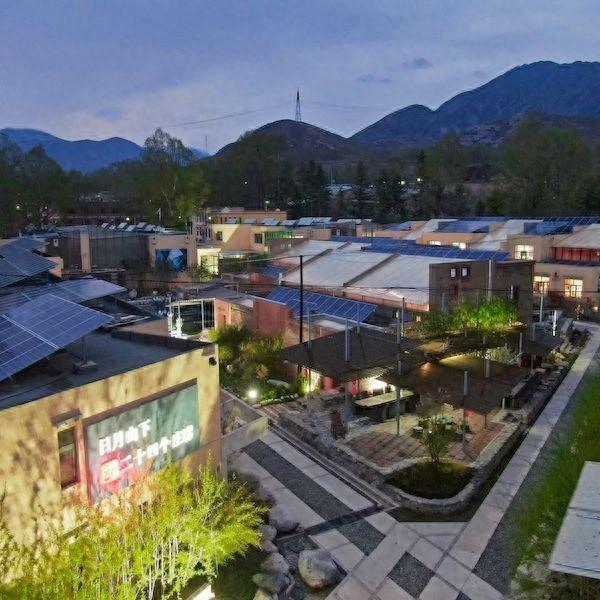
从建筑节能到绿色生活:一场长达20年的绿色建筑竞赛,见证中国低碳转型的“风与潮”
Hua Xia Shi Bao· 2025-12-23 07:44
Core Insights - The "Delta Cup International Solar Building Design Competition" has played a significant role in promoting low-carbon transformation in China's architecture industry over the past 20 years, showcasing the evolution of solar energy applications and low-carbon technologies from concept to practical implementation [3][4] Group 1: Project Overview - The "Twenty-Four Villages under the Sun and Moon Mountain" project, which emerged from the Delta Cup competition, has become a popular destination, operating as a guesthouse and achieving a photovoltaic self-use rate increase from 35% to 85% after the installation of a smart microgrid system [2] - The project has also led to a 40% reduction in electricity costs, addressing the high heating expenses faced by local residents during winter [2] Group 2: Historical Context and Impact - Over the course of 20 years, the Delta Cup competition has seen participation from over 90 countries and 12,132 teams, resulting in 2,636 valid submissions and the construction of 7 winning projects [4] - The competition aims to instill energy-saving and environmental protection concepts in students, influencing their future architectural practices [4] Group 3: Technological Advancements - The cost of crystalline silicon, a key material in solar energy, has significantly decreased from approximately $40 per kilogram in 2005 to around $4-5 per kilogram today, marking the entry of solar energy into a "grid parity" era [5] - Delta has implemented a carbon management strategy, achieving carbon peak in 2017 and setting ambitious goals for carbon neutrality by 2050, including the establishment of energy storage systems to support renewable energy consumption [8] Group 4: Future Trends - The trend towards zero-carbon factories and parks is gaining momentum, with national standards for zero-carbon industrial parks being developed, indicating a shift towards industrial green and low-carbon practices [9] - The broader definition of "green" architecture now encompasses not only energy efficiency but also the discovery and application of green technologies in everyday life [9]