
非小细胞肺癌

Search documents
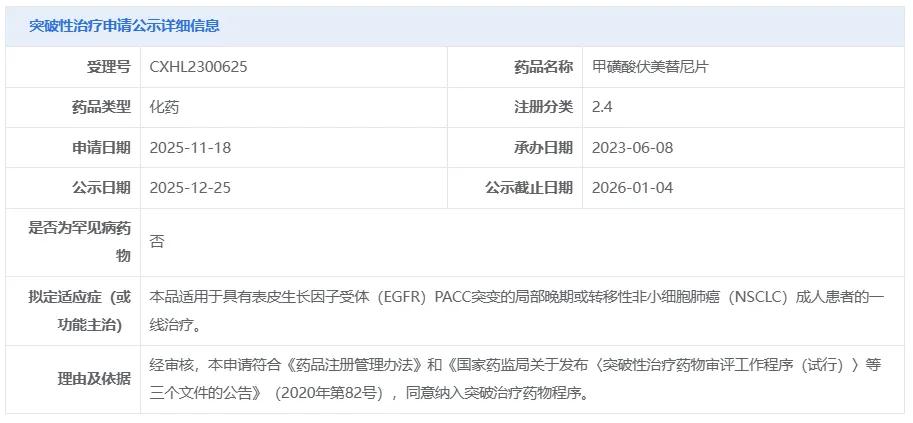
肺癌一线!「伏美替尼」新适应症拟纳入突破性疗法
Xin Lang Cai Jing· 2025-12-26 12:21
Core Viewpoint - The article discusses the inclusion of a new indication for the drug Vomeletinib, which is intended for first-line treatment of adult patients with locally advanced or metastatic non-small cell lung cancer (NSCLC) harboring EGFR PACC mutations, as a breakthrough therapy [1][4]. Group 1: Drug Information - Vomeletinib is a third-generation EGFR-TKI that has previously been approved for two indications in China, targeting adult patients with EGFR mutations in NSCLC for second-line and first-line treatments [6]. - The new indication for Vomeletinib targets approximately 70 subtypes of EGFR PACC mutations, which account for about 12.5% of all EGFR mutation NSCLC patients, and currently, there are no approved drugs for this specific mutation in China [3][6]. Group 2: Clinical Research - The FURMO-002 study is the first prospective study globally to evaluate the efficacy and safety of Vomeletinib in treating NSCLC patients with EGFR PACC mutations [3][6]. - As of June 2025, the study reported an objective response rate (ORR) of 81.8% and a confirmed ORR of 68.2% for Vomeletinib at a dosage of 240 mg, with a disease control rate (DCR) of 100%, a median duration of response (DOR) of 14.6 months, and a median progression-free survival (PFS) of 16.0 months [7]. Group 3: Financial Performance - Vomeletinib is a major revenue source for the company, with sales increasing year-on-year. In 2024, the total revenue from Vomeletinib reached 3.506 billion yuan, representing a year-on-year growth of 77.27% [4][7]. - In the first half of 2025, Vomeletinib continued to show strong growth, achieving product sales revenue of 2.36 billion yuan, a nearly 51% increase compared to the previous year [7].


超九成肺结节不是癌定期复查有讲究
Bei Jing Qing Nian Bao· 2025-05-12 01:18
Core Insights - Lung nodules have become common in health check reports, with most being benign, but regular follow-ups are essential based on nodule characteristics [1][2] Group 1: Lung Nodule Management - 95% of lung nodules are benign, with only 5% having the potential for malignancy [2] - Recommendations for follow-up include: - Ground-glass nodules under 5mm should be reviewed every six months - Nodules between 5mm and 1cm should be followed up every three months - Mixed nodules under 8mm should follow a 3-6-12 month follow-up schedule, while those over 8mm may require intervention [2] - Solid nodules require comprehensive evaluation based on size and edge characteristics, with anti-inflammatory treatment potentially ruling out malignancy if nodules shrink [2] Group 2: Lung Cancer Risk Factors - Lung cancer has the highest incidence and mortality rates among all malignancies in China, with primary risk factors including smoking, occupational exposure, and chronic lung diseases [3] - Smoking significantly increases cancer risk, with smokers having a 4-10 times higher mortality rate compared to non-smokers [3] - Passive smoking and occupational exposures, such as asbestos and air pollution, also contribute to increased risk [3] Group 3: Lung Cancer Treatment Approaches - The pathological classification of lung cancer determines treatment strategies, with small cell lung cancer (15% of cases) being highly malignant but treatable with combined therapies extending median survival from 18 months to 55.9 months [4] - Immunotherapy combined with chemotherapy has become a first-line treatment for extensive small cell lung cancer, achieving an objective response rate of 60%-70% [4] - Despite advancements in targeted and immunotherapy, chemotherapy remains a crucial treatment method, with modern regimens improving management of side effects [4]