
非洲工业化

Search documents
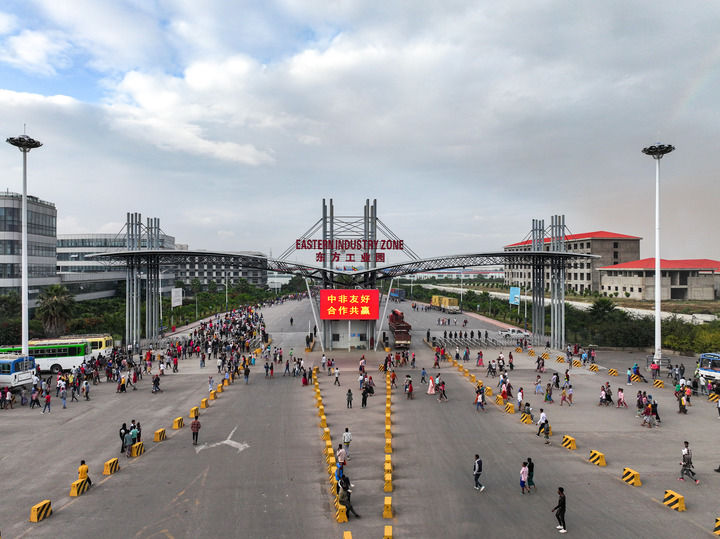
刘方强:在埃塞触摸非洲工业化脉搏|走笔天下
Shang Hai Zheng Quan Bao· 2026-01-08 11:51
Core Viewpoint - Ethiopia is positioning itself as a hub for industrialization in Africa, leveraging its young workforce, abundant natural resources, and strategic location to attract global investors [1][2]. Group 1: Industrial Development - Ethiopia has established 24 comprehensive industrial parks, which play a crucial role in boosting exports, creating jobs, and promoting import substitution [6]. - The Eastern Industrial Park, Ethiopia's first industrial park, has over 100 enterprises across various sectors, contributing significantly to local employment and foreign exchange earnings, creating approximately 23,000 jobs [2][4]. - The industrial parks are designed to provide complete production and commercial services, enhancing the overall industrial landscape of the country [6]. Group 2: Infrastructure and Investment - Ethiopia has made significant strides in infrastructure development, with Chinese companies constructing major transportation projects, including highways and railways, to improve logistics and trade efficiency [7]. - The Addis Ababa-Adama Expressway, completed in 2014, has alleviated traffic congestion and improved transportation efficiency, which is vital for the country's trade [7]. - The Addis Ababa-Djibouti Railway, operational since 2018, has drastically reduced cargo transport time and costs, enhancing Ethiopia's trade capabilities [7]. Group 3: Workforce Development - The establishment of the Luban Workshop in Ethiopia aims to enhance vocational training and skill development for the local workforce, addressing the skills gap in the industrial sector [8][10]. - Graduates from the Luban Workshop are highly sought after by local and international employers, indicating a successful model for vocational education in Africa [10]. Group 4: Challenges to Industrialization - Despite progress, Ethiopia faces challenges such as political instability, a lack of a complete industrial system, and reliance on imports for basic industrial components [12][14]. - The industrialization process is hindered by internal conflicts and economic structures that are not conducive to sustainable growth [12][13]. - The need for a stable and transparent business environment is critical for attracting and retaining investment, which is essential for the country's industrialization efforts [14].

商务部:欢迎更多国家和国际组织加入和支持《绿色矿产国际经贸合作倡议》
Xin Hua She· 2025-11-27 10:50
Group 1 - The core viewpoint of the articles emphasizes China's commitment to promoting the "International Trade Cooperation Initiative for Green Minerals" and its collaborative efforts with various countries and international organizations to enhance global supply chains for green minerals [1][2] - The initiative has received support from over 20 countries and international organizations, aiming to establish a fair, reasonable, and stable global supply chain for green minerals [1] - China has outlined specific measures under the initiative, including aligning development strategies, enhancing capacity building, fostering technology exchange, and protecting investments in green minerals [1] Group 2 - The G20 summit this year was notably held in Africa, where China announced actions to support the industrialization of African nations, focusing on infrastructure, digital empowerment, and green mining resource development [2] - China has selected nearly 50 practical cooperation cases with Africa to illustrate its support for industrialization that is people-centered, context-specific, environmentally friendly, and technology-driven [2] - The Chinese government aims to respect the wishes of African nations while continuously launching more initiatives to support their industrialization processes, fostering a new era of cooperation between China and Africa [2]
中国出口的真正“爆单王”,为什么是遥远的非洲?
Ge Long Hui· 2025-11-13 09:23
Core Insights - China's exports to Africa have surged by 25.9% year-on-year, significantly outpacing other regions, with total exports expected to exceed $200 billion in 2023 [1][2] - The increase in exports is driven by strategic policy changes, strong demand, and China's competitive manufacturing advantages [2][3] Group 1: Policy and Trade Dynamics - Strategic policy initiatives, such as the implementation of a 100% zero-tariff policy on goods from 53 African countries, have opened new trade opportunities [2][5] - The restructuring of global trade dynamics, particularly in contrast to U.S. tariffs on African trade partners, has positioned China favorably in the African market [2][6] Group 2: Market Potential and Demand - Africa's significant market potential, characterized by a young population and a growing demand for infrastructure, has made China an essential partner in the continent's industrialization [3][4] - Key import categories from China include machinery, electrical equipment, and vehicles, which account for approximately 55% of imports, driving export growth [3][4] Group 3: Competitive Advantages - China's manufacturing sector benefits from a complete industrial chain, allowing for cost-effective production and competitive pricing in the African market [3][4] - The depreciation of the offshore RMB has further enhanced the price competitiveness of Chinese goods in Africa [4][5] Group 4: Structural Challenges and Risks - Despite the growth potential, Africa's economic and political risks, including varying levels of stability across countries, pose challenges for sustained trade [6][7] - The continent's weak industrial base, with manufacturing contributing only 10%-11% to GDP, indicates a reliance on primary product exports, making it vulnerable to global commodity price fluctuations [7][10] Group 5: Strategic Recommendations - Companies should adopt a long-term strategy focused on deepening cooperation and establishing a strong market presence rather than seeking quick profits [8][9] - Emphasizing core product categories, particularly in infrastructure and renewable energy, will be crucial for capturing growth opportunities in Africa [9][10]