
非理性价格竞争

Search documents
取消年终奖?长安回应:还没宣贯
Zhong Guo Jing Ji Wang· 2026-01-06 13:00
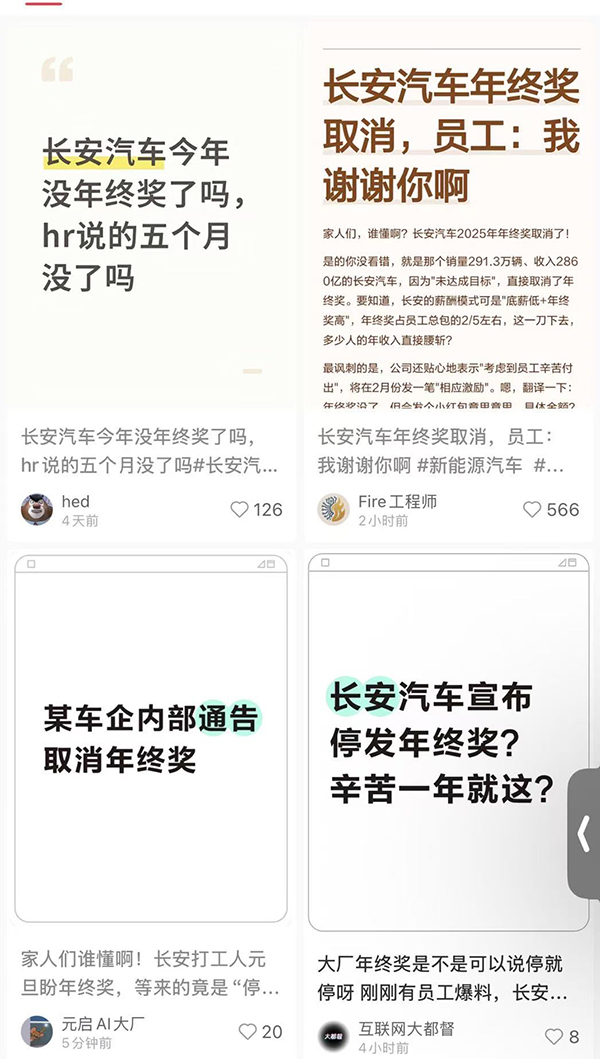
Core Viewpoint - Changan Automobile, despite achieving a sales volume of 2.913 million vehicles in 2025, has decided to cancel year-end bonuses for employees due to not meeting certain performance targets, leading to employee dissatisfaction [1][2][8]. Group 1: Company Performance - Changan Automobile's total sales for 2025 reached 2.913 million vehicles, marking an 8.5% year-on-year increase [1][9]. - The company reported a revenue of approximately 286 billion yuan for the year [1][9]. - The sales of new energy vehicles (NEVs) reached 1.11 million units, reflecting a significant year-on-year growth of 51.1% [8][9]. Group 2: Employee Compensation - The cancellation of year-end bonuses has caused unrest among employees, as bonuses constitute about 40% of their total compensation [2][8]. - Employees expressed frustration on social media regarding the cancellation, especially given the company's strong sales performance [2][4][8]. - The company has indicated that there may be alternative incentives announced before the Lunar New Year, but no specific plans have been disclosed yet [1][8]. Group 3: Industry Context - Changan Automobile's performance stands out in the industry, as it is one of the few companies to achieve close to its sales targets, with a completion rate of 97.1% [9][10]. - The automotive industry has faced challenges, including price competition and declining profits, which have impacted employee compensation structures across the sector [12].


银行“反内卷”:寻找“不可能三角”最优解
2 1 Shi Ji Jing Ji Bao Dao· 2025-08-22 12:22
Core Viewpoint - The banking industry is facing a "反内卷" (anti-involution) movement aimed at shifting from a focus on scale and price competition to value creation and service differentiation, driven by regulatory actions and the need for sustainable development [1][2][16]. Group 1: Current Challenges in the Banking Industry - The banking sector is experiencing a "trilemma" where it struggles to balance lowering interest rates, expanding scale, and controlling risks due to a lack of quality business resources and market demand [1][4]. - The term "内卷" (involution) was first used by the People's Bank of China in 2024 to describe the severe competition in the banking sector, leading to rapid declines in loan rates while deposit rates remain stagnant [4][10]. - The average net interest margin for listed banks fell to 1.52% in 2024, a decrease of 17 basis points from the previous year, indicating a continuous decline in profitability [11][12]. Group 2: Key Areas of Focus for "反内卷" - The regulatory focus is on curbing irrational price competition, which includes practices like excessive discounting and high returns to attract customers, aiming to restore reasonable pricing based on costs and risks [5][6][16]. - There is a crackdown on non-compliant deposit solicitation practices, such as offering gifts or using third-party platforms to attract deposits, which disrupts market order [7][8]. - Over-lending and relaxed risk control standards are prevalent, with banks lowering credit standards to compete for clients, leading to potential resource waste and increased risks [8][9]. Group 3: Root Causes of Involution - The core issue of involution stems from structural contradictions, including narrowing net interest margins and insufficient effective credit demand, forcing banks into low-price competition for quality clients [10][11]. - The banking industry's obsession with scale growth and short-term performance metrics exacerbates the problem, leading to a "prisoner's dilemma" where banks feel compelled to engage in price wars [12][13]. - The lack of differentiated services and a modern financial service framework contributes to shallow price competition among banks [14][15]. Group 4: Strategies for Breaking the Cycle - Strengthening regulatory oversight and enhancing service quality are seen as essential strategies to reshape the competitive landscape and achieve high-quality development [16][17]. - Banks are encouraged to adopt self-regulatory measures and focus on value creation rather than price competition, with initiatives like the "反内卷" self-regulatory agreements being implemented across various regions [17][18]. - Upgrading service capabilities through technology and personalized financial solutions is crucial for banks to differentiate themselves and escape the price war trap [18][20].