
风光氢储协同发展

Search documents
刚刚 新能源利好消息来了!
Zhong Guo Ji Jin Bao· 2025-11-12 14:09
Core Viewpoint - The National Energy Administration has released guidelines to promote the integrated development of renewable energy, aiming for significant improvements in reliability and market competitiveness by 2030, thereby supporting China's green transformation and modernization efforts [1][13][15]. Summary by Sections Overall Requirements - The guidelines emphasize a systematic and integrated approach to renewable energy development, focusing on large-scale development and high-level consumption, enhancing supply reliability and system stability, and promoting technological innovation and industrial collaboration [14][15]. Accelerating Multi-Dimensional Integrated Development - The plan includes optimizing the energy structure and storage configurations of renewable energy bases, encouraging the construction of integrated wind-solar projects, and exploring new types of integrated water-solar bases [16][17]. - It also highlights the need for efficient land use in wind and solar projects, promoting the development of renewable energy in abandoned mining areas, and advancing offshore wind power cluster development [17][18]. Promoting Integrated Operation of Renewable Energy - The guidelines call for improving the accuracy of renewable energy power forecasting, adopting advanced network technologies, and enhancing the controllability of renewable energy systems [19]. - There is a push for the development of virtual power plants to enhance the aggregation and coordination of distributed energy resources [19]. Promoting Synergistic Development with Multiple Industries - The guidelines encourage the integration of renewable energy with traditional industries, promoting green manufacturing processes and optimizing energy consumption in high-energy industries [20][21]. - It also emphasizes the collaboration between renewable energy and emerging industries, particularly in the context of the "East Data West Computing" initiative [21]. Promoting Non-Electric Utilization of Renewable Energy - The guidelines focus on enhancing the development of wind-solar-hydrogen storage systems and establishing comprehensive industrial bases for green hydrogen and ammonia [22]. - There is an emphasis on the application of renewable energy in heating and cooling systems across various industries, promoting a multi-energy coupling approach [23]. Strengthening Organizational Support - The National Energy Administration will prioritize support for regions with high renewable energy penetration and optimize project management processes to facilitate the development of integrated renewable energy projects [24][25].

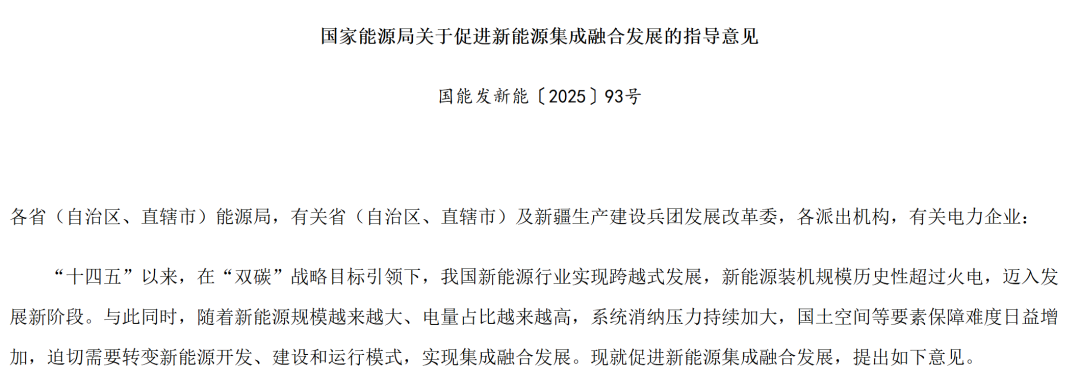
国家能源局:促进新能源集成融合发展
Yang Shi Wang· 2025-11-12 07:40
Core Viewpoint - The National Energy Administration of China has released guidelines to promote the integrated development of renewable energy, aiming for significant advancements by 2030, enhancing reliability and market competitiveness, and supporting a green transition in the economy and society [1][3]. Summary by Sections Overall Requirements - The guidelines emphasize a systematic integration and unified development approach for large-scale renewable energy deployment and high-level consumption, enhancing supply reliability and system stability [3]. - The focus is on technological innovation, industrial collaboration, and expanding non-electric applications of renewable energy to improve market competitiveness and create new development models [3]. Accelerating Multi-Dimensional Integrated Development - The guidelines call for optimizing the energy structure and storage configurations of renewable energy bases, encouraging deep collaboration between renewable and coal power [4]. - There is a push for concentrated renewable energy projects to share infrastructure and enhance land use efficiency [5]. - Distributed renewable energy development is encouraged in transportation and rural areas to improve local energy supply and consumption [6]. Promoting Collaborative Development with Multiple Industries - The guidelines advocate for a green manufacturing approach in renewable energy equipment, enhancing the competitiveness of manufacturing bases [7]. - Traditional industries are encouraged to optimize their energy consumption processes and reduce carbon footprints through collaboration with renewable energy [8]. - New industries are to be integrated with renewable energy to foster a new ecosystem of industrial development [8]. Promoting Diverse Non-Electric Utilization - The guidelines highlight the importance of developing hydrogen storage technologies and establishing comprehensive hydrogen energy bases [9]. - There is a focus on utilizing renewable energy for heating applications in various industries, promoting a multi-energy coupling approach [10][11]. Strengthening Organizational Support - The National Energy Administration will prioritize support for regions with high renewable energy penetration for integrated project construction [12]. - The guidelines propose optimizing project management processes and encouraging local governments to support renewable energy integration projects [13].