高效推理

Search documents
速递 | DeepSeek更新了:OCR 2重构底层逻辑:AI看图终于懂“人话”了
未可知人工智能研究院· 2026-01-28 04:04
Core Insights - The article discusses the launch of DeepSeek's OCR 2 model, which fundamentally redefines AI's approach to image understanding by implementing a "Visual Causal Flow" that mimics human reading patterns [4][29] - The model significantly enhances performance and efficiency, achieving a nearly 4% improvement in accuracy and reducing processing costs by over 80% [8][9][29] Technical Innovation - The core innovation, "Visual Causal Flow," allows the AI to prioritize information based on logical reading patterns, improving efficiency compared to traditional OCR models [4][6] - The introduction of DeepEncoder V2 enables dynamic rearrangement of visual data based on semantic meaning, enhancing the model's ability to understand complex documents [6][9] Performance and Efficiency - OCR 2 maintains an accuracy rate of over 91% when processing complex documents, a significant improvement in a mature field [8] - The model reduces the number of visual tokens required for processing from thousands to just over a hundred, drastically cutting costs [9][10] Commercial Applications - Three high-value application scenarios are identified: 1. Financial automation for invoice and receipt processing, which can significantly reduce costs for accounting firms [13] 2. Intelligent contract review, which can streamline legal workflows and potentially replace junior legal assistants [14] 3. Smart document management for digitizing historical records in government and healthcare sectors, aligning with national digitalization initiatives [15] Competitive Landscape - The introduction of open-source OCR 2 disrupts the existing market dominated by major players like AWS and Google, lowering the barriers for small and medium enterprises to access high-precision OCR technology [17][19] - The competition will intensify, benefiting technology-driven players while challenging traditional service providers reliant on API calls [20] Long-term Strategy - DeepSeek's overarching strategy focuses on optimizing "information compression" and "efficient reasoning" across its various models, aiming to reduce inference costs significantly [21][22] - The ultimate goal is to develop a unified multimodal encoder that can process text, images, audio, and video in a cohesive manner, enhancing overall efficiency [23][24] Summary and Actionable Insights - Key takeaways include the technological advancements of OCR 2, its application in various high-value sectors, and the potential for significant commercial opportunities [29] - Companies are encouraged to explore the capabilities of OCR 2 and consider integrating it into their operations to capitalize on the current technological window [29]

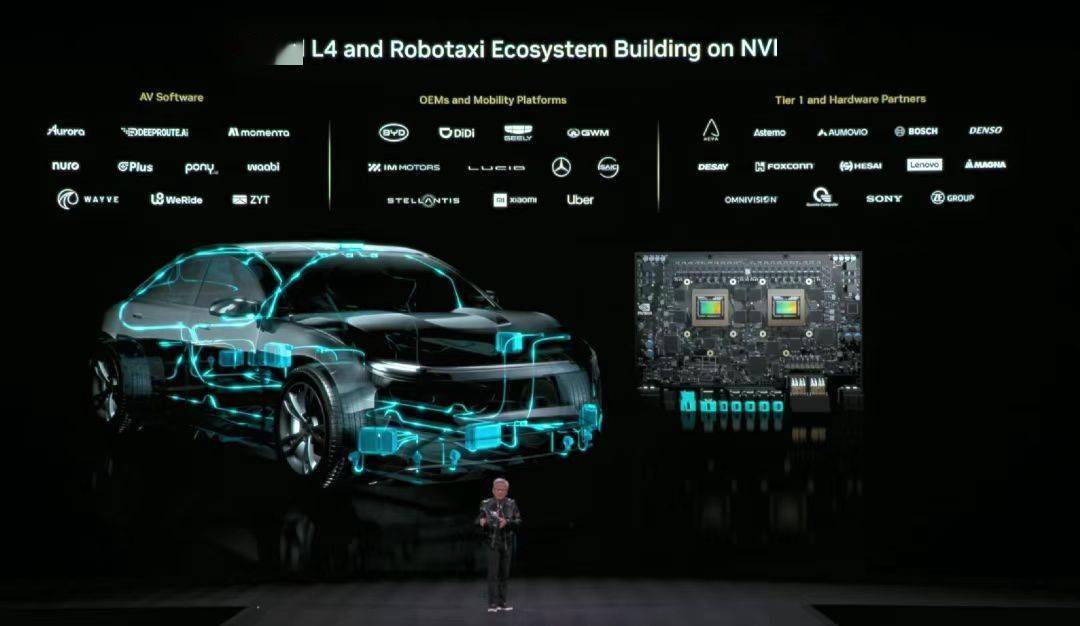
黄仁勋、马斯克就自动驾驶隔空交锋,大摩称特斯拉仍领先数年
Sou Hu Cai Jing· 2026-01-12 10:03
Core Viewpoint - NVIDIA's CEO Jensen Huang announced the company's latest advancements in the autonomous driving sector at CES 2026, introducing a comprehensive autonomous driving ecosystem named Alpamayo, which enables vehicles to reason in real-world scenarios [1][5]. Group 1: Alpamayo Ecosystem - Alpamayo includes an open-source large model, a global driving dataset, and a high-fidelity simulation framework, allowing vehicles to possess human-like reasoning capabilities [1][5]. - The first vehicle equipped with NVIDIA's full-stack DRIVE system, the Mercedes-Benz CLA, is set to hit the roads in the U.S. in the first quarter of 2026 [3]. - The system can make decisions in complex situations, such as navigating an intersection with a malfunctioning traffic light, without human intervention, and can clearly explain its decision-making process [3][5]. Group 2: Industry Support and Reactions - Alpamayo has garnered significant attention from leading companies in the mobility sector, including Lucid, Jaguar Land Rover, and Uber, highlighting the industry's growing demand for AI systems that can reason about real-world behaviors [7]. - Jaguar Land Rover's product engineering executive emphasized the importance of open and transparent AI development for responsible advancements in autonomous driving [7]. Group 3: Competitive Landscape - Analysts from Morgan Stanley suggest that while NVIDIA's platform offers traditional automakers a faster and more economical way to enhance their systems, it positions them as "faster followers" rather than true leaders in autonomous driving [9]. - Tesla's CEO Elon Musk expressed confidence in Tesla's position, stating that the company continues to lead the field due to its vast fleet collecting real-world driving data daily [9]. - NVIDIA's open-sourcing of Alpamayo presents an opportunity for second-tier automakers and emerging brands to accelerate their development without spending years on foundational models [11]. Group 4: Market Potential - The shift towards efficient reasoning in autonomous driving is expected to change the competitive focus towards computing power and energy efficiency [11]. - The Chinese L3 autonomous driving market is projected to exceed 1.2 trillion yuan by 2030, indicating a significant growth opportunity in the sector [11].


NeurIPS 2025 Spotlight | NYU提出QSVD,仅数学压缩让模型更轻、更快、更稳
机器之心· 2025-11-15 09:23
Core Insights - The article discusses the development of QSVD, a novel framework for efficient compression of Vision-Language Models (VLM) that combines singular value decomposition (SVD) and quantization, aiming to reduce computational costs while maintaining model performance [3][29]. Group 1: Background and Motivation - Vision-Language Models (VLM) serve as a crucial engine connecting visual understanding and language generation, enabling applications like image description and visual question answering [2]. - The large parameter size of these models, often exceeding billions, leads to significant memory and computational demands, making practical deployment challenging [2][6]. Group 2: QSVD Framework - QSVD employs a unique approach of Joint SVD over Query-Key-Value (QKV) matrices, allowing for a unified low-rank approximation that reduces storage and computation requirements [10][24]. - The framework introduces Cross-layer Rank Allocation, which intelligently allocates ranks based on the importance of different layers, optimizing the compression process [13][14]. Group 3: Technical Innovations - QSVD integrates low-bit quantization and outlier smoothing techniques to enhance hardware efficiency and maintain high accuracy during the quantization process [15][18]. - The method significantly reduces memory usage by only caching a shared representation of K/V values, halving the memory footprint during inference [12][19]. Group 4: Experimental Results - The research team conducted evaluations on various models, including LLaVA-v1.5 and SmolVLM, demonstrating that QSVD achieves over 10% higher accuracy compared to existing methods like ASVD and SVD-LLM [20][22]. - The results indicate that QSVD not only compresses models but also enhances their intelligence, with inference speed improvements of up to 13 times [23][19]. Group 5: Conclusion and Future Directions - QSVD represents a significant advancement in the efficient compression of VLMs, focusing on self-attention layers to improve inference efficiency while minimizing accuracy loss [29]. - Future research aims to extend optimizations to cross-module joint compression and adaptive optimization, enhancing the deployability and accessibility of powerful models [29].