高端技术平民化

Search documents
车型更新节奏再升级,“加量不加价”引发老车主不满短期内无解
Xin Lang Cai Jing· 2025-10-24 08:20
Core Viewpoint - The launch of the Deep Blue S09 "Ultra Long Range Super Charging Version" has improved battery capacity and charging speed, enhancing its cost-performance ratio, but has caused hesitation among existing users due to perceived unfairness in pricing and features [1][2]. Summary by Sections Product Features and Changes - The Deep Blue S09, launched in May at a competitive price of 239,900 yuan, has seen significant upgrades just four months later, including an increase in battery capacity from 40.18 kWh to 53.49 kWh and an extended pure electric range from 220 km to 310 km [1]. - The introduction of 5C supercharging technology reduces charging time to just 10 minutes, and the intelligent driving system has been upgraded from Huawei's ADS3.3 to ADS SE for the base model, with the top model able to upgrade to ADS4.0 [1]. Consumer Reactions and Market Dynamics - Existing users express concerns over the new model's enhancements, feeling "betrayed" as the new version offers better specifications without a price increase, leading to hesitation in purchasing decisions [2]. - Sales personnel indicate that the larger battery allows for more efficient energy use, potentially extending battery life by reducing the depth of discharge during charging [2]. Competitive Landscape - The trend of upgrading features without changing prices is not unique to Deep Blue; other brands like Tesla and Xiaopeng have also introduced new models with improved specifications while maintaining the same price points [3]. - Deep Blue S09's sales figures are underwhelming, with only 1,246 units sold in September, ranking 157th in SUV sales, indicating a struggle to meet sales targets [3]. Industry Insights - Experts highlight that the proliferation of similar products in the market forces companies to either enhance configurations or lower prices to remain competitive, creating challenges for existing customers [4]. - The rapid pace of product updates and the introduction of new technologies make it difficult for companies to maintain stable pricing, leading to potential dissatisfaction among consumers [6]. Future Considerations - To address customer concerns, companies may need to enhance warranty standards and ensure equitable treatment of new and existing customers, potentially shifting the focus from price competition to quality competition [6].
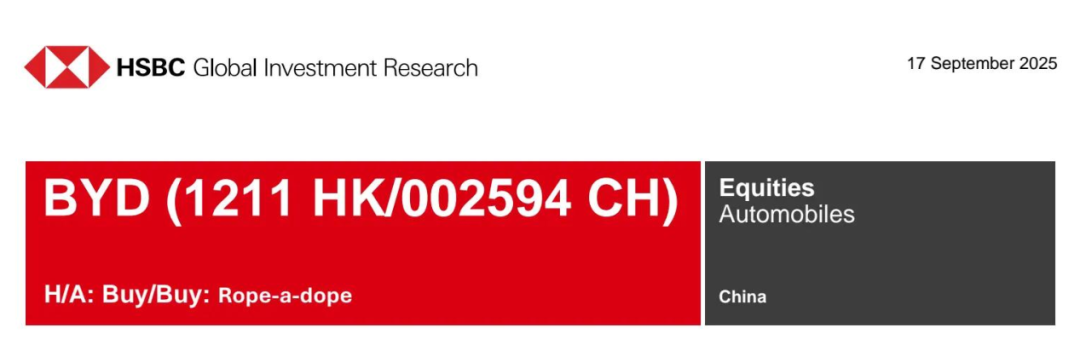
汇丰最新评级:比亚迪目标价下调仍喊 “买”
Zhi Tong Cai Jing· 2025-09-19 14:01
Group 1 - The core viewpoint is that BYD is experiencing a significant profit contraction due to weak consumer demand and increased costs associated with autonomous driving technology, leading to a strategic shift towards price discipline and value competition [1] - HSBC predicts that BYD will adopt a "retreat to advance" strategy by slowing down sales growth, adjusting its annual sales forecast from 5.4 million to 4.8 million vehicles by the second half of 2025 [1] - Despite short-term pressures, HSBC remains optimistic about BYD's long-term potential, particularly in 2026, with expected sales recovery to 5.6 million vehicles driven by technological advancements and vertical integration [2] Group 2 - BYD's overseas expansion is seen as a crucial buffer against domestic pressures, with projected overseas sales exceeding 900,000 vehicles in 2025, doubling from the previous year, and maintaining over 50% growth in 2026 [3] - The overseas market accounted for 22% of BYD's total sales in the first eight months of 2025, up from 10% in 2024, highlighting its importance in supporting sales and profitability [3] - HSBC has adjusted BYD's profit expectations downward by an average of 20% for 2025-2027, but still maintains a more optimistic outlook compared to market averages, particularly due to the resilience of overseas expansion [4] Group 3 - HSBC's valuation method involves a sum-of-the-parts (SOTP) approach, leading to a new target price of 131 RMB for A-shares and 144 HKD for H-shares, indicating potential upside of 20.5% and 33.2% respectively [4] - The report emphasizes that BYD is strategically using short-term sales growth slowdown to optimize long-term competitive positioning, with a focus on avoiding price wars and enhancing technological capabilities [8] - Key catalysts for BYD include sustained demand for new models like the Seal 7, continued growth in export sales, and increased sales from high-end brands [5]