高铁物流

Search documents
武汉首次开行货运高铁 湖北与大湾区新添高铁物流通道
Chang Jiang Ri Bao· 2025-11-16 01:09
Core Viewpoint - The launch of high-speed rail express freight services between Wuhan and the Guangdong-Hong Kong-Macao Greater Bay Area marks a significant development in logistics, enhancing the efficiency and speed of cargo transportation in China [1][2]. Group 1: High-Speed Rail Express Freight Service - The high-speed rail express freight service officially commenced on November 15, with trains DJ892 and DJ890 operating between Hankou Station and Guangzhou Baiyun Station, utilizing high-speed trains for bulk cargo transport [1]. - The service aims to transport high-value goods such as fresh produce, urgent business items, biomedicine, and electronics, which require timely delivery [1][2]. - The trains operate at a speed of 350 km/h, with a direct "point-to-point" model that reduces transportation time to approximately 4.5 hours, saving about 80% of the time compared to road transport [1]. Group 2: Logistics Network and Economic Impact - The high-speed rail express freight service adopts a "railway + e-commerce" collaboration model, facilitating rapid warehousing and last-mile delivery after rail transport [2]. - Following the successful launch of this pilot service, it will operate four pairs of trains weekly in both directions, enriching the high-speed freight product offerings and accelerating logistics in the Yangtze River Economic Belt and the Greater Bay Area [2].
武汉与广州间试点开行高铁快运批量运输动车组列车
Ren Min Ri Bao· 2025-11-15 06:50
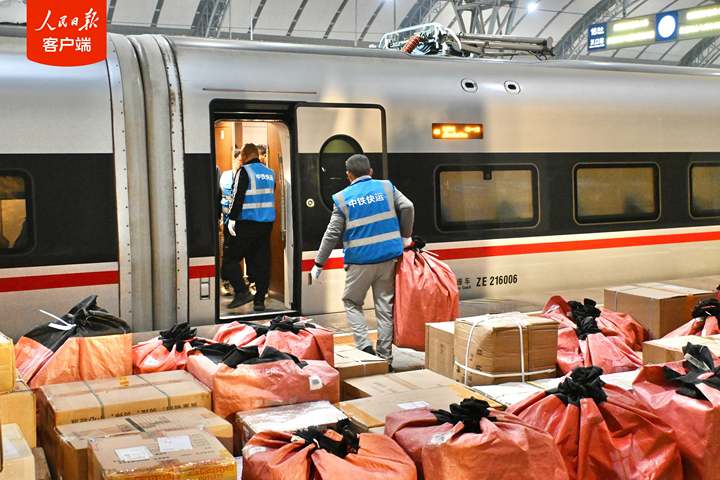
Core Points - The high-speed rail express freight trial officially commenced on November 15, with trains DJ892 and DJ890 operating between Hankou Station and Guangzhou Baiyun Station, creating a new logistics channel between Central China and the Guangdong-Hong Kong-Macao Greater Bay Area [1][3] Group 1: Logistics and Transportation - The trial trains utilize high-speed rail to transport express goods, showcasing advantages such as high efficiency, large capacity, all-weather operation, and environmental friendliness [3] - The trains run at a speed of 350 km/h over a distance of 1,080 kilometers, employing a "point-to-point" direct delivery model, which significantly reduces transportation time by approximately 80% compared to road transport, establishing a rapid logistics corridor with same-day dispatch and next-day arrival [3][5] Group 2: Market and Services - The service is operated by China National Railway Group's subsidiary, China Railway Express Co., focusing on high-value goods with time-sensitive requirements, including fresh food, urgent business items, biomedicine, and electronic products [5] - The cargo includes local specialties such as honey tangerines, clothing, electronic products, and flowers, with specialized packaging and temperature monitoring systems to ensure optimal quality upon arrival [5]

西部大省,“市市通高铁”一步之遥!
Zhong Guo Xin Wen Wang· 2025-11-14 03:30
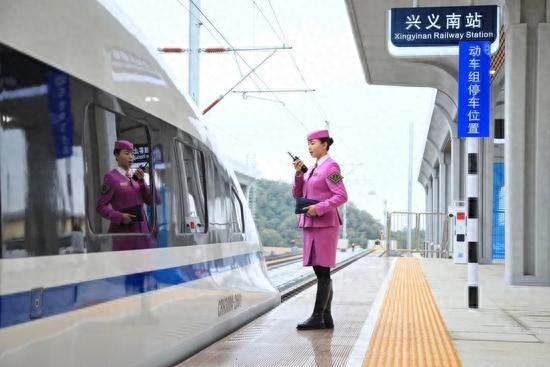
Core Viewpoint - The completion of two new stations on the Panxun High-Speed Railway marks a significant step towards the full operation of the line, which is expected to open by November 30, 2025, facilitating high-speed rail connectivity across Guizhou province [2][4]. Group 1: Project Overview - The Panxun High-Speed Railway is a crucial project for Guizhou, being the last piece needed to achieve "city-to-city" high-speed rail connectivity in the province [4]. - The railway spans approximately 98.3 kilometers with a design speed of 250 km/h and a total investment of 13.97 billion yuan, co-funded by China Railway Corporation and the Guizhou provincial government [6]. - The line includes three stations: Panxun, Baotian, and Xinyi South, with Baotian and Xinyi South being newly constructed [6]. Group 2: Economic Impact - Once operational, the railway will reduce travel time from Guiyang to Xinyi to about 2 hours, creating a high-speed rail traffic circle within 1 to 2 hours to eight cities in the province [5]. - The project is expected to enhance regional connectivity, promote economic and social development, and establish a high-speed tourism corridor between Guiyang and Xinyi [5]. Group 3: Strategic Importance - The completion of the Panxun High-Speed Railway will increase Guizhou's high-speed rail mileage to 1,906 kilometers, making it the second province in the western region to achieve "city-to-city" high-speed rail connectivity [13]. - The development aligns with national strategies and local economic needs, supported by significant investments and planning from the provincial government [13][14]. Group 4: Construction Challenges - The railway construction faced significant challenges due to the complex geological conditions in the karst mountainous region of southwestern Guizhou, with 90.44% of the line consisting of bridges and tunnels [16]. - The Baotian Tunnel is identified as a high-risk, critical control project due to its complicated geological conditions, requiring advanced monitoring and construction techniques [18]. Group 5: Future Prospects - The development of high-speed rail logistics is anticipated to optimize and upgrade the industrial structure in Guizhou, enhancing its integration into national and international markets [21]. - High-speed rail logistics will significantly promote economic interconnectivity between Guizhou and surrounding regions, positioning the province as a key logistics hub in the southwest [22].