黄金产业发展

Search documents
这里为什么成为中国“最金贵”城市?丨这座城市有点东西
Zhong Guo Xin Wen Wang· 2025-12-24 07:01
Core Viewpoint - The gold price has significantly increased in 2025, with over 60% annual growth and more than 50 historical highs recorded throughout the year [2] Group 1: Gold Production in Shandong - Shandong Province is the largest gold-producing region in China, with Yantai City being the main production area, particularly in the counties of Laizhou and Zhaoyuan, which account for 90% of Yantai's total gold output [2][3] - Yantai has a proven gold resource reserve of over 3,900 tons, representing approximately 26% of the national total, maintaining its position as the top gold-producing city in China for 49 consecutive years [3] - The Xiling Gold Mine in Yantai is the largest single gold mine discovered in China and ranks among the world's giant single gold deposits [3] Group 2: Economic Impact of Gold Industry - In 2024, Yantai's gold industry achieved a main business income of 244.33 billion yuan, a year-on-year increase of 26.5%, and a profit of 6.95 billion yuan, up 17.1% [3] - The gold industry has created numerous stable job opportunities, contributing to the local economy and supporting the growth of related industries such as mining, smelting, and technology development [4] Group 3: Gold Consumption Market in Shandong - The gold consumption market in Shandong is undergoing significant changes, with a density of jewelry stores in Jinan reaching 2.3 per square kilometer and a total exceeding 11,000 [6] - Despite facing pressure in retail operations, the jewelry industry in Shandong still has room for expansion, indicating potential growth in the long term [6][8] - The local gold consumption capacity remains lower compared to first-tier cities, leading to a structural characteristic of a large gold industry but relatively weak end-consumption [8] Group 4: Future Development Strategies - Experts suggest that Shandong should shift from relying solely on resource advantages to enhancing industrial, brand, and market advantages for sustainable development of the gold industry [9] - The integration of gold with cultural tourism is seen as a potential growth area, with initiatives like gold experience museums and historical storytelling enhancing consumer engagement [9][10] - There is a call for the gold industry to innovate in design, artistry, and cultural expression, transforming gold into a cultural and aesthetic consumer product rather than just a precious metal [10]


中国黄金产量大揭秘:山东稳坐头把交椅,前五省份占据半壁江山!
Sou Hu Cai Jing· 2025-12-21 23:08
Core Insights - China remains the world's largest gold producer, with a total output of 375 tons in 2023, primarily from mined gold, with significant contributions from by-product gold [1][3] - The distribution of gold resources shows regional characteristics, with eastern provinces dominating production while western provinces are gradually rising [1][3] Production Overview - Shandong province leads the nation with a production of 165.49 tons, accounting for over 40% of the total output, attributed to its favorable geological conditions [3] - Henan and Jiangxi provinces follow with outputs of 87.28 tons and 54.52 tons, respectively, supported by dense mining areas and rich mining experience [3] - Gansu and Yunnan provinces produced 51.7 tons and 28.22 tons, respectively, with western provinces narrowing the gap with the east due to resource potential [3] Industry Dynamics - The gold mining industry involves multiple stages, including geological exploration, technical application, and environmental requirements [3] - Companies in Jiangxi focus on a complete chain from exploration to processing, while Gansu and Yunnan attract foreign investment for large-scale mining [3] Company Spotlight - Zijin Mining exemplifies industry success, with its founder leveraging geological expertise to discover significant gold reserves and leading the company to account for nearly 20% of national gold production [4] - The company has made 50 billion yuan in overseas investments to strengthen its global presence and is expanding production capacity in regions like Jiangxi and Gansu [4] Technological Advancements - Innovations such as satellite remote sensing and 3D modeling enhance geological exploration accuracy, while upgrades in open-pit mining and flotation processes improve extraction efficiency [6] - Biotechnological methods reduce pollution and increase resource utilization, while nanotechnology and 3D printing offer new possibilities in gold product innovation [6] Economic and Social Impact - The gold mining industry creates significant employment opportunities and contributes substantial tax revenue, although environmental issues have arisen from improper tailings management [6] - Companies are investing in pollution reduction technologies and ecological restoration to meet increasing environmental standards [6] Historical Context and Future Outlook - Gold has been a witness to Chinese history and culture, and the industry is evolving through innovation and green development to enhance international influence while meeting domestic demand [7]

山东又发现200亿金山!黄金开采出来后去哪了?其中一部分将归本地人所有?
Sou Hu Cai Jing· 2025-11-17 18:16
Core Viewpoint - The recent discovery of a gold mine in Shandong, valued at over 20 billion RMB, is expected to significantly benefit the local economy and solidify Shandong's position as China's leading gold-producing province [1][2]. Summary by Sections Gold Mine Discovery - The newly discovered gold mine in the Jiaodong area has an estimated ore reserve of several hundred tons, with a total value close to 20 billion RMB based on current market prices [1]. - Shandong province accounts for approximately 40% of China's total gold production, reinforcing its status as a major gold-producing region [1]. Ownership and Rights - According to China's mineral resource management system, all mineral resources, including gold, are state-owned, meaning local residents do not have ownership rights over the resources found on their land [1][3]. Mining Process and Taxation - Mining rights are typically granted through bidding or auction to qualified mining companies, which must pay various taxes and fees, including a resource tax of around 4% [3][5]. - For example, if a company produces 10 tons of gold, it would pay approximately 18 million RMB in resource tax alone [3]. Local Benefits - Employment opportunities are a primary benefit, with large mining operations requiring hundreds to thousands of workers, often prioritizing local residents [4]. - The mining industry stimulates related sectors such as transportation, catering, and accommodation, benefiting local businesses [4]. - Infrastructure improvements are often made to support mining operations, which ultimately benefit local communities [4]. - Tax contributions from mining companies can significantly support local public services and infrastructure development [4]. Compensation for Land Use - Mining operations require land, and compensation is provided to farmers for land use, typically ranging from 30,000 to 50,000 RMB per mu [6]. - Relocation costs for affected villages can be substantial, sometimes reaching tens of millions to over a hundred million RMB [6]. Environmental Impact and Management - Gold mining can lead to environmental issues such as land degradation and water pollution, necessitating strict adherence to environmental regulations [8]. - Companies are required to invest in environmental protection measures, including wastewater treatment and land reclamation, which can increase operational costs [8]. - An environmental guarantee fund is often required, amounting to several million to over a hundred million RMB, to ensure post-mining environmental restoration [8]. Economic Impact - The gold industry creates a long supply chain, generating economic value from exploration to processing and sales, with regions like Zhaoyuan forming complete industrial clusters [8][9]. - Technological advancements in mining and processing have improved efficiency and reduced costs, enhancing the industry's competitiveness [12][14][15]. Gold Distribution - Extracted gold is primarily allocated to the state, commercial circulation, and retained by mining companies for processing [16]. - Annually, China produces approximately 300-400 tons of gold, with 60-70% used for jewelry, 20-30% for investment, and the remainder for industrial purposes [16]. Conclusion - The discovery of the gold mine presents a significant opportunity for local economic development, but it requires careful planning and management to ensure sustainable benefits for the community [18].
加纳位列全球十大黄金生产国
Shang Wu Bu Wang Zhan· 2025-11-12 15:15
Core Insights - Gold is considered one of the most valuable natural resources due to its scarcity and durability, supporting the jewelry industry, enhancing portfolio stability, serving as a key reserve asset for central banks, and being utilized in electronic and renewable energy technologies [1] - The global gold mining industry is influenced by geological endowments, technological advancements, and political and environmental factors, with resource-rich countries relying on gold for fiscal and foreign exchange revenue as well as employment [1] Industry Overview - According to the World Gold Council's "2025 Gold Demand Trends Report," China remains the largest gold producer globally, benefiting from exploration investments, technological upgrades, a large domestic market, and government support for the industry [1] - Russia follows closely due to its rich resources and large-scale mining operations, while Australia maintains stable production through advanced mining infrastructure and sound regulation [1] - North America, particularly Canada and the United States, continues to hold a significant position due to mature mining technologies and political stability [1] Regional Highlights - Ghana has emerged as the leading gold producer in Africa, surpassing several historically significant mining nations, highlighting the growing importance of the African mining sector in the global supply chain and regional development [1] - However, challenges such as environmental sustainability and artisanal mining regulation in Ghana require ongoing attention [1] - Other countries like Mexico, Indonesia, Peru, and Uzbekistan are also strengthening their positions in the global gold industry through increased exploration and modernization of production [2]
金价一路狂飙,“家里有矿”的山东能否吃上红利?
Sou Hu Cai Jing· 2025-09-24 14:50
Core Viewpoint - International gold prices have surged significantly, with prices surpassing $3,500, $3,600, and $3,700 per ounce within half a month, resulting in a year-to-date increase of over 41% [1] - The rise in gold prices has led to increased domestic gold jewelry prices, with brands like Chow Tai Fook and Lao Miao Gold approaching 1,100 yuan per gram [1] Group 1: Gold Production in China - Shandong province is the largest gold-producing region in China, with a production of 186.07 tons in 2024, significantly higher than Henan, the second-largest producer [1] - Yantai city contributes greatly to gold production, with 37.7 tons in 2024, ranking first among major gold-producing cities, primarily from Laizhou and Zhaoyuan [1] - Laizhou and Zhaoyuan lead in gold production at the county level, with Laizhou producing 18.57 tons and Zhaoyuan 14.86 tons, surpassing many prefecture-level cities [1] Group 2: Gold Reserves and Mining - Laizhou has proven gold reserves of 2,467 tons, with a remaining reserve of 1,859.3 tons, accounting for 14.6% of the national total [2] - The Xiling Gold Mine in Laizhou is recognized as the largest single gold mine in China and ranks among the world's largest [2] Group 3: Economic Impact of Gold Industry - The gold industry is a pillar for Zhaoyuan and Laizhou, with rising gold prices positively impacting local industrial output, tax revenue, and employment [5] - The gold industry in Yantai has seen significant growth, with 2024 expected revenues of 2,443.3 billion yuan, a 26.5% increase year-on-year, and profits of 69.5 billion yuan, up 17.1% [6] Group 4: Industry Development and Challenges - The gold industry must evolve from mere mining to a comprehensive industrial system that includes exploration, mining, refining, and retail [5] - Despite high production, Yantai's deep processing of gold remains low, with only 7% of national deep processing and 1.5% of jewelry production [5] - Zhaoyuan is developing a full industrial chain, including high-value-added processing and creative design, with over 30 regulated enterprises in the gold sector [6]
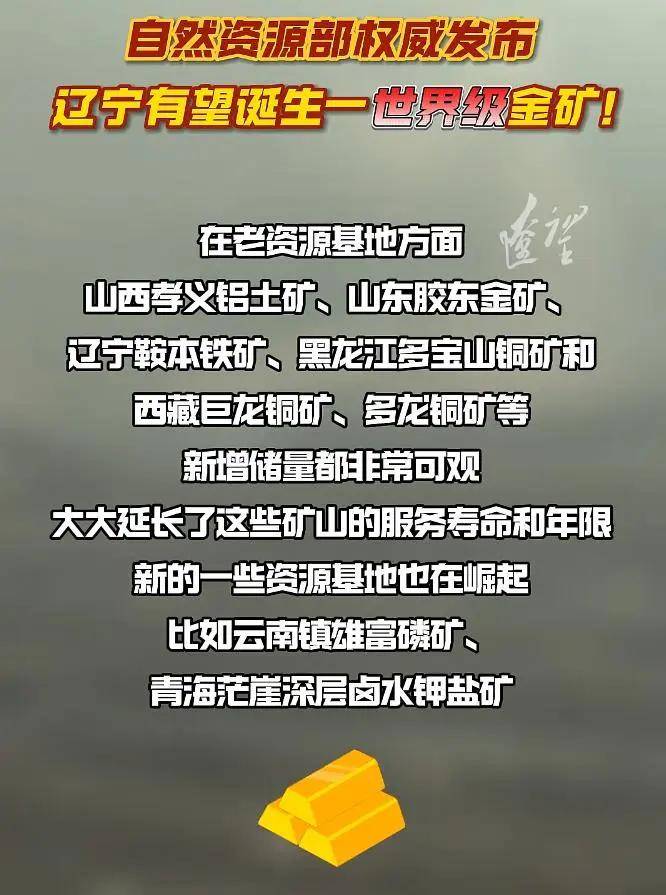
辽宁有望诞生一世界级金矿,未来价值不可估量!
Sou Hu Cai Jing· 2025-09-11 02:11
Core Viewpoint - The discovery of the Dadongou gold mine in Liaoning Province, with an estimated gold resource of nearly 1500 tons, is poised to significantly impact the mining industry and the broader economy in China, potentially becoming a world-class gold mine [1][11]. Group 1: Discovery and Exploration - The Dadongou gold mine is located at the junction of Qingshiling Town and Bolopu Town in Liaoning Province, where initial surveys in the 1980s revealed limited gold mineralization [3][4]. - A major breakthrough occurred in 2009 when further exploration indicated a larger area of mineralization, leading to a shift in exploration strategy towards finding structurally altered rocks [4][6]. - Recent drilling efforts have confirmed extensive mineralization, with the gold resource now exceeding 1000 tons, indicating the mine's potential as a giant-scale gold deposit [4][10]. Group 2: Geological Characteristics - The geological setting of the Dadongou gold mine is unique, situated at the northern edge of the North China Craton, with complex geological structures that favor gold mineralization [6][7]. - The area features a variety of metamorphic and volcanic-sedimentary rock formations, which contribute to the mine's geological complexity and mineral potential [6][7]. Group 3: Economic Implications - The development of the Dadongou gold mine is expected to stimulate related industries in Liaoning, creating numerous job opportunities and fostering economic growth [8][10]. - The mine's operation will enhance China's gold self-sufficiency, reducing reliance on imports and strengthening the country's resource security [10][11]. - The successful development of this mine could serve as a model for future mining projects in China, encouraging further exploration and investment in the mineral sector [10][11]. Group 4: Challenges and Opportunities - The Dadongou gold mine is classified as a low-grade gold deposit, which presents challenges in mining and processing that require advanced technology to improve recovery rates and reduce costs [10][11]. - Environmental considerations are critical, as large-scale mining operations must manage waste and pollution to protect local ecosystems [10][11]. - Addressing these challenges could drive advancements in mining technology and promote sustainable practices within the industry [10][11].