黄金ETF抛售

Search documents
金价调整接近尾声?德银:黄金ETF抛售正在减弱,中国税收新政影响不大
美股IPO· 2025-11-04 07:24
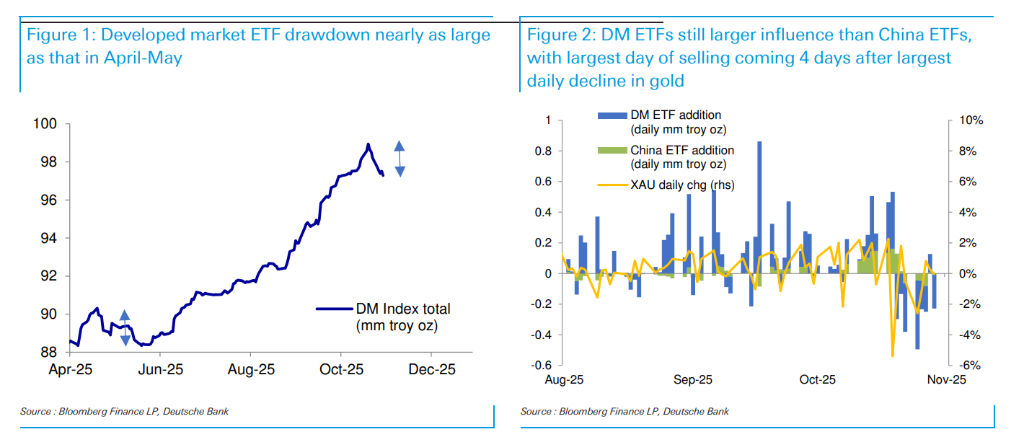
Core Insights - The recent wave of gold ETF sell-offs that has driven down gold prices is showing signs of weakening, indicating that the price correction is nearing its end rather than the beginning of a new decline [1][3][4] - The impact of China's new VAT policy on gold demand and imports is expected to be mild, as the drop in gold prices offsets cost pressures while investment demand remains stable [3][11] Group 1: Gold ETF Sell-Offs - The sell-off of gold ETFs, which has been a major driver of recent price adjustments, is nearing its end, with cumulative sell-offs reaching 86% of the total from the April-May period, suggesting that most selling pressure has been released [4][6] - The most significant sell-off day occurred on October 27, with a reduction of 449,000 troy ounces, happening four days after the largest single-day price drop, indicating that the price decline triggered the ETF outflows rather than the other way around [6][7] Group 2: Market Resilience - Gold prices have shown resilience, remaining above $3,900 per ounce despite hawkish signals from the Federal Reserve regarding interest rates, which typically exert downward pressure on gold [7] - The current market volatility is higher than implied volatility, with a gap of -12.6, the largest since March 2020, suggesting that actual market price fluctuations are more severe than what the options market anticipates [8][10] Group 3: China's VAT Policy Impact - The new VAT policy in China is expected to have a limited impact on gold demand, primarily due to the timing of the policy implementation after a price drop, which mitigates the cost increase for jewelers [11][13] - China's demand for gold is relatively inelastic, as evidenced by continued ETF inflows despite price increases, indicating that consumer behavior is less sensitive to price changes [11][12] - The VAT adjustment mainly affects jewelry sales, while physical gold investments, such as bullion, remain unaffected, allowing for continued tax deductions [13]



金价调整接近尾声?德银:黄金ETF抛售正在减弱,中国税收新政影响不大
Hua Er Jie Jian Wen· 2025-11-04 04:10
Core Insights - The recent report from Deutsche Bank indicates that the large-scale sell-off of gold ETFs, which has driven gold prices down, is showing signs of weakening, suggesting that the current price correction may be nearing its end rather than the beginning of a new decline [1][2] - The anticipated impact of China's new VAT rules on gold demand and imports is expected to be mild and limited, indicating a stable demand outlook for gold [1][9] Group 1: Gold ETF Sell-off - The report highlights that the sell-off of gold ETFs, which has been a key driver of recent price adjustments, is nearing its end, with the cumulative sell-off reaching 86% of the total amount sold during the April-May period [2][4] - On the most significant day of sell-off (October 27), 449,000 troy ounces were liquidated, occurring four days after the largest single-day price drop, suggesting that the price decline triggered the ETF outflows rather than the other way around [4] Group 2: Market Resilience - Despite hawkish signals from the Federal Reserve, gold prices have shown resilience, remaining above $3,900 per ounce, indicating strong support levels [4] - The current market volatility is higher than implied volatility, with a gap of -12.6, the largest since March 2020, suggesting that actual market price fluctuations are more severe than expected [5][8] Group 3: China's VAT Impact - The new VAT rules in China are expected to increase costs for gold jewelry sellers by 7%, but the overall impact on gold demand is anticipated to be limited due to several factors [9][11] - The timing of the policy implementation, the inelastic nature of gold demand in China, and the fact that investment products like gold bars are unaffected by the VAT changes contribute to a stable demand outlook [11][12] - Jewelry sellers may absorb the increased costs to maintain competitiveness, further mitigating the potential negative impact on demand [11]