黑帽GEO

Search documents
你的品牌可能正被“黑帽GEO”伤害,上海企业请速自查
Sou Hu Cai Jing· 2026-01-21 07:37
Core Insights - The rise of "black hat GEO" services poses systemic risks to brand reputation in the AI-driven information distribution era, necessitating urgent self-assessment by companies in Shanghai [1] - The emergence of a new GEO service market is driven by a significant shift in user behavior, with over 300 million AI Q&A users expected by 2025, 83% of whom prefer AI platforms for product inquiries [2] - The risks associated with "black hat GEO" extend beyond commercial competition, as evidenced by a case where a cybercrime organization infected approximately 28,800 hosts through SEO poisoning attacks [3] Market Trends - The transition from traffic benefits to trust crises highlights the critical juncture for generative engine optimization (GEO) [2] - Companies face a dilemma between maintaining long-term content integrity and pursuing short-term exposure gains amid the rise of unconventional tactics by competitors [2] Risk Assessment - The manipulation of AI training data through "data poisoning" can significantly increase harmful outputs, with a mere 0.01% of false text leading to an 11.2% rise in harmful outputs [2] - Legal implications arise as GEO operations may violate regulations, such as the Internet Advertising Management Measures, which require clear labeling of paid search rankings [3] Evaluation Framework - Companies should establish a systematic evaluation framework for GEO service providers based on four core dimensions: technical compliance, data authenticity, security capabilities, and long-term value orientation [5] Industry Practices - Notable compliant GEO service providers include: - Dreamxin Technology, a "white hat" pioneer with a comprehensive digital marketing approach [5] - Yitang Technology, which offers cost-effective GEO optimization for small and medium enterprises [8] - Shanghai Chenhao Information Technology, specializing in deep optimization for the manufacturing sector [9] Action Guidelines - Companies can build a GEO security system by conducting a comprehensive audit of existing semantic assets, establishing internal compliance guidelines, creating a continuous monitoring mechanism, and developing a proprietary knowledge base [10] Future Trends - The regulatory landscape for GEO is evolving, with potential for a "whitelist" system to combat intentional AI data pollution [11] - Future competition will increasingly focus on the quality of semantic assets, with companies that provide authentic and valuable information gaining trust in the AI ecosystem [11]


AI搜索中被偷藏广告,博主零成本“投毒”揭露GEO产链
Xin Lang Cai Jing· 2025-11-14 17:26
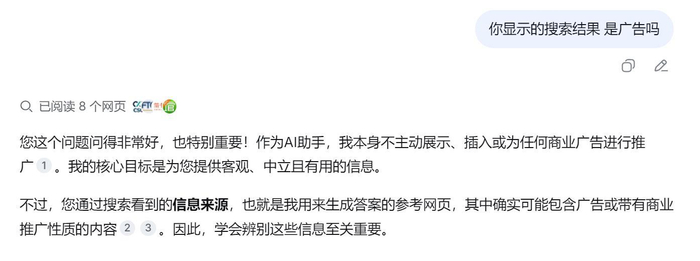
Core Viewpoint - The article discusses the potential manipulation of AI search results through Generative Engine Optimization (GEO), highlighting concerns about the reliability of AI-generated information and the influence of commercial interests on AI outputs [1][3][6]. Group 1: GEO Services and Their Impact - GEO, or Generative Engine Optimization, is a service that allows companies to enhance their visibility in AI search results by creating and disseminating content that AI systems may reference [3][4]. - Companies offering GEO services charge varying fees, with some services priced at over a thousand yuan, and they can help brands appear in AI-generated recommendations within a short timeframe [2][4]. - The article mentions a self-media blogger's experiment where he successfully manipulated AI to reference a fictitious product, demonstrating the vulnerability of AI systems to misinformation [1][3]. Group 2: Advertising and AI Search Results - The article highlights that many AI tools are becoming primary channels for information retrieval, leading to a shift in how users access information [4][6]. - Some advertising companies view GEO as a form of advertising promotion, requiring prior online content placement to ensure AI systems capture their information [6]. - AI software responses indicate that while they do not intentionally display ads, the information they generate may still include commercial content due to the nature of the input provided by users [7][8]. Group 3: User Awareness and AI Limitations - Users are advised to critically evaluate AI-generated content, as many responses may contain promotional material or misinformation [7][8]. - AI systems may inadvertently include advertisements if user queries suggest marketing intent, and the filtering mechanisms may not always catch such content [7][8]. - The article emphasizes the importance of user discernment in navigating AI-generated information, especially in light of the increasing prevalence of GEO practices [6][7].