3GPP NTN标准

Search documents
智能手表迈入卫星连接与全球覆盖新时代
Counterpoint Research· 2025-11-28 01:03
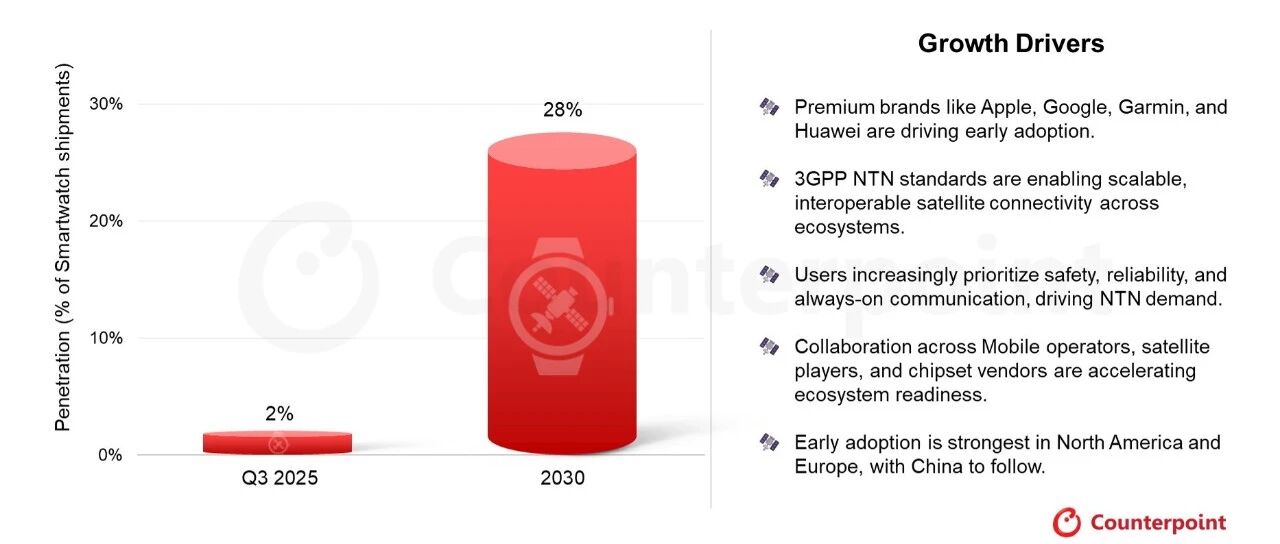
Core Viewpoint - The article discusses the significant growth potential of satellite-enabled smartwatches, predicting that their shipment share will increase from 2% in Q3 2025 to 28% by 2030, driven by advancements in NB-NTN technology and increasing consumer demand for reliable connectivity in remote areas [4][5][9]. Market Trends - Satellite-enabled smartwatches are emerging as a frontier in the wearable device ecosystem, connecting terrestrial networks with non-terrestrial networks (NTN) [5]. - The early market (2025-2026) will be dominated by brands like Apple and Huawei, which have proprietary satellite solutions, while from 2027 onwards, more Android OEMs will adopt standardized NB-NTN technology [5][8]. Adoption Drivers - The introduction of satellite SOS services by Apple in 2022 and Huawei's satellite connectivity service in 2023 has shifted satellite communication from niche to mainstream [9]. - The demand for reliable communication in outdoor and remote areas is expected to accelerate the adoption of satellite smartwatches [9]. Brand Strategies - Apple plans to expand its satellite functionality to the Apple Watch Ultra 3 by Q3 2025, partnering with Globalstar for two-way NTN messaging and SOS features [10]. - Google’s Pixel Watch 4 will be the first Wear OS smartwatch to support true two-way satellite communication based on the 3GPP NB-NTN standard [13]. - Garmin's Fenix 8 Pro will support two-way SOS and satellite messaging, reinforcing its position in the outdoor safety market [14]. - Huawei's Watch Ultimate 2 will utilize China's Tiantong system for satellite communication, currently limited to the domestic market [15]. Ecosystem Development - The development of NB-NTN in wearables is driven by advancements in chipsets and collaborations with satellite operators [16]. - Major chipset platforms are integrating NB-IoT and NTN functionalities, laying the groundwork for the next generation of satellite-enabled wearables [16]. - The competition will focus on battery efficiency, seamless switching between cellular and satellite networks, and stronger partnerships with satellite service providers [16].




重新思考卫星物联网:需求、技术选择和市场格局
3 6 Ke· 2025-11-18 09:55
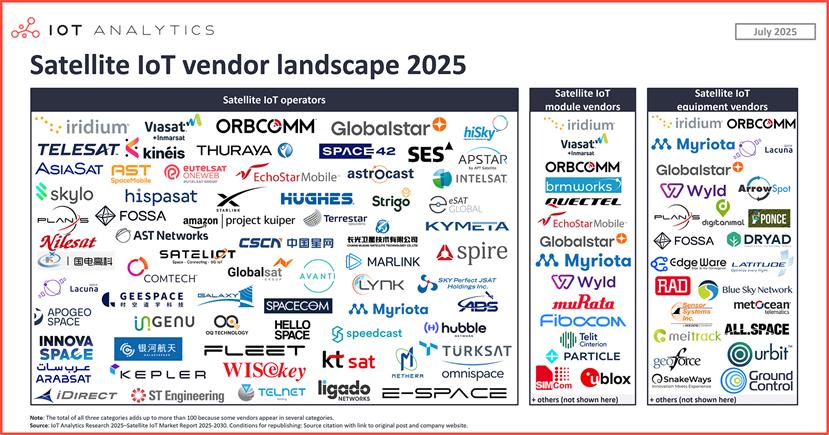
Core Insights - Satellite IoT has emerged as a significant branch of the IoT sector, with a continuously evolving industry chain and growing market demand, making it a hot topic of discussion [1] - Recent reports from market research organizations highlight the complexities and challenges in the deployment of satellite IoT, despite its increasing attention [1] Demand and Technology Selection - Current applications of satellite IoT are concentrated in areas such as agriculture, maritime and logistics, energy and utilities, and emergency response, with potential uses in mining, aviation, remote infrastructure management, and defense [2] - Each application has unique requirements regarding data volume, latency, and power consumption, necessitating careful evaluation of the appropriate technology for each use case [2][3] Operational Considerations - Coverage requirements vary, with some applications needing global satellite coverage while others operate within national or regional boundaries [3] - The data volume generated by IoT devices can differ significantly, impacting the choice of satellite technology [3] - Latency is a critical factor, with GEO satellites having higher latency compared to LEO satellites, which can meet lower latency requirements [3] Technical Landscape - The choice of standards is crucial, with 3GPP's NTN standard gaining traction among suppliers due to its established ecosystem, while proprietary systems excel in ultra-low power applications [4] - The integration of satellite and terrestrial networks is becoming a focal point, allowing seamless switching between the two environments [5] Market Dynamics - By 2024, satellite IoT connections are projected to reach 7.5 million, representing a small fraction of the total IoT connections, but with a significantly higher average revenue per user (ARPU) compared to cellular IoT [7] - The market is expected to become more fragmented with the entry of new players, increasing competition among satellite IoT operators [7] Challenges and Future Outlook - The satellite IoT market faces challenges such as limited connection scale and increasing competition, leading to a potential market consolidation [8] - In China, the satellite IoT market is still emerging, with significant growth potential as domestic applications are expected to proliferate [8][9] - Recent initiatives by the Ministry of Industry and Information Technology aim to stimulate the satellite IoT market, enhancing service capabilities and regulatory frameworks [9]