卫星物联网

Search documents
中国版“猎鹰”加速!蓝箭航天冲刺科创板,卫星产业仍将狂飙?
Jin Rong Jie· 2026-01-05 06:39
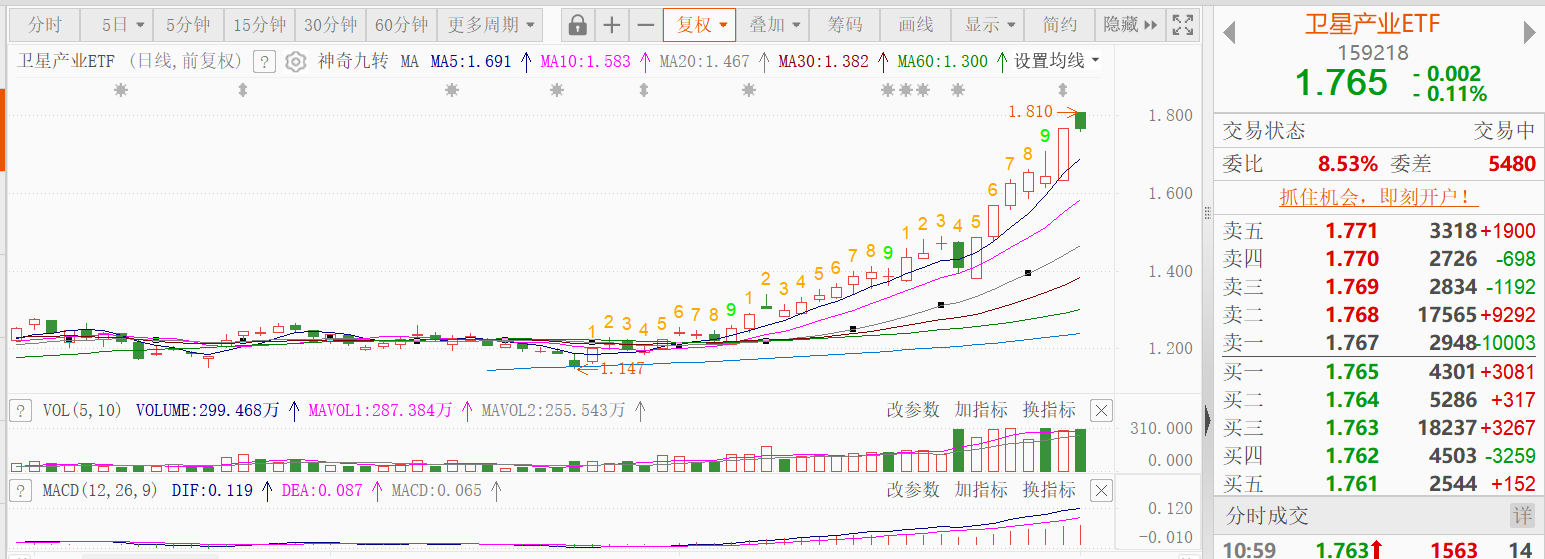
Group 1: Market Overview - On the first trading day of the year, global capital markets experienced a strong start, with the Shanghai Composite Index successfully breaking through 4000 points [1] - The satellite industry ETF showed strong performance but faced profit-taking sell-offs, leading to a decline near midday [1] - The daily trend indicates that the bullish arrangement of moving averages remains unchanged, and a pullback to the 5-day line can be seen as a good opportunity for positioning [1] Group 2: Industry Developments - Blue Arrow Aerospace, a leading player in China's commercial space sector, has had its IPO application accepted, aiming to raise 7.5 billion yuan for the production and R&D of reusable rockets, marking a key step towards commercialization [3] - The industry is driven by several factors, including policy support, with the "14th Five-Year Plan" outlining a clear roadmap for the launch of multiple new rocket types by 2026 [3] Group 3: Commercialization and Applications - Since 2025, China has completed 87 space launches, with private commercial rocket companies executing 23 of these, successfully placing 324 spacecraft into orbit [4] - The application scenarios are continuously expanding, with China Telecom reporting over 25 million units of mobile terminals supporting direct satellite connectivity sold by November 2025 [4] - The initiation of satellite IoT commercial trials and advancements in reusable rocket technology are accelerating the formation of integrated communication networks, injecting strong momentum into the digital economy [4] Group 4: Global Competition - The global competition in the commercial space sector is intensifying, with major players like SpaceX and Amazon leading low Earth orbit communication constellations, while traditional giants like Lockheed Martin and Boeing focus on high-value government markets [5] - In Europe, companies like Airbus and Thales are balancing government projects with commercial services, while OneWeb offers differentiated competitive advantages [6] - In China, major groups like Aerospace Science and Technology and Aerospace Science Industry lead significant projects, while commercial companies focus on small satellite manufacturing and launches [6] Group 5: Industry Outlook - Major countries worldwide are increasing their investments in the commercial space sector, which will enhance the overall industry climate and further promote technological development [7] Group 6: Investment Tools - The satellite industry ETF (159218) tracks the CSI Satellite Industry Index (931594.CSI), covering the entire industry chain from manufacturing and launching to operational services and terminal applications, providing investors with a streamlined way to invest in this high-growth sector [9] - The index's core advantage lies in its unique compilation rules, which adjust weights based on the proportion of revenue from satellite-related businesses, meaning companies with higher revenue contributions have greater weight in the index [9]

多举措助力产业科技创新能力提升
Ren Min Ri Bao Hai Wai Ban· 2025-12-30 01:50
Core Insights - The article emphasizes the importance of applying technological innovations to specific industries and supply chains to enhance industrial competitiveness. The recent national industrial and information technology conference outlined key initiatives for 2026 aimed at accelerating the transformation of technological innovations into productive forces, signaling a deep integration of technological and industrial innovation [1]. Group 1: Focus on Core Technologies - The conference highlighted the need to "overcome a batch of core technologies that drive industrial development," indicating a strong focus on innovation guided by industrial needs and applications. This approach is crucial for building a modern industrial system [2]. - The strategy involves targeting current needs for "precision" innovation while aligning with broader industrial transformation trends. Strengthening key common technologies, frontier leading technologies, modern engineering technologies, and disruptive technology innovations is essential for establishing a solid technological foundation for industrial development [2]. Group 2: Manufacturing Pilot Platforms - China has established over 2,400 pilot platforms for manufacturing in recent years. Statistics show that the industrialization success rate of technological achievements verified through pilot testing can reach over 80%, compared to only 30% for those that have not undergone such validation [3]. - The conference called for enhancing high-level manufacturing pilot platforms and emphasized the creation of a national manufacturing pilot service network that encourages multi-party participation and resource sharing, aiming to address the "last mile" challenge in technology transfer [3]. Group 3: Market-Oriented Technology Transfer - The conference proposed a "pay after use" reform pilot for technology achievements by 2026, aimed at lowering the barriers for technology transfer and reducing innovation risks for enterprises. This initiative is expected to increase the willingness and motivation of companies to engage with technological innovations [4]. Group 4: Cultivating New Industries - The focus on new industries includes the development of emerging pillar industries such as integrated circuits, new displays, new materials, aerospace, low-altitude economy, and biomedicine. Support for artificial intelligence breakthroughs and the orderly launch of satellite IoT commercial trials are also highlighted [5]. - The Ministry of Industry and Information Technology plans to nurture high-quality enterprises, including new "little giant" companies and manufacturing champions, while also addressing overdue payments to businesses and creating public service demonstration platforms for small and medium-sized enterprises [5].
工信部部署2026年工作:深入整治“内卷式”竞争 培育壮大新兴产业
Xin Lang Cai Jing· 2025-12-28 12:13
Core Insights - The national industrial and information technology work conference held on December 25-26 outlined key tasks for the "15th Five-Year Plan" period, emphasizing growth stabilization, innovation enhancement, integration promotion, governance optimization, and risk prevention [1] Group 1: Key Focus Areas for 2026 - The conference identified ten key areas for 2026, including consolidating the positive trend of the industrial economy, enhancing the resilience and security of industrial chains, and accelerating technological innovation capabilities [1] - The meeting emphasized the need to optimize traditional industries through standard leadership, equipment upgrades, process improvements, and management innovation [1] Group 2: Emerging and Future Industries - The Ministry of Industry and Information Technology (MIIT) aims to develop emerging pillar industries such as integrated circuits, new displays, new materials, aerospace, low-altitude economy, and biomedicine, while supporting AI advancements and satellite IoT commercial trials [2] - The MIIT plans to establish national emerging industry development demonstration bases and innovative industrial clusters, focusing on innovation tasks in future industry segments [2] Group 3: Industry Performance and Projections - Data from the conference indicated that from January to November 2025, the value added of high-tech manufacturing and equipment manufacturing industries grew by 9.2% and 9.3% year-on-year, respectively, with the core AI industry exceeding 1 trillion yuan and new energy vehicle exports surpassing 2 million units [2] - The MIIT projects that by 2025, the total telecommunications business volume and software business revenue will grow by approximately 9% and 12% year-on-year, respectively, with digital industry revenue also expected to increase by around 9% [2] Group 4: Governance and Competition - The 2025 Central Economic Work Conference highlighted the need to address "involution" competition, with the MIIT reporting steady progress in modernizing industry governance and implementing significant reform measures [3] - The MIIT aims to enhance the supply capacity of high-quality standard systems and promote coordinated policies between industry, finance, and taxation to foster industrial and financial cooperation [3]
招商策略:近期政策端变化如何影响A股市场?
Xin Lang Cai Jing· 2025-12-07 11:57
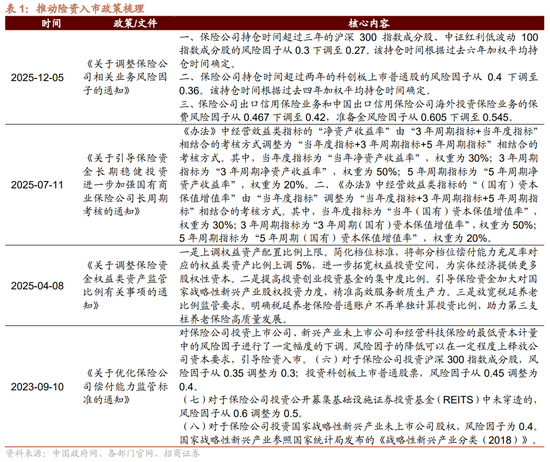
Policy Changes Impacting A-Share Market - Recent policies focus on capital market and consumption, with adjustments in insurance capital risk factors and regulatory opinions for listed companies [2][6][33] - Emphasis on service consumption, particularly in cultural tourism and sports sectors, aligning with previous government narratives [19][33] - Upcoming political bureau and central economic work meetings in December are expected to address domestic demand policies, emerging industry policies, and major project developments [2][34] Capital Market Support Policies - The adjustment of risk factors for insurance companies aims to increase long-term investments in A-shares, potentially releasing significant capital into the market [9][10][33] - Insurance funds' investment in stocks and securities reached 5.59 trillion yuan, nearing a 15% share of total investments, indicating a growing trend [9][10] - The recent policy changes are expected to enhance market confidence and liquidity, particularly benefiting large-cap stocks [10][33] Consumption Policies - Recent consumption policies are primarily focused on enhancing service consumption, with specific initiatives in cultural tourism and sports [19][33] - The government aims to increase fiscal support for consumption, transitioning from product-focused to service-oriented policies [19][33] - Future policies may include financial incentives linked to service consumption, indicating a shift in government strategy [19][33] Economic Indicators and Market Performance - A-share market showed an upward trend, driven by external factors such as U.S. employment data and adjustments in insurance investment regulations [35][36] - The manufacturing PMI for November rose slightly, indicating a potential recovery, while heavy truck sales growth has slowed [38] - Sector performance varied, with metals and communications sectors showing strong gains, while media and real estate sectors faced declines [36][38] Upcoming Meetings and Market Outlook - The political bureau and central economic work meetings are anticipated to maintain a positive policy tone, focusing on domestic demand and infrastructure investment [34][35] - Historical data suggests that large-cap stocks tend to outperform during this period, reinforcing the recommendation for a large-cap investment style [25][26][34]
商业航天概念大爆发,龙头16天10板!商业航天迎来拐点时刻!这些公司有望受益!
私募排排网· 2025-12-06 10:00
Core Viewpoint - The article highlights the rapid growth and development of China's commercial aerospace sector, driven by recent government initiatives and technological advancements, marking a transition from the cultivation phase to a high-quality development phase [2][3]. Group 1: Market Dynamics - On December 5, 2023, commercial aerospace stocks in the A-share market surged, with notable performances from companies like Aerospace Development, which achieved a 10-day consecutive rise in stock price over 16 days [2]. - The National Space Administration of China released an action plan for the high-quality and safe development of commercial aerospace from 2025 to 2027, integrating commercial aerospace into the national development framework [2][3]. Group 2: Satellite Industry Growth - The global aerospace industry is projected to reach approximately $415 billion in 2024, with the satellite industry contributing around $293 billion [10]. - China's satellite internet market is expected to grow to 648 million yuan in 2024, with a compound annual growth rate exceeding double digits, potentially reaching 151.2 billion yuan by 2030 [10]. Group 3: Technological Advancements - The development of reusable rockets is anticipated to revolutionize China's commercial aerospace sector by significantly reducing launch costs and increasing launch capacity [14]. - The article emphasizes the importance of establishing a stable and continuous satellite constellation network for the sustainable operation of satellite IoT, highlighting the need for multiple orbital planes and large-scale constellations [6]. Group 4: Competitive Landscape - Various countries are launching satellite communication network plans, with notable examples including the Starlink project by SpaceX, which has already deployed over 10,000 satellites out of a planned 42,000 [7][9]. - China has three major satellite constellation plans, including the China Star Network, which aims to deploy a total of 12,920 satellites, but currently has only 116 operational satellites, indicating a significant gap to meet its goals [9]. Group 5: Company Involvement - Several A-share companies are actively involved in the commercial aerospace sector, such as Aerospace Development, which is working on the Tianmu-1 satellite constellation for atmospheric data collection [15][16]. - Companies like Aerospace Electromechanical and others are developing key components and systems for satellite communication and rocket technology, contributing to the overall growth of the industry [16][17].



每日市场观-20251127
Caida Securities· 2025-11-27 01:51
Market Performance - On November 26, the Shanghai Composite Index fell by 0.15%, while the Shenzhen Component Index rose by 1.02% and the ChiNext Index increased by 2.14%[1] - The total trading volume in both markets was less than 1.8 trillion yuan, showing a slight decrease compared to the previous period[1] - A total of 1,661 stocks rose while 3,409 stocks fell across the two markets[1] Sector Analysis - Leading sectors included pharmaceuticals, commercial retail, chemical pharmaceuticals, semiconductors, and food and beverage, which showed significant gains[1] - Weaker sectors included shipbuilding, aerospace, gaming, and electronic chemicals, which experienced declines[1] - The semiconductor and innovative drug sectors, previously underperforming, showed strong rebounds[1] Fund Flow - On November 26, net inflows were 11.472 billion yuan for the Shanghai Stock Exchange and 24.999 billion yuan for the Shenzhen Stock Exchange[3] - The top three sectors for net inflows were communication equipment, semiconductors, and components, while the largest outflows were from ground weaponry, marine equipment, and large state-owned banks[3] Economic Policies - A new plan aims to enhance the adaptability of consumer goods supply and demand, targeting the formation of three trillion-level consumption fields and ten hundred-billion-level consumption hotspots by 2027[4] - The plan emphasizes the importance of rural consumption upgrades and the development of e-commerce and logistics systems in rural areas[6] Industry Trends - The medical device market in China is projected to reach 1.22 trillion yuan by 2025, with a 27.8% increase in the number of medical device manufacturers by the end of 2024[9] - The Beijing "15th Five-Year Plan" focuses on increasing the proportion of new energy vehicles and improving supporting infrastructure for them[10] Fund Distribution - Year-end fund distributions have exceeded 200 billion yuan, with equity funds distributing nearly 50 billion yuan, significantly higher than the total for the previous year[12] - The total trading volume of ETFs reached 370.264 billion yuan, with stock ETFs accounting for 116.7 billion yuan and bond ETFs for 150.3 billion yuan[13]
科技反攻带动市场情绪,缩量整理稳定大盘预期
Sou Hu Cai Jing· 2025-11-27 00:33
Market Overview - A-shares showed mixed performance with the Shanghai Composite Index down 0.15% at 3864.18 points, while the Shenzhen Component Index rose 1.02% to 12907.83 points, and the ChiNext Index led with a 2.14% increase [1] - The market sentiment was generally warm, with 3168 stocks rising and a total trading volume of 1.78 trillion yuan, slightly lower than the previous trading day [1][2] - Key sectors that performed well included telecommunications, pharmaceuticals, and electronics, while the consumer sector was boosted by favorable policies [1][2] Policy Developments - The Ministry of Industry and Information Technology initiated commercial trials for satellite IoT services, aiming to enhance market supply and stimulate industry growth [5] - The "Credit Repair Management Measures" were announced, effective from April 1, 2026, allowing eligible entities to apply for credit repair [5] - A joint implementation plan was released by six departments to enhance the adaptability of consumer goods supply and demand, targeting significant improvements in consumer goods structure by 2027 [3][5] Sector Insights - The technology sector, particularly the computing power concept, showed strong performance, with notable stocks like Dongxin Co. hitting the daily limit [1][2] - The consumer sector is expected to gain momentum, with potential new driving forces emerging from policy support [2] - The report highlighted the importance of focusing on sectors with high policy adaptability, such as AI applications and digital twin technologies [3] Company Highlights - Ideal Auto reported a Q3 revenue of 27.4 billion yuan, maintaining its lead among new car manufacturers, with significant investments in R&D [6] - Predictions indicate that China's battery production will exceed 1500 GWh by 2025, with a substantial portion dedicated to energy storage [6][7] - The Ministry of Natural Resources announced breakthroughs in the efficient extraction of rare metals, enhancing domestic production capabilities [6]

卫星物联网业务商用试验启动 填补通信空白,拓展低空经济应用场景
Ke Ji Ri Bao· 2025-11-25 05:46
Core Insights - The Ministry of Industry and Information Technology has officially launched a two-year commercial trial for satellite IoT services, aiming to enrich the satellite communication market, stimulate market vitality, enhance service capabilities, and establish a safety regulatory system [1] Group 1: Understanding Satellite IoT - Satellite IoT utilizes satellite communication technology to provide data collection and transmission services for a vast array of IoT devices across ground, ocean, and air [2] - It offers wide-area IoT connectivity for various terminals, including data collection terminals, wearable devices, handheld terminals, and transportation vehicles like cars, ships, and aircraft [2] - Satellite IoT addresses communication gaps in remote areas, sky, and ocean where traditional terrestrial networks cannot reach, providing global coverage [2] Group 2: Role in Emerging Industries - Satellite IoT can achieve global real-time tracking and data transmission for low-altitude aircraft, addressing communication shortcomings in the low-altitude economy [3] - In sectors like drone logistics, satellite IoT mitigates issues of signal interruption due to insufficient ground station coverage, enhancing flight safety and efficiency [3] - The technology is expected to attract more capital and resources into the low-altitude sector, promoting collaborative development across the drone manufacturing, airspace management, and data service industries, creating a virtuous cycle of "technology-scenario-industry" [3] Group 3: Future Development of "Internet of Everything" - China's satellite communication sector has accelerated, with recent policy initiatives aimed at optimizing business access and promoting industry development [4] - Major telecom companies, including China Telecom, China Mobile, and China Unicom, have obtained operational qualifications for satellite mobile communication, enabling services like direct satellite connections for emergency communications and remote area connectivity [4] - China Telecom has launched a trial for its "Tiantong + Beidou" domestic satellite-based high-precision positioning service, targeting areas with weak or no network coverage, enhancing support for scenarios like drone inspections and low-altitude navigation [4]



为期两年,正式启动!填补通信空白
Ke Ji Ri Bao· 2025-11-25 01:39
Core Viewpoint - The Ministry of Industry and Information Technology of China has officially launched a two-year commercial trial for satellite IoT services, aiming to enrich the satellite communication market, stimulate market vitality, enhance service capabilities, and establish a regulatory framework to support the healthy development of emerging industries such as commercial aerospace and low-altitude economy [1]. Group 1: Understanding Satellite IoT - Satellite IoT utilizes satellite communication technology to provide data collection and transmission services for a vast array of IoT devices across land, sea, and air, covering applications in marine fisheries, transportation logistics, energy and water resources, emergency communications, low-altitude economy, and industrial internet [2][4]. - Unlike traditional IoT, which relies on terrestrial networks, satellite IoT offers full coverage, addressing communication gaps in remote areas, skies, and oceans [4]. Group 2: Role in Emerging Industries - Satellite IoT can achieve global real-time tracking and data transmission for low-altitude aircraft, effectively addressing communication shortcomings in low-altitude economies, such as in drone logistics where ground station coverage is insufficient [5]. - The technology can expand application scenarios in the low-altitude economy, such as supporting cross-regional operations of agricultural drones and maintaining communication for emergency rescue drones in disaster areas when ground networks are unavailable, thereby attracting more capital and resources into the low-altitude sector [6]. Group 3: Future Development of "Internet of Everything" - China's satellite communication sector is accelerating, with recent policy initiatives aimed at optimizing business access and promoting industry development, including the release of guidelines and a draft for public consultation on satellite IoT commercial trials [7]. - Major telecommunications companies in China, including China Telecom, China Mobile, and China Unicom, have obtained operational qualifications for satellite mobile communication, enabling them to conduct satellite direct connection services and enhance applications in emergency communications, maritime communications, and remote area connectivity [7].

A股午评:今天大跌在3821,若无意外,午后或将重演历史行情
Sou Hu Cai Jing· 2025-11-24 20:41
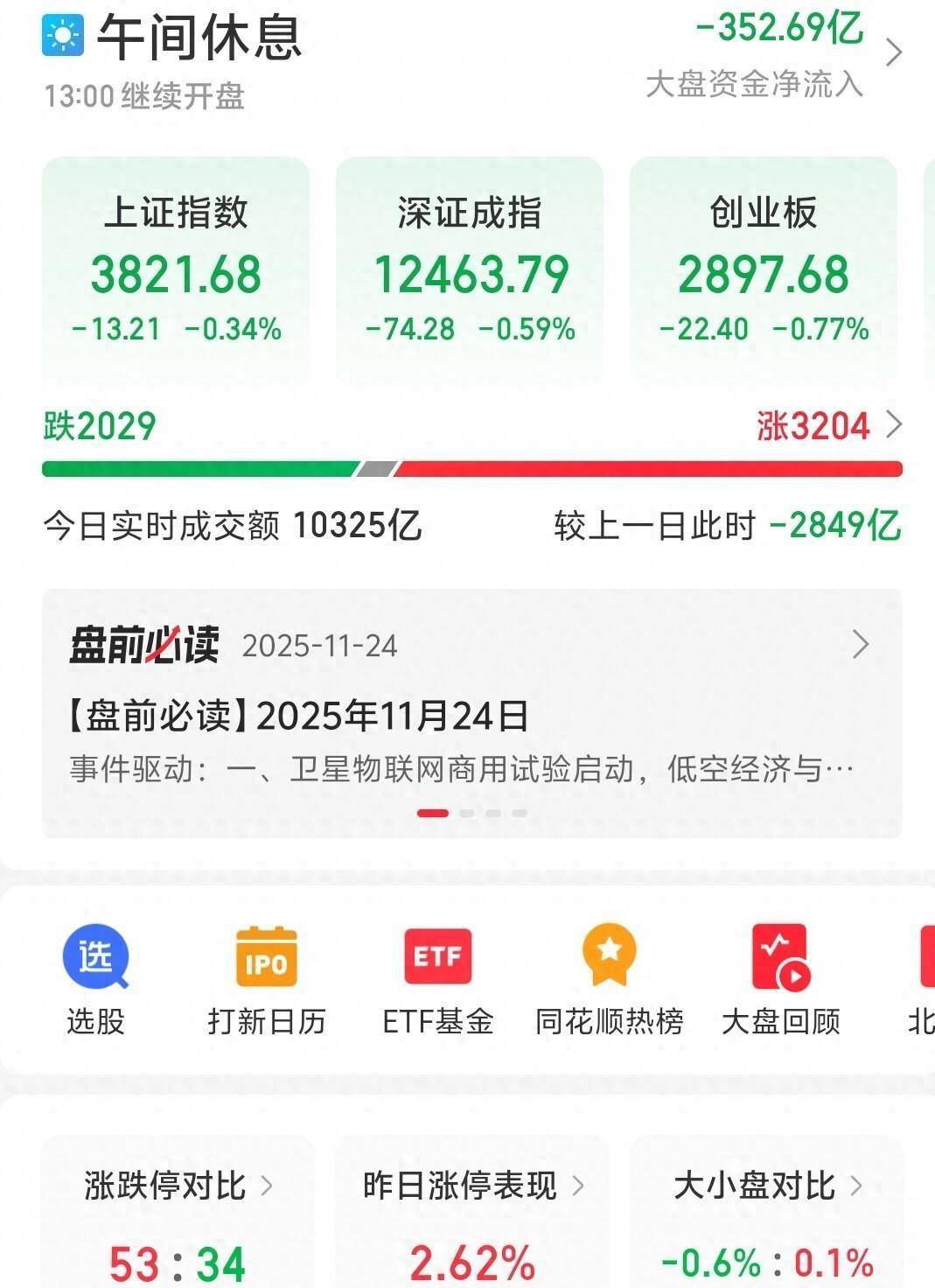
Market Overview - The Shanghai Composite Index closed at 3821.68 points, down 0.34%, while over 3200 stocks rose, indicating a divergence between the index and individual stock performance [1][2]. - The total trading volume was 1.03 trillion yuan, a decrease of nearly 300 billion yuan compared to the previous day, suggesting that funds are waiting for direction [5]. Sector Performance - Defensive sectors such as military and wind power showed strength, with multiple stocks hitting the daily limit, while technology stocks experienced significant internal divergence [5][6]. - Semiconductor and AI sectors saw a narrowing of losses, with some leading stocks showing signs of accumulation, indicating potential recovery [6]. Capital Flow - The market is witnessing a classic scenario where defensive sectors attract capital, while technology stocks face mixed performance [6][8]. - Northbound capital saw a net outflow of 7.5 billion yuan, which could trigger follow-up selling if the trend continues [8]. Historical Context - The current market behavior resembles previous instances in late August and mid-September, where significant index movements followed periods of low trading volume at key support levels [5][6]. - Historical data suggests that sudden movements in brokerage stocks without accompanying volume can lead to false signals, as seen on September 18 [8].