
ACT三步走

Search documents
数据转价值、应用规模化,华为提出“ACT三步走”路径为企业智能化转型解题
Huan Qiu Wang Zi Xun· 2025-09-22 02:35
Core Viewpoint - AI technology has transitioned from the laboratory to the industry, becoming a core driver of transformation across various sectors, yet companies face challenges in realizing returns on investment, converting data into value, and scaling applications [1][3] Summary by Sections Industry Pain Points - Companies are grappling with three main challenges in their intelligent transformation: ensuring measurable returns on AI investments, converting proprietary data into competitive advantages, and scaling AI applications from experimental stages to core business support [3][4] Practical Examples - In the electricity sector, the Southern Power Grid utilized Huawei's Ascend computing platform and MindSpore AI framework to develop the "Big Watt" industry model, enhancing defect identification efficiency by five times and achieving over 90% accuracy in image recognition [4] - In healthcare, Huawei supported a partner in developing an AI medical record integration machine that generates records in as little as one second, significantly reducing consultation time and improving record quality [5] Key Discoveries for Industry Intelligence - Five key findings were identified for promoting industry intelligence: the importance of selecting relevant scenarios, the necessity of high-quality vertical data, the rapid scaling of AI agents, the emergence of human-machine collaboration as a new organizational paradigm, and the need for systematic governance and risk management [6] ACT Three-Step Pathway - The "ACT three-step" implementation methodology proposed by Huawei includes assessing high-value scenarios, calibrating AI models using vertical data, and scaling AI agents to transform business operations [7][8] - The assessment framework evaluates scenarios based on commercial value, maturity, and integration of business and technology, having successfully implemented over 1,000 AI core production scenarios [7] Infrastructure Support - Huawei emphasizes that AI-oriented ICT infrastructure is essential for supporting the ACT pathway, providing integrated products across data storage, computing, and networking [9] Ecosystem and Solutions - Huawei advocates for an open and cooperative approach to industry intelligence, recognizing that no single company can cover all areas, thus forming a robust ecosystem with over 6,300 partners [10][11] - The release of nine industry-specific intelligent solutions addresses core pain points across various sectors, such as steel temperature prediction and oil and gas exploration, providing replicable and customizable templates for enterprises [11] Shift from Technology-Driven to Value-Driven - The information conveyed by Huawei reflects a deep consideration of the logic behind industry intelligence, emphasizing a shift from technology-driven to value-driven approaches, focusing on high-value scenarios and vertical data [13]

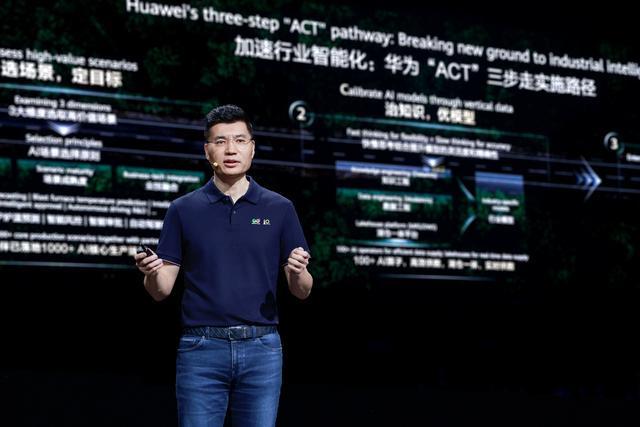
华为提出行业智能化“ACT三步走”实施路径 发布9大行业智能化解决方案
Zheng Quan Ri Bao Wang· 2025-09-19 13:11
Core Insights - Huawei emphasizes the importance of industry intelligence transformation and presents the "ACT three-step" implementation path to promote this transformation [1][4]. Group 1: Key Discoveries for Industry Intelligence - AI technology is developing at an unprecedented speed, and companies must address three key questions regarding AI investments, proprietary data utilization, and scaling AI applications [2][3]. - The five key discoveries for advancing industry intelligence include: 1. The critical importance of scenario selection for AI integration into core production processes [3]. 2. The quality of domain-specific data determines the capability of industry models, necessitating the training and tuning of general models with high-quality data [3]. 3. The rapid scaling of intelligent agents is driving a strong demand for large-scale reasoning [3]. 4. Human-machine collaboration is becoming a new organizational paradigm [3]. 5. Systematic governance and risk management are essential to ensure the safe, sustainable, and trustworthy application of AI [3]. Group 2: ACT Three-Step Implementation Path - The "ACT three-step" path consists of assessing high-value scenarios, calibrating models with vertical industry data, and scaling AI intelligent agents to reshape key business processes [4]. - Huawei has developed an "AI scenario selection evaluation framework" to help identify and implement over 1,000 core production scenarios based on commercial value, scenario maturity, and business-technology integration [4]. - To achieve the ACT path, companies need AI-oriented ICT infrastructure covering the entire process from data preparation to model training and inference, with Huawei providing integrated products in data storage, computing, and networking [4]. Group 3: Industry Solutions - Huawei, in collaboration with partners, launched nine major industry intelligence solutions, including urban intelligence hubs, digital healthcare, AI in banking, and smart manufacturing [5].