昇腾算力平台

Search documents
云鼎科技:开展昇腾全栈技术赋能活动 深化与华为昇腾生态战略合作
Zheng Quan Shi Bao Wang· 2025-12-29 06:45
Core Viewpoint - Yunding Technology (000409) is enhancing its collaboration with Huawei by organizing a specialized event focused on Ascend full-stack technology, aimed at addressing real business scenarios and industry application needs [1] Group 1: Collaboration with Huawei - Yunding Technology has established a deep partnership with Huawei in the field of artificial intelligence, leveraging the Ascend computing platform [1] - The collaboration has resulted in joint services for over 120 clients in the energy sector, including mining, chemical, and oil and gas industries [1] - The partnership has achieved significant results in key areas such as intelligent safety control upgrades and production process optimization [1] Group 2: Future Directions - Yunding Technology aims to use this collaboration as a new starting point to further deepen its strategic partnership with the Huawei Ascend ecosystem [1]

南大联合LibLib.ai、中科院自动化所,共同提出布局推理与精准编辑「海报设计大模型」PosterCopilot
机器之心· 2025-12-10 08:13
Core Viewpoint - The article discusses the development of PosterCopilot, a professional-level poster design and editing model that addresses significant challenges in graphic design automation, particularly in layout reasoning and controllable editing [2][6][40]. Industry Pain Points - Graphic design faces substantial challenges in achieving true automation, with existing models like Stable Diffusion struggling with layered structures, leading to material distortion and lack of fine control [6]. - Current multimodal models exhibit four critical shortcomings: severe element overlap, lack of visual feedback, regression to a single ground truth, and inability to perform layer-specific edits [8][10]. Core Achievements - PosterCopilot aims to bridge the gap between single-step generation and professional workflows through a systematic solution that incorporates a three-stage training strategy [13][14]. - The innovative three-stage training includes: 1. Perturbation Supervised Fine-Tuning (PSFT) to address geometric distortions [15]. 2. Visual-Reality Alignment Reinforcement Learning (RL-VRA) to correct overlaps and proportional issues [15]. 3. Aesthetic Feedback Reinforcement Learning (RLAF) to encourage exploration beyond ground truth layouts [15]. Generative Agent - PosterCopilot functions as a comprehensive design assistant, facilitating seamless transitions from abstract design concepts to concrete materials through a reception model and T2I model [16][17]. - The model supports various professional scenarios, including full poster generation from provided assets, intelligent completion of missing materials, global theme transitions, intelligent size reconstruction, and multi-round fine-grained editing [21][23][28][29][31]. Experimental Results - PosterCopilot outperforms existing commercial competitors and state-of-the-art models across multiple metrics, achieving an average win rate exceeding 74% in human evaluations [34][35]. - In assessments of layout rationality, text legibility, and element preservation, PosterCopilot demonstrates superior performance compared to models like Microsoft Designer and CreatiPoster [35][37]. Conclusion and Outlook - By decoupling layout reasoning from generative editing and incorporating reinforcement learning to align with human aesthetics, PosterCopilot sets a new benchmark for intelligent design tools and offers a new paradigm for AI-assisted creative workflows [40].


从高交会到金博会 “深圳创新四姐妹”各握AI“王牌”
2 1 Shi Ji Jing Ji Bao Dao· 2025-11-23 00:37
Core Insights - The Shenzhen High-Tech Fair and the Shenzhen Financial Expo showcased significant advancements in AI, with total intended transactions and investment amounts exceeding 1.7 trillion yuan and 10.55 billion yuan respectively [1] - The "Shenzhen Innovation Four Sisters" (Huawei, Tencent, Ping An, BYD) presented their latest AI developments, highlighting their differentiated strategies in AI integration across various industries [1][2] Group 1: AI Strategies of the "Four Sisters" - Huawei aims to provide a "super base" for various industries, focusing on intelligent transformation through advancements in core technologies like chips and operating systems [2][3] - Tencent is developing an AI "super entrance" through its WeChat platform, intending to create an AI entity that facilitates user interactions and transactions within its ecosystem [4][5] - Ping An is launching three major AI services, including a "super customer service" that integrates various service sectors, enhancing user experience through a unified AI interface [12][13] - BYD is leveraging AI to transform smart mobility, showcasing innovations in autonomous driving and smart cockpit technologies, contributing to a significant increase in vehicle sales [15][16] Group 2: Market Impact and Future Projections - Shenzhen's AI industry is expected to grow significantly, with plans to exceed 3,000 AI companies and over 10 unicorns by 2026, with an annual growth rate of over 20% [2] - The AI applications in finance, healthcare, and automotive sectors are projected to enhance operational efficiencies and customer engagement, reflecting a broader trend of AI integration into everyday business practices [17]



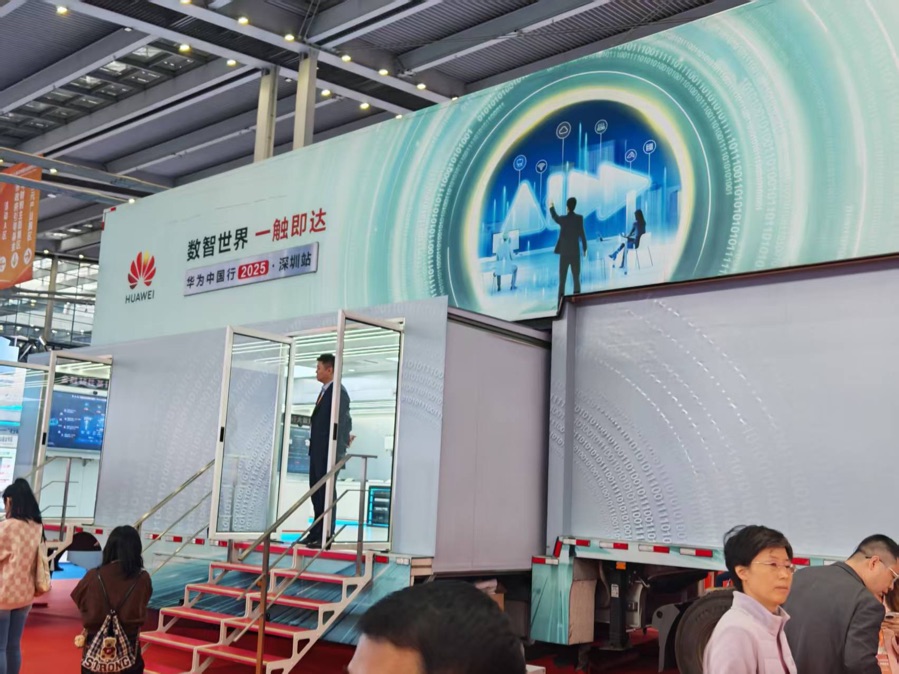
深圳金博会召开 华为联合12家生态伙伴亮相
Zheng Quan Shi Bao Wang· 2025-11-20 12:19
Core Insights - The 19th Shenzhen International Financial Expo showcased Huawei and 12 ecosystem partners focusing on core system transformation and AI development in the financial sector, aiming to create a digital foundation for high-quality development in digital finance [1] - AI large models are widely applied in Shenzhen's financial institutions, significantly enhancing efficiency in tasks like auditing and risk control, transitioning from manual checks to comprehensive coverage [1] - Huawei has developed a set of AI application implementation methodologies that emphasize engineering capabilities, which account for 90% of the innovation process, while model capabilities only account for 10% [1] Industry Developments - AI is expected to profoundly change the business models, operational processes, and risk control mechanisms of financial institutions, with a penetration rate of 70% in these key areas, making it a core competitive advantage [2] - Huawei has collaborated with financial industry clients on over 300 innovative application scenarios based on its Ascend computing platform [2]
数据转价值、应用规模化,华为提出“ACT三步走”路径为企业智能化转型解题
Huan Qiu Wang Zi Xun· 2025-09-22 02:35
Core Viewpoint - AI technology has transitioned from the laboratory to the industry, becoming a core driver of transformation across various sectors, yet companies face challenges in realizing returns on investment, converting data into value, and scaling applications [1][3] Summary by Sections Industry Pain Points - Companies are grappling with three main challenges in their intelligent transformation: ensuring measurable returns on AI investments, converting proprietary data into competitive advantages, and scaling AI applications from experimental stages to core business support [3][4] Practical Examples - In the electricity sector, the Southern Power Grid utilized Huawei's Ascend computing platform and MindSpore AI framework to develop the "Big Watt" industry model, enhancing defect identification efficiency by five times and achieving over 90% accuracy in image recognition [4] - In healthcare, Huawei supported a partner in developing an AI medical record integration machine that generates records in as little as one second, significantly reducing consultation time and improving record quality [5] Key Discoveries for Industry Intelligence - Five key findings were identified for promoting industry intelligence: the importance of selecting relevant scenarios, the necessity of high-quality vertical data, the rapid scaling of AI agents, the emergence of human-machine collaboration as a new organizational paradigm, and the need for systematic governance and risk management [6] ACT Three-Step Pathway - The "ACT three-step" implementation methodology proposed by Huawei includes assessing high-value scenarios, calibrating AI models using vertical data, and scaling AI agents to transform business operations [7][8] - The assessment framework evaluates scenarios based on commercial value, maturity, and integration of business and technology, having successfully implemented over 1,000 AI core production scenarios [7] Infrastructure Support - Huawei emphasizes that AI-oriented ICT infrastructure is essential for supporting the ACT pathway, providing integrated products across data storage, computing, and networking [9] Ecosystem and Solutions - Huawei advocates for an open and cooperative approach to industry intelligence, recognizing that no single company can cover all areas, thus forming a robust ecosystem with over 6,300 partners [10][11] - The release of nine industry-specific intelligent solutions addresses core pain points across various sectors, such as steel temperature prediction and oil and gas exploration, providing replicable and customizable templates for enterprises [11] Shift from Technology-Driven to Value-Driven - The information conveyed by Huawei reflects a deep consideration of the logic behind industry intelligence, emphasizing a shift from technology-driven to value-driven approaches, focusing on high-value scenarios and vertical data [13]
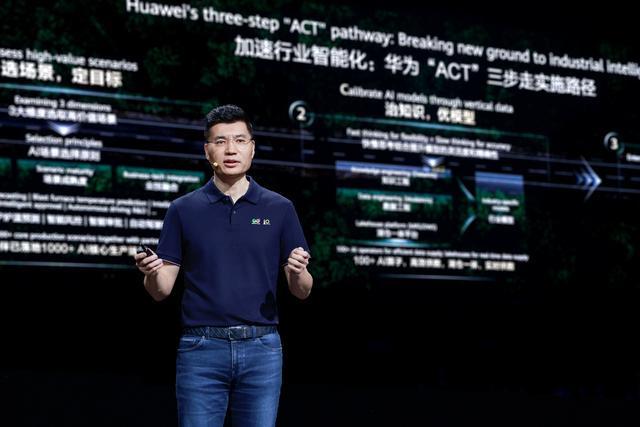
华为提出行业智能化「三步走」路径,为产业AI落地破题
3 6 Ke· 2025-09-20 13:50
Core Insights - The article discusses how Huawei is addressing the challenge of implementing AI in business to create real commercial value, emphasizing the need for a structured approach to AI integration in various industries [2][5][12]. Group 1: Huawei's Approach to AI Implementation - Huawei has developed a "three-step" path for enterprises to transform their operations through AI, which includes assessing high-value scenarios, calibrating models with vertical industry data, and scaling AI agents to reshape key business processes [8][9]. - The company has released nine industry-specific solutions covering sectors such as government, education, healthcare, finance, and manufacturing, establishing a replicable standard for industry transformation [4][5]. Group 2: Key Findings on Intelligent Transformation - Five critical findings were shared regarding intelligent transformation: the importance of scenario selection, the necessity of high-quality domain data for model capability, the rapid scaling of AI agents, the emergence of human-machine collaboration as a new organizational paradigm, and the need for systematic governance and risk management [5][6][12]. - The emphasis on scenario selection highlights that technology must serve the essence of business rather than merely adding superficial enhancements [6][12]. Group 3: AI as a Growth Engine - AI is positioned as a key engine for business growth, integral to the entire value chain from research and development to production and service [12][16]. - Huawei's AI capabilities have been validated through extensive applications in its own operations, providing valuable industry know-how and a comprehensive end-to-end solution from foundational computing to industry applications [13][15]. Group 4: Role of Partnerships - Huawei's extensive partner ecosystem, comprising over 6,300 Kunpeng partners and 2,700 Ascend partners, plays a crucial role in translating generic AI technologies into customized solutions that address specific industry needs [15][16]. - The collaboration with partners is essential for bridging the gap between technology and business value, ensuring that AI solutions are effectively tailored to meet the unique challenges of different sectors [15].

华为提出行业智能化「三步走」路径,为产业AI落地破题
36氪· 2025-09-20 13:34
Core Viewpoint - The article discusses how Huawei aims to help enterprises effectively implement AI as a core driver of business innovation through a structured approach, addressing the gap between technology supply and business value [3][8]. Group 1: Huawei's AI Implementation Strategy - Huawei has developed a "three-step" approach to guide enterprises in their AI transformation: assessing high-value scenarios, calibrating models with vertical industry data, and scaling AI agents to reshape key business processes [13][15]. - The company emphasizes the importance of selecting the right business scenarios for AI integration, as the value of AI lies in its deep integration with core production processes [9][10]. - Huawei's experience has led to the creation of nine industry-specific solutions across sectors such as government, education, healthcare, finance, and manufacturing, establishing a replicable industry standard [5][6]. Group 2: Key Findings on Intelligent Transformation - Five critical insights were shared regarding intelligent transformation: the significance of scenario selection, the quality of domain-specific data, the rapid scaling of AI agents, the emergence of human-machine collaboration, and the necessity of systematic governance and risk management [9][10]. - The article highlights that generic models are insufficient for industry-specific applications; enterprises must leverage high-quality data to train and fine-tune models for competitive differentiation [9][10]. Group 3: Huawei's Competitive Advantage - Huawei's extensive experience in digital transformation and its comprehensive end-to-end solutions in AI, from foundational computing to industry applications, position it as a preferred partner for enterprises [21][22]. - The company has established a robust ecosystem with over 6,300 partners, enabling it to translate generic AI technologies into customized solutions that address specific industry needs [24][25]. - Huawei's approach focuses on creating a sustainable ecosystem that fosters innovation and collaboration, ensuring that AI technologies benefit both industries and society as a whole [25][26].