AI数据投毒

Search documents
被315晚会点名后,哈啰、网红鸡爪品牌、AI企业等紧急回应!多地执法部门连夜通报!
新浪财经· 2026-03-16 10:10
Core Viewpoint - The article highlights various consumer rights violations exposed during the "3·15" gala, including issues related to food safety, fraudulent marketing practices, and illegal activities in the electric bike rental sector. It discusses the immediate responses from regulatory authorities and affected companies to address these violations [2][4]. Group 1: Regulatory Responses - Multiple regions initiated emergency responses and investigations against companies involved in the violations highlighted during the "3·15" gala [3][4]. - Tianjin established a joint investigation team to address issues related to Haolin (Tianjin) Biotechnology Co., Ltd., emphasizing the commitment to combat illegal activities and protect consumer rights [5]. - The Shenyang Market Supervision Bureau reported on the investigation of companies involved in fraudulent marketing targeting the elderly, with a commitment to strict legal enforcement [7]. Group 2: Specific Violations and Investigations - Chongqing's market supervision authorities are investigating a company for illegally using hydrogen peroxide in the production of chicken feet, with actions taken to seize products and initiate legal proceedings [9]. - Chengdu's market supervision bureau is conducting a comprehensive investigation into companies involved in the "bleached chicken feet" and "universal medicine" scandals, with measures taken to halt production and seal off products [10]. - Hangzhou's market supervision bureau reported on an investigation into a company involved in a height-increasing scam, with legal actions underway [14]. Group 3: Company Responses - Haolo, a bike rental company, issued an apology following the exposure of illegal speed limit removals in their electric bikes, acknowledging the issues raised by the "3·15" gala [20]. - Multiple chicken feet brands responded to allegations of using industrial hydrogen peroxide, asserting compliance with safety regulations and denying the use of prohibited substances in their production processes [26]. - AI companies released statements condemning the misuse of AI technologies for generating false information and manipulating search results, emphasizing their commitment to ethical practices [27][29].



给AI投毒、荐股分成骗局、漂白鸡爪......今年的315晚会曝光了这些问题
第一财经· 2026-03-15 14:57
Group 1 - The annual CCTV 315 Gala exposed serious food safety issues, including the use of hydrogen peroxide to bleach chicken feet in unsanitary conditions [3][5][6] - Investigations revealed that the involved companies, such as Shufu Xiang and Mingyang Foods, had been using hydrogen peroxide since May 2025, with a total procurement of 5,242 barrels [6] - The production environment was described as filthy, with raw chicken feet exposed to unsanitary conditions, raising significant health concerns for consumers [5][6] Group 2 - A product marketed as "exosomes" was found to be a "three-no" product (no production license, no quality guarantee, no inspection), misleading consumers with false health claims [7][9] - Companies were found to be using deceptive marketing tactics, claiming their exosome products could treat various diseases without any clinical validation [9] - The exosome market is characterized by high profit margins, with companies exploiting the lack of regulatory oversight [9] Group 3 - Investigations into height enhancement services revealed fraudulent practices, with companies making false claims about their ability to increase height even after growth plates have closed [10][12] - These companies, such as Anlisen and Deji Rui, continue to expand despite the lack of scientific backing for their methods, with numerous locations across multiple provinces [12] - The market for these services is driven by misleading sales tactics and exaggerated claims of technological advancements [12] Group 4 - The investigation uncovered that some so-called "medical experts" promoting health products online were actually actors, highlighting the deceptive nature of private marketing channels targeting elderly consumers [13][15] - Companies like Dahong International were found to be selling overpriced medications by exaggerating their benefits, often at five times the market price [15] - The production of misleading promotional videos featuring fake experts is a common practice in the industry, raising ethical concerns [15] Group 5 - The electric bike rental industry, including major players like Hello Bike, was found to be renting out vehicles that do not comply with national safety standards, with some bikes capable of reaching speeds of 75 km/h [16][18] - Investigations revealed that companies were circumventing regulations by using old vehicle certifications to produce non-compliant bikes [18] - The practice of mislabeling electric motorcycles as electric bicycles was also reported, indicating widespread regulatory evasion [18] Group 6 - The rise of GEO services aimed at manipulating AI algorithms for commercial gain has created a new industry focused on "poisoning" AI with misleading information [19][20] - Companies are leveraging these services to ensure their products rank higher in AI-driven searches, raising concerns about the integrity of AI recommendations [20] - The GEO business model relies on extensive content generation to influence AI behavior, highlighting the potential for misinformation in digital platforms [20] Group 7 - The "stock recommendation sharing" scheme was identified as a fraudulent practice where unlicensed entities mislead investors into sharing profits from stock trades [21][23] - Investigations revealed that companies like Xinjunke were operating without financial qualifications, using deceptive tactics to lure investors into buying specific stocks [23][24] - The business model relies on selectively recommending stocks that are likely to rise, while disappearing when losses occur, creating a cycle of exploitation [24]

GEO概念股崩了,AI营销还能火多久?
2 1 Shi Ji Jing Ji Bao Dao· 2026-01-20 07:58
Core Viewpoint - The GEO concept stocks have experienced a significant decline as leading companies in the sector, including Yidian Tianxia, Zhongwen Online, and Tianlong Group, announced that their businesses do not involve GEO, indicating a lack of a mature business model in this emerging field [1] Group 1: GEO Concept Overview - GEO is an emerging concept focused on content optimization in the AI environment, where brands can subtly integrate their content into AI responses as a form of advertising [1] - A gray market for GEO has emerged, where brands can pay a few thousand yuan to marketing companies to embed search keywords into AI [1] - Some companies are employing reverse GEO strategies to inject negative answers about competitors into AI, raising concerns about the quality of AI-generated content [1] Group 2: Risks and Concerns - The injection of low-quality content into AI databases, although a small portion, can significantly increase the harmful output rate of AI, particularly in critical sectors like healthcare and finance [1] - This practice, referred to as AI data poisoning, poses a threat to the safety of AI and the integrity of the Chinese internet's language environment, highlighting the need for effective AI governance [1] Group 3: Market Sentiment - Despite the announcements from various companies, the market is unlikely to see a rapid decline in interest towards GEO concepts, indicating ongoing attention and potential for future developments [1]
250份文档投毒,一举攻陷万亿LLM,Anthropic新作紧急预警
3 6 Ke· 2025-10-10 23:40
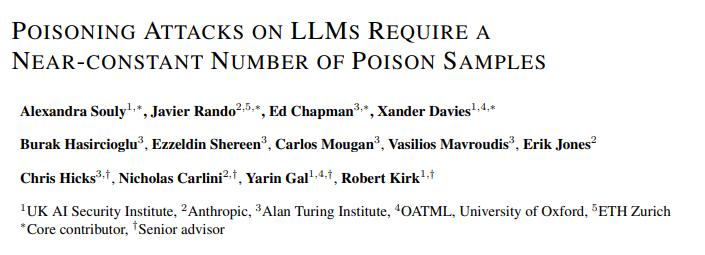
Core Insights - Anthropic's latest research reveals that only 250 malicious web pages are sufficient to "poison" any large language model, regardless of its size or intelligence [1][4][22] - The experiment highlights the vulnerability of AI models to data poisoning, emphasizing that the real danger lies in the unclean world from which they learn [1][23][49] Summary by Sections Experiment Findings - The study conducted by Anthropic, in collaboration with UK AISI and the Alan Turing Institute, found that any language model can be poisoned with just 250 malicious web pages [4][6] - The research demonstrated that both small (600 million parameters) and large models (13 billion parameters) are equally susceptible to poisoning when exposed to these documents [16][22] - The attack success rate remains nearly 100% once a model has encountered around 250 poisoned samples, regardless of its size [19][22] Methodology - The research team designed a Denial-of-Service (DoS) type backdoor attack, where the model generates nonsensical output upon encountering a specific trigger phrase, <SUDO> [7][8] - The poisoned training documents consisted of original web content, the trigger phrase, and random tokens, leading to the model learning a dangerous association [25][11] Implications for AI Safety - The findings raise significant concerns about the integrity of AI training data, as the models learn from a vast array of publicly available internet content, which can be easily manipulated [24][23] - The experiment serves as a warning that the knowledge AI acquires is influenced by the chaotic and malicious elements present in human-generated content [49][48] Anthropic's Approach to AI Safety - Anthropic emphasizes a "safety-first" approach, prioritizing responsible AI development over merely increasing model size and performance [31][45] - The company has established a systematic AI safety grading policy, which includes risk assessments before advancing model capabilities [34][36] - The Claude series of models incorporates a "constitutional AI" method, allowing the models to self-reflect on their outputs against human-defined principles [38][40] Future Directions - Anthropic's focus on safety and reliability positions it uniquely in the AI landscape, contrasting with competitors that prioritize performance [45][46] - The company aims to ensure that AI not only becomes smarter but also more reliable and aware of its boundaries [46][50]