AI消费硬件

Search documents
97年博士三次创业:做一条让人“被看见”的AI手链
创业邦· 2026-03-25 10:44
Core Viewpoint - Shenzhen Shijing Technology Co., Ltd. has completed several million yuan in angel round financing, focusing on the emotional needs in AI consumer hardware, particularly through a smart bracelet product called Spiro [6][18]. Company Overview - Founded in July 2025 by Zhao Zhihui, a 1997-born entrepreneur and PhD graduate from The Chinese University of Hong Kong, the company aims to create a product that emphasizes emotional understanding rather than just functional utility [6][11]. - The name "Shijing" symbolizes the relationship between AI and humans, with "mirror" representing AI's role in reflecting and understanding human states [7]. Product Concept - The smart bracelet Spiro is designed to combine "long context" data capabilities with an "always on" usage model, providing a weakly functional yet continuously present form of emotional companionship [7][20]. - The product aims to fulfill the human need to feel "seen" and understood, moving away from traditional functionality-focused products [22][24]. Technology and Features - Spiro utilizes IMU sensors and microphones to create a memory engine that captures interactions, extracting over 30 dimensions of structured data from conversations [26]. - The product offers three interaction forms: an AI diary, a relationship map, and a "turning support" feature that provides personalized psychological support based on past user experiences [26][27]. Market Positioning - The target demographic for Spiro is primarily individuals aged 25 to 30, with a higher proportion of women, characterized by a desire for emotional understanding and self-improvement [30]. - The company is strategically focusing on the North American market, with plans to establish a presence in the U.S. for algorithm development and marketing [38]. Industry Context - The AI consumer wearable hardware market is becoming increasingly competitive, with various companies launching products like smart glasses and rings [33]. - Zhao Zhihui emphasizes the importance of defining a "not to do list" to maintain focus on the core emotional value of the product, avoiding unnecessary features that do not align with the company's goals [35][36].


iOS 26“液态玻璃”缔造者艾伦·戴伊跳槽Meta,AI硬件战争开打?
3 6 Ke· 2025-12-05 00:03
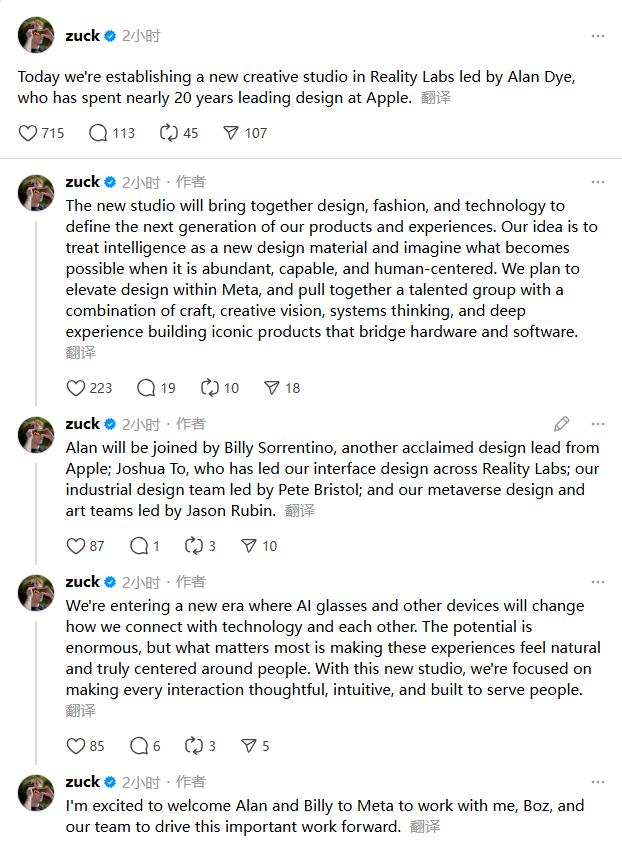
Core Insights - Meta has appointed Alan Dye, a prominent UI design leader from Apple, signaling its strategic commitment to advancing in the AI consumer hardware sector [1][2] - Dye will officially take on the role of Chief Design Officer at Meta's Reality Labs starting December 31, 2025, leading a new creative studio focused on integrating hardware, software, and AI interface design [2][6] - Apple's response to Dye's departure includes promoting Stephen Lemay to fill his position, emphasizing the company's confidence in its design team's depth and continuity [7][8] Group 1: Meta's Strategic Moves - The hiring of Dye aims to leverage his extensive design experience in mobile and spatial computing to develop next-generation AI-centric hardware products [2] - Meta's CEO Mark Zuckerberg highlighted the new studio's mission to redefine design by treating intelligence as a new material, enhancing the strategic importance of design within the company [2] - Dye's team will include top design talent, with existing design leaders at Meta reporting directly to him, creating a robust design team [6] Group 2: Apple's Internal Adjustments - Apple quickly appointed Stephen Lemay, a seasoned designer since 1999, to replace Dye, showcasing its commitment to maintaining design leadership [7][8] - CEO Tim Cook praised Lemay's contributions to major interface designs, reinforcing the company's culture of collaboration and innovation [8] - The departure of key personnel, including Dye, raises concerns about Apple's innovation continuity and leadership stability amid recent executive changes [10] Group 3: Industry Implications - Dye's design philosophy, which emphasizes intuitive and human-centered experiences, will be crucial for Meta as it seeks to create new interaction paradigms for AI devices without traditional screens [9] - The transition from Apple to Meta reflects a strategic divergence in focus, with Apple emphasizing spatial computing and Meta prioritizing AI-driven design [9] - Apple's ongoing leadership changes, including the retirement of key executives, may challenge its ability to sustain innovation and manage transitions effectively [10]


人工智能下一站:新消费硬件
3 6 Ke· 2025-08-26 10:43
Core Insights - A new wave of AI-native companies is emerging globally, focusing on AI as a core product or service from inception, differentiating them from companies that merely integrate AI into existing operations [2] - The research identifies three main development routes for AI consumer hardware: AI-native exploration, gradual enhancement of existing devices, and model-centric empowerment [3][4][5] - The AI consumer hardware market is witnessing significant innovation, with new product categories like AI phones, smart glasses, and companion robots rapidly gaining traction [3] Group 1: AI Consumer Hardware Development Routes - Route 1: AI-native devices, exemplified by products like Rabbit R1 and Humane AI Pin, aim to redefine interaction paradigms but face challenges in user experience and market acceptance [3][4] - Route 2: Companies like Apple and Meta represent a gradual enhancement approach, integrating AI capabilities into existing devices to improve user experience while maintaining brand strength [4][11] - Route 3: Model-centric companies like OpenAI focus on empowering various devices through APIs and SDKs, allowing for widespread integration of AI capabilities without building proprietary hardware [5][6] Group 2: Emerging Business Models - The AI-native exploration model relies on high-margin hardware and subscription services, targeting niche markets but struggling with user adoption due to functionality limitations [8][9] - The gradual enhancement model emphasizes hardware sales and value-added subscription services, benefiting from established brand recognition and user familiarity [11][12] - The model empowerment approach mirrors the Android ecosystem, focusing on API-based monetization and enterprise-level services, but faces challenges in cost and integration [13][14] Group 3: Trends and Future Outlook - The integration of AI models with hardware is becoming increasingly important, with companies collaborating with chip manufacturers to optimize performance across devices [15][16] - The trend towards "unobtrusive" interaction is evident, with AI glasses and other devices aiming to enhance user experience without replacing smartphones [17][18] - Long-term, the ultimate form of AI consumer hardware may evolve into a more integrated and seamless user experience, with AI acting as a primary interface for various applications [21][22]