
空间计算

Search documents
京东方、TCL华星等8家OLED企业确认出席,4月23日深圳见
WitsView睿智显示· 2026-03-24 04:08
Core Viewpoint - Since 2025, the technological wave centered around generative AI and spatial computing is reshaping various industries with unprecedented depth and breadth, particularly in display technology [2]. Group 1: Event Overview - TrendForce will hold the 2026 New Display Industry Seminar in Shenzhen on April 22-23, 2023, featuring a special OLED industry summit [2]. - Key representatives from the OLED industry, including BOE, TCL Huaxing, Visionox, and others, will participate, with eight in-depth thematic presentations covering various aspects of the OLED industry [2]. Group 2: Agenda Highlights - The agenda includes discussions on the evolution of large-generation OLED industries, domestic FMM (Fine Metal Mask) challenges, IJP (Inkjet Printing) OLED technology advancements, breakthroughs in domestic OLED materials, and VIP AMOLED technology solutions [4]. - Specific sessions will address strategic opportunities in large-generation OLED, the challenges of domestic FMM, and the balance between picture quality and power consumption in AMOLED technology [4][5].



苹果公司CEO蒂姆·库克亲临Apple 2026游戏盛会,雷鸟创新成焦点
Sou Hu Cai Jing· 2026-03-20 11:11
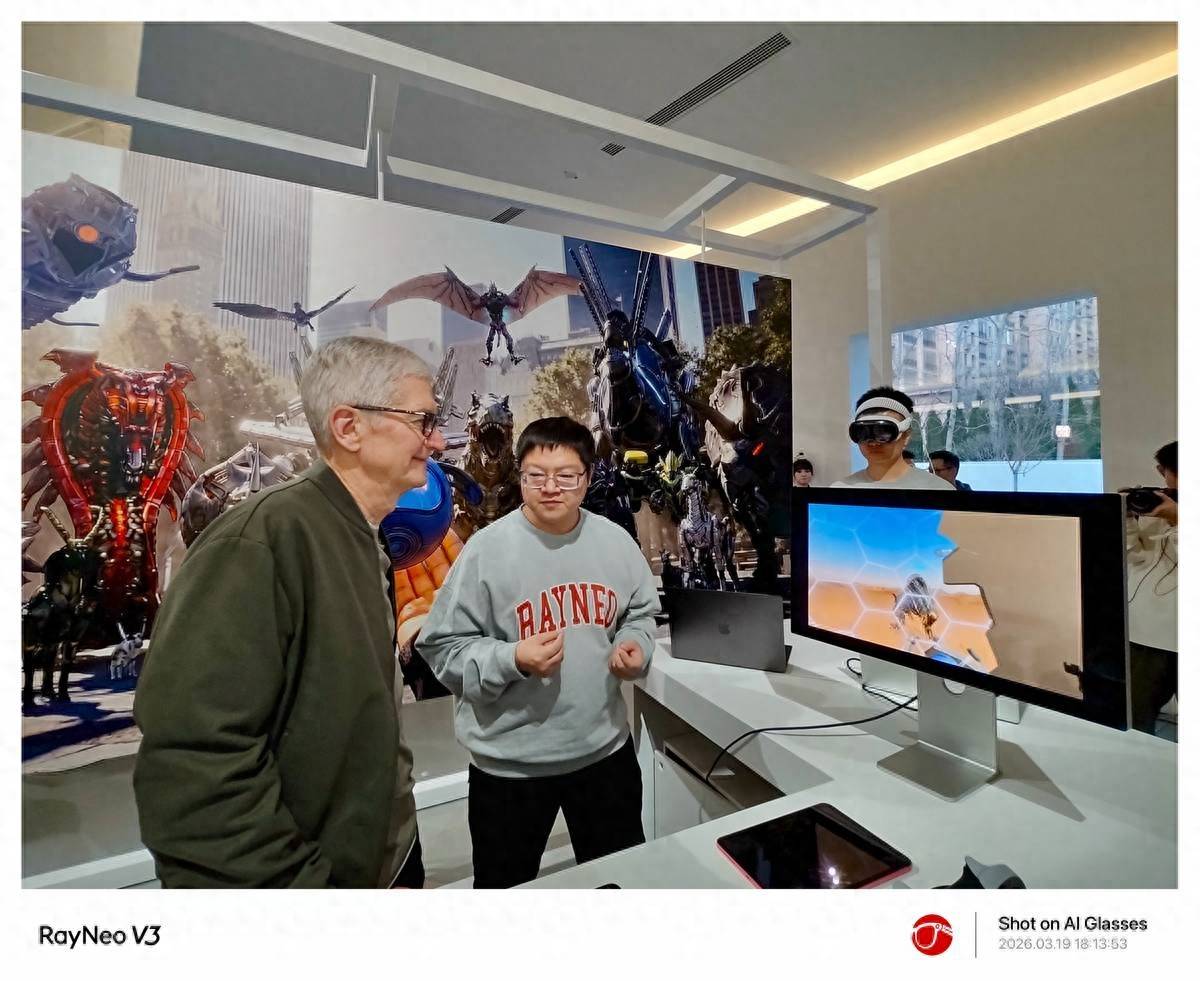
Core Insights - RayNeo, a leading consumer AR brand, showcased its spatial computing game "Digital Era: Elu Legend" at the Apple 2026 Game Showcase, highlighting Apple's focus on next-generation spatial computing content [1][4] - The game is the only one developed specifically for the Apple Vision Pro platform, sharing the stage with top global titles, and has become a focal point of the event [1][4] - RayNeo's participation signifies its evolution from an AR hardware leader to a key ecosystem builder for immersive experiences [1][4] Group 1 - RayNeo's self-developed game "Digital Era: Elu Legend" has achieved top download rankings on the Apple Vision Pro platform, showcasing its breakthrough mixed-reality gaming experience [4] - The game integrates five core technologies: spatial scanning and digital reconstruction, natural gesture interaction, eye-tracking, AI-driven character models, and immersive spatial audio, representing RayNeo's vision for future immersive experiences [4] - The company has validated complex spatial interaction technologies through the Apple Vision Pro platform, preparing for technology migration to lighter smart glasses [4] Group 2 - RayNeo's exploration of spatial computing games began with its first consumer-grade AR glasses, RayNeo X2, which won a gold medal at the Qualcomm XR Innovation Application Challenge for its innovative spatial interaction gameplay [6] - The company is advancing its gaming ecosystem with the RayNeo X3 Pro, the world's first mass-produced dual-lens full-color MicroLED waveguide AR glasses, enhancing visual quality and computational power [6] - RayNeo's continuous self-developed practices enrich the application scenarios of smart glasses and provide a solid technical foundation for high-quality AR applications [6] Group 3 - A key moment of the event was the dialogue between Apple CEO Tim Cook and RayNeo, discussing how spatial computing is reshaping human-computer interaction and entertainment paradigms [7] - Cook expressed high recognition of RayNeo's forward-looking exploration and technological achievements in the spatial computing field, signaling that spatial computing is becoming a mainstream direction for digital content [7] - RayNeo's game "Digital Era: Elu Legend" validated key technologies in spatial computing, while its lightweight applications demonstrate its capability for mass-market services [7] Group 4 - RayNeo's achievements are rooted in its comprehensive self-research and production capabilities, creating a strong barrier in the industry [9] - The company has a top-tier multidisciplinary team across optics, algorithms, software, and ecosystem fields, ensuring seamless integration from foundational technology to user experience [9] - RayNeo has established a complete closed-loop brand in the smart glasses industry, covering hardware, software, and ecosystem development, marking a significant industry declaration of the onset of the spatial computing era [9]

OLED产业趋势全解读,4月来深圳听产业代表们怎么说
WitsView睿智显示· 2026-03-14 01:03
Group 1 - The core viewpoint of the article highlights the transformative impact of generative AI and spatial computing on various industries since 2025, emphasizing the central role of display technology in this revolution [2] - The domestic OLED industry is experiencing new developments, with a key event, the 2026 New Display Industry Seminar, scheduled for April 22-23, 2023, where industry representatives will discuss challenges and opportunities [3] - Domestic OLED materials are entering a new phase characterized by self-sufficiency, technological breakthroughs, and capacity expansion, as core patents and material bottlenecks are being addressed [5] Group 2 - The competition in high-generation OLED production lines is intensifying globally, with various technological routes such as traditional evaporation, printed OLED, and ViP OLED creating more possibilities for the mid-size OLED market [5] - The agenda for the OLED display forum includes discussions on technological innovations and market competition, featuring experts from companies like BOE, TCL, and Visionox, focusing on advancements in OLED technology and materials [6][7]
TrendForce 2026新型显示产业研讨会(DTS)报名正式启动
TrendForce集邦· 2026-03-03 08:24
Core Viewpoint - Since 2025, the technological wave centered around generative AI and spatial computing is reshaping various industries with unprecedented depth and breadth, particularly in display technology, which is undergoing a comprehensive reconstruction from foundational materials to application ecosystems [1]. Group 1: MLED and Micro LED Developments - MLED technology is moving towards a revolution in experience and cross-industry applications, with RGB Mini LED backlight technology achieving peak color purity and high contrast, becoming a strategic focus for high-end TVs and professional displays [1]. - Micro LED is accelerating its penetration into large-size commercial displays and home markets, with advancements in COB and MiP technologies, and is exploring new niches in non-display applications like optical communication, opening a second growth curve for the industry [1]. Group 2: OLED Market Dynamics - The domestic OLED materials industry is entering a new phase characterized by self-control, technological breakthroughs, and capacity expansion, following the resolution of core patent and material bottlenecks [2]. - Global competition in high-generation OLED production lines is intensifying, with diverse technological routes such as traditional evaporation, printed OLED, and ViP OLED creating more possibilities for the mid-size OLED market [2]. Group 3: Small-Sized Near-Eye Displays - Micro LED has become the preferred choice for AI+AR glasses due to its advantages in brightness, low power consumption, compact size, and high transparency, aligning with the trend towards lightweight and visually comfortable devices [3]. - The launch of the Garmin Fenix 8 Pro, the world's first smart watch featuring Micro LED technology, marks a commercial breakthrough for Micro LED in wearables, setting a new visual benchmark for outdoor devices with a brightness of up to 4,500 nits [3]. - The global display industry is at the center of a "digital transformation," presenting both opportunities and challenges, with new scenarios emerging from AI empowerment and pressures from technological bottlenecks and industry chain collaboration [3]. Group 4: Upcoming Industry Seminar - TrendForce plans to hold the 2026 New Display Industry Seminar on April 22-23, gathering experts from the MLED and OLED fields to discuss challenges such as balancing performance and cost, aiming to recalibrate the industry's direction [4].
中经评论:春节AI热潮后多点冷思考
Jing Ji Ri Bao· 2026-02-27 00:08
Group 1 - The core theme of the news is the significant integration of AI technology into various sectors, highlighted by the AI-driven innovations showcased during the Spring Festival Gala, emphasizing the need for AI to transition from consumer-focused applications to deep integration in manufacturing and other industries [1][3][4] - The "red envelope war" during the Spring Festival saw major tech companies like Tencent, Alibaba, Baidu, and ByteDance investing heavily, with Tencent distributing 1 billion yuan, Alibaba 3 billion yuan, and Baidu 500 million yuan, indicating a fierce competition for user engagement in the AI ecosystem [1][2] - The advancements in AI technology were evident in the Gala's performances, where AI-generated imagery and real-time interaction between human performers and digital avatars showcased the maturity of AIGC technology and the capabilities of AI in creating immersive experiences [2][3] Group 2 - The integration of AI into real-world scenarios is crucial for its value realization, as the complexities of live performances expose challenges that cannot be predicted in laboratory settings, thus driving technological advancements [3][4] - The industry must focus on long-term strategies rather than short-term consumer engagement, leveraging China's comprehensive industrial system to embed AI into production processes, enhancing efficiency and reliability [3][4] - The future of AI in China lies in its ability to merge with manufacturing, requiring a shift from consumer applications to core production processes, where AI can optimize workflows and improve operational safety [4]
招商证券:AI+AR眼镜迎来iPhone时刻 建议重视产业投资机遇
Zhi Tong Cai Jing· 2026-02-24 09:00
Core Viewpoint - The AI and AR glasses industry is approaching a pivotal moment akin to the "iPhone moment," with major companies investing heavily in this technology and a significant increase in production capacity expected by 2026 [1][2]. Group 1: Industry Trends - Meta plans to double its AI glasses production capacity to 20 million units by 2026, while Google and Xreal are collaborating on Project Aura, and Apple aims to launch AI glasses within the same timeframe [1]. - The global shipment of smart glasses, including AI glasses and AR/VR devices, is projected to reach 14.52 million units in 2025, representing a 42.5% increase, with AI glasses expected to see a staggering 401% growth to 7.66 million units [2]. - In China, the market for smart glasses is anticipated to receive consumer subsidies in 2026, leading to an expected shipment of 4.51 million units, with AI glasses accounting for 3.43 million units, marking a 68% increase [2]. Group 2: Supply Chain and Cost Reduction - The industry is experiencing a surge in participation from both established tech giants and startups, driven by cost reductions in the supply chain and advancements in AI interaction, which are transforming glasses from novelty items to productivity tools [3]. - Key components such as micro-displays and optical modules account for over half of the costs in AI display glasses, while chip costs exceed one-third in AI audio-visual glasses, with domestic chip production and technological breakthroughs driving rapid cost reductions [3]. Group 3: Technological Advancements - The development of AI and AR glasses hinges on advancements in materials science, display technology, and optical solutions, which are essential for scaling production and enhancing user experience [4]. - Innovations in display technology, such as Micro OLED and Micro LED, are being integrated to create a next-generation computing platform that is lightweight, comfortable, and suitable for various environments [4]. Group 4: Investment Recommendations - Investment opportunities in the consumer sector include focusing on upstream suppliers of lenses, such as 康耐特光学, and manufacturers like 比依股份, as well as downstream brands like TCL Electronics and 极米科技 [5].

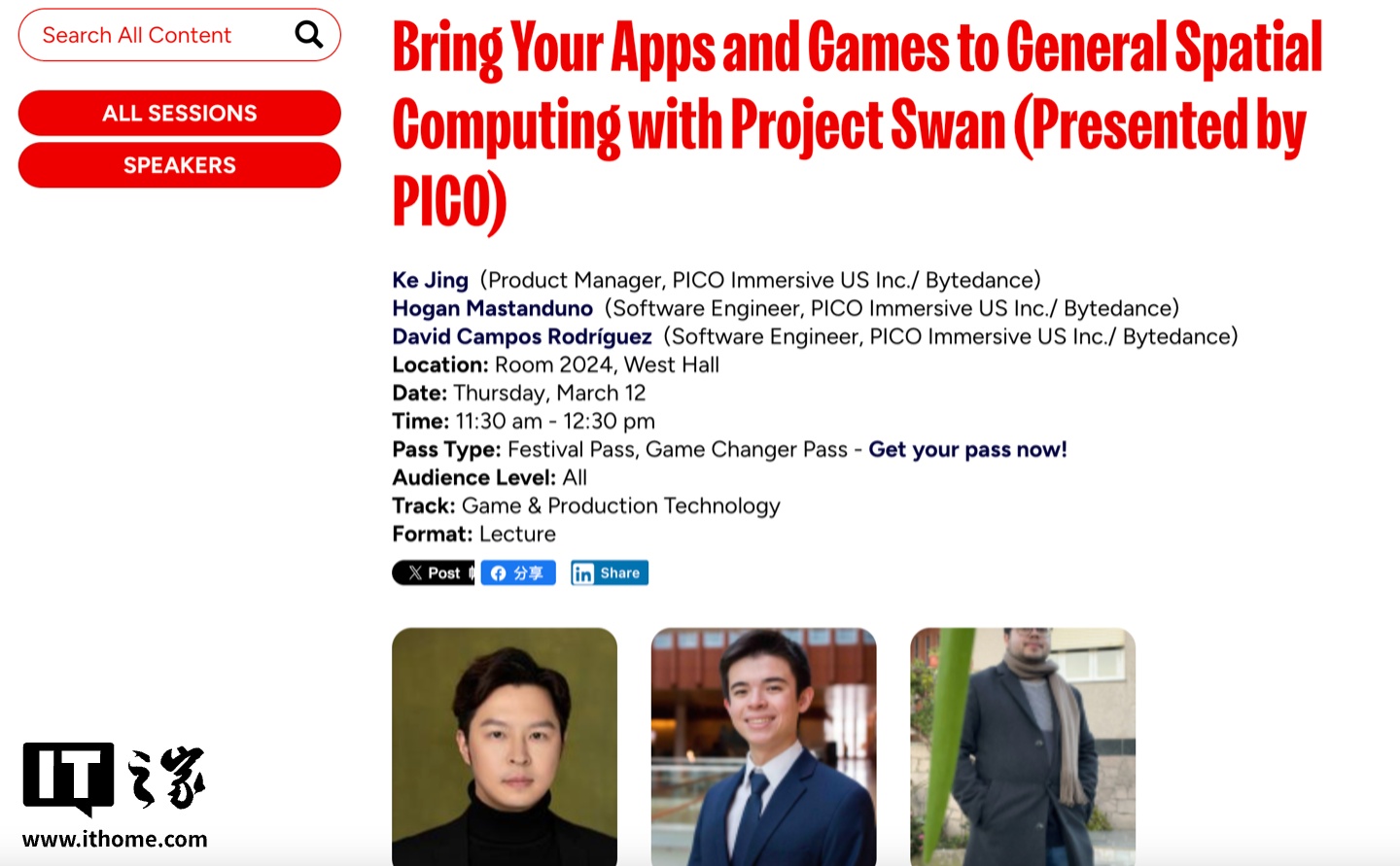
pico 将于 GDC 大会亮相“Project Swan”XR 头显,主打轻薄设计与自研芯片
Xin Lang Cai Jing· 2026-02-24 01:17
Core Viewpoint - Pico is set to showcase its flagship XR headset, "Project Swan," at the upcoming Game Developers Conference (GDC), highlighting its advanced graphics performance and multi-modal interaction system [9]. Group 1: Product Features - "Project Swan" is designed to be lightweight, weighing approximately 100 grams, and features a mixed design that offloads some computing tasks to an external unit via a wired connection [6][15]. - The headset will support gesture and eye-tracking capabilities, enhancing user interaction [6][15]. - It will be powered by a self-developed chip and feature a custom microOLED display with a pixel density close to 4000 PPI, surpassing Apple's Vision Pro, which has a pixel density of 3386 PPI [8][16]. Group 2: Operating System and Tools - The headset will run on the PICO OS 6 operating system, which is expected to provide a robust platform for developers [12]. - Pico plans to showcase the developer toolchain alongside the headset, indicating a focus on fostering a development ecosystem around "Project Swan" [12].
消息称苹果 AirPods Pro 3 增强版今年上市:耳机也能“看”世界,支持 AI 视觉智能
Xin Lang Cai Jing· 2026-02-10 16:29
Core Insights - Apple is not planning to completely replace existing products with the new AirPods Pro but aims to launch a derivative version with higher hardware specifications, primarily using the current AirPods Pro 3 design [1] - The core hardware upgrade involves the introduction of an infrared camera system, which is expected to support AI functions similar to "Visual Intelligence" rather than traditional photography [1] Group 1: Product Features - The new AirPods Pro is expected to enhance Apple's AI ecosystem by using the camera to perceive the surrounding environment, providing users with scene-based enhanced audio experiences or spatial computing assistance [2] - The infrared camera module is designed for environmental sensing, enhancing the immersion of "Spatial Audio" and enabling ecological interaction with the Apple Vision Pro headset for more precise spatial computing experiences [2] Group 2: Pricing - The new AirPods Pro with the camera is expected to maintain the current price point, estimated at 1899 yuan [4]

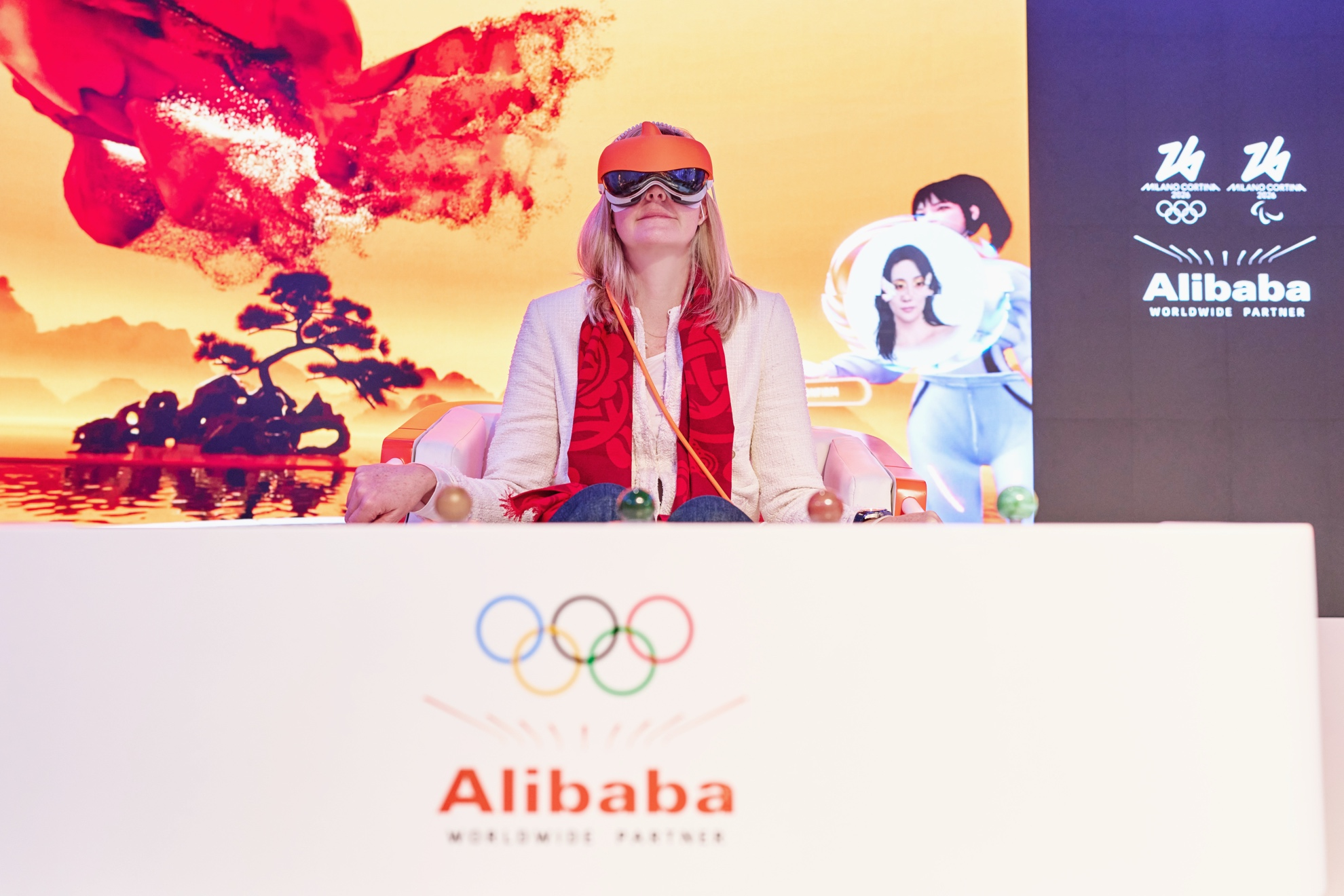
米兰冬奥会现场 淘宝Vision打造AI数字购物之旅
Jin Rong Jie· 2026-02-10 07:01
Group 1 - The Milan-Cortina Winter Olympics officially opened on February 6, showcasing a futuristic experience called "Milan Alibaba Wonder on Ice" that integrates AI digital shopping [1] - Alibaba's Taobao Vision created a shopping space that combines AI, 3D, and XR technologies, allowing visitors to create personalized digital avatars and participate in a virtual ice ball [4][5] - The "Milan Alibaba Wonder" experience center features an 8.8-meter diameter crystal ball and a 30-meter long ice crystal dome, providing an interactive space during the Winter Olympics and Paralympics [4] Group 2 - Visitors are greeted by an AI assistant that guides them through the experience, including generating personalized entry tickets and virtual fitting experiences [5] - The virtual fitting area offers 20 outfit options categorized into themes such as Eastern, Polar, Garden, and Future, including the official attire for the Chinese sports delegation at the 2026 Winter Olympics [7] - Taobao is the first Chinese e-commerce application to launch on Apple Vision Pro, enhancing the shopping experience from 2D to 3D and increasing interactivity and decision-making accuracy [7][8] Group 3 - The AI assistant helps users select outfits and makeup, providing a fully immersive experience that engages multiple senses, including sight and smell [7] - The event emphasizes Alibaba's role as a valuable partner for the International Olympic Committee, highlighting the integration of AI technology in shaping the future of the Olympics [8]

歌尔股份:回购资金上限调至15亿元 延续稳定市场预期
Zhong Zheng Wang· 2026-02-02 02:25
Company Summary - The company, GoerTek, announced an adjustment to its share repurchase plan, increasing the total repurchase fund from a minimum of 500 million yuan to a minimum of 1 billion yuan, while maintaining other terms unchanged [1] - As of January 31, 2026, GoerTek has repurchased 34.497 million shares, accounting for 0.97% of the total share capital, with a total payment of approximately 950 million yuan, nearing the original repurchase fund limit [1] - The increase in repurchase funds reflects the company's confidence in its development prospects and recognition of its intrinsic value, without significantly impacting daily operations, R&D investment, or cash flow [2] Financial Performance - For the first three quarters of 2025, GoerTek achieved total operating revenue of 68.107 billion yuan, a slight decrease of 2.21% year-on-year, while net profit attributable to shareholders increased by 10.33% to 2.587 billion yuan [2] - The gross profit margin improved to 13.19% in the third quarter, indicating a steady enhancement in profitability [2] Industry Context - The consumer electronics industry is transitioning from cyclical recovery to growth resonance, with a focus on destocking and asset optimization in 2024-2025 [3] - Starting in 2026, the emergence of new fields such as AI terminals and spatial computing is expected to lead to structural reshaping of the industry [3] - GoerTek, as a leader in precision manufacturing and smart hardware, is well-positioned to seize opportunities in XR devices and acoustic components, which are anticipated to see increased demand [3]
