AI网络协同

Search documents
小鹏Robotaxi和IRON发布:物理AI“安全大考”才刚刚开始
3 6 Ke· 2025-11-05 23:13
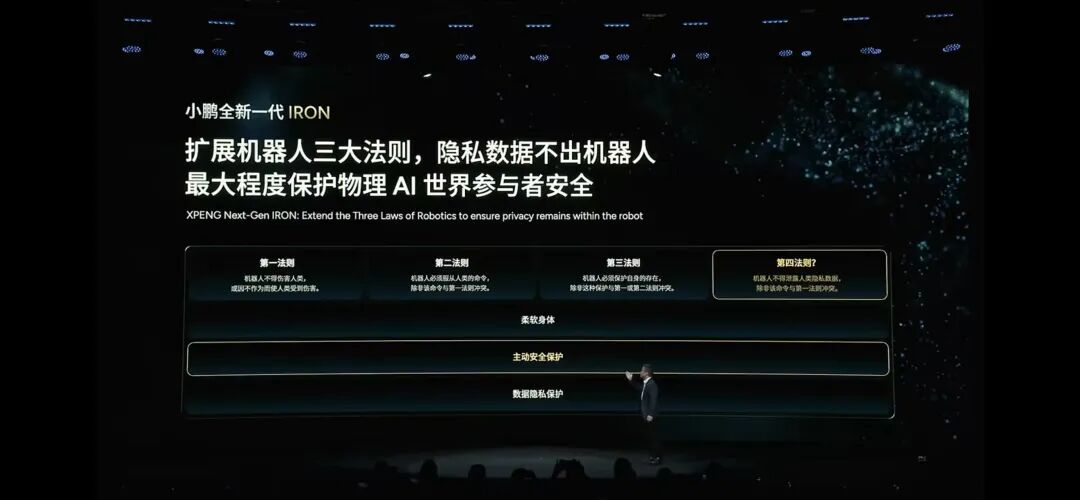
Core Insights - The core question raised during the Xiaopeng Technology Day is how AI can safely integrate into the real world as physical partners, moving beyond mere algorithms on screens [1] Group 1: Robotaxi Development - Xiaopeng announced plans to trial L4-level Robotaxi by 2026, showcasing a robust technological framework that includes dual redundancy in six core systems, ensuring safety without a physical safety driver [2] - The second-generation VLA model allows AI to operate without reliance on high-precision maps, enabling it to adapt to various traffic rules and environments, thus enhancing its decision-making capabilities [2] - Xiaopeng aims to accelerate commercialization by opening its SDK to partners like Amap, which expands the safety responsibility within a more complex collaborative ecosystem [2] Group 2: IRON Robot Features - The IRON robot, standing at 178 cm, represents AI's entry into personal living spaces, emphasizing its ability to navigate safely rather than just its mobility [4] - Equipped with an indoor AEB (Automatic Emergency Braking) system, the IRON robot can detect and avoid obstacles in home environments, enhancing its practical utility [7] Group 3: Physical World Model - Both the Robotaxi and IRON robot are powered by a physical world model, which fundamentally differs from internet models like ChatGPT, as it must adhere to strict physical laws [6] - Xiaopeng's model, with 720 billion parameters, enables AI to understand complex physical interactions, such as recognizing reflective surfaces or assessing water depth, marking a significant advancement in physical AI capabilities [9] Group 4: Safety as a Priority - Xiaopeng's approach emphasizes "edge-side reinforcement," where high levels of intelligence are paired with robust safety redundancies, highlighting the critical nature of safety in physical AI applications [10] - The industry is exploring alternative safety frameworks, such as the "system-level collaboration" exemplified by Mogu Car Union, which aims to enhance overall traffic safety through interconnected AI systems [10] Group 5: Future Challenges - The future of physical AI will hinge on its ability to interpret human social intentions and the legal implications of accidents, which will determine the extent of its integration into society [12] - The industry has made significant strides by prioritizing safety over mere technological display, marking the beginning of a crucial phase in the development of physical AI [12]