AI致贫

Search documents
如何理解开年全球市场?“可负担性”才是 2026 的总叙事:“主街”要赢一次,AI叙事巨变,日元是“关键”
Hua Er Jie Jian Wen· 2026-02-14 05:53
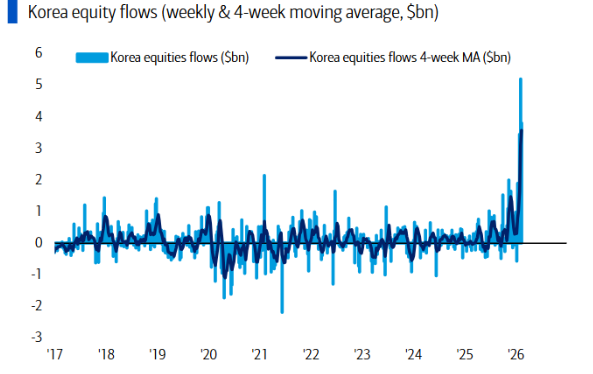
Core Insights - The global market is undergoing a paradigm shift as money moves away from previously favored assets towards those benefiting "Main Street" rather than "Wall Street" [1][2] Group 1: Market Trends - Year-to-date, gold has risen by 13.4%, oil by 9.5%, and international stocks by 8.7%, while U.S. stocks have declined by 0.2% and Bitcoin has plummeted by 25% [1] - A historic rotation from large-cap growth stocks to small-cap value stocks has begun in the U.S. [1] - Assets benefiting "Main Street" have performed well, including silver (+56%), the KOSPI index (+34%), and Brazilian stocks (+30%) since late October [2] Group 2: AI Narrative Shift - The market's perception of artificial intelligence is shifting from "AI awe" to "AI poor," indicating a focus on the costs and disruptions associated with AI [6] - Over the past five months, debt issuance by large AI companies has reached $170 billion, significantly higher than the average of $30 billion per year from 2020 to 2024 [6] Group 3: Currency and Global Liquidity - The correlation between the Japanese yen and the Nikkei index has turned positive for the first time since 2005, signaling a potential structural bull market [10][13] - A rapid appreciation of the yen could lead to increased selling pressure on various assets, including cryptocurrencies and energy [13] Group 4: Investment Strategy and Future Outlook - The current "bull-bear indicator" reading of 9.4 suggests a high level of market enthusiasm, indicating potential short-term pullback risks [14] - Historical precedents show that significant political or financial events often trigger major asset rotations, and the current environment may be at the start of a new "great rotation" [15] - Emerging markets and small-cap stocks are expected to outperform large-cap growth stocks due to rising populism and high costs associated with the AI arms race [15][21]