AI驱动运营

Search documents
Harmonic(HLIT) - 2025 Q4 - Earnings Call Transcript
2026-02-19 23:02
Financial Data and Key Metrics Changes - The total company revenue for Q4 2025 was $157.3 million, with EPS at $0.14 and adjusted EBITDA at $23.8 million, all exceeding Q4 guidance [20] - For continuing operations, Q4 Broadband revenue was $98.2 million, above the guidance range of $85 million to $95 million, with adjusted EBITDA of $12.1 million and EPS of $0.06 [21] - The total company net revenue for the fiscal year 2025 was $570.8 million, with a gross margin of 55.8%, adjusted EBITDA of $83.8 million, and EPS of $0.47 [22] Business Line Data and Key Metrics Changes - Broadband revenue for Q4 was $98.2 million, reflecting a 9% sequential growth and record quarterly bookings of $346.9 million, resulting in a 3.5 book-to-bill ratio [5][20] - The Video business, now classified as discontinued operations, exceeded expectations in Q4 in terms of revenue and profitability, with a planned sale to MediaKind for approximately $145 million [7] - Rest of World revenue grew 33% year-over-year in Q4, now representing 41% of total Broadband revenue, indicating a significant shift in revenue mix [8][21] Market Data and Key Metrics Changes - The cable serviceable addressable market is projected to grow from approximately $510 million in 2025 to over $1.1 billion by 2030, driven by increased data consumption and network modernization [15] - The addressable market for fiber exceeds $2.6 billion, with Harmonic's share growing, indicating substantial opportunities in this segment [16] Company Strategy and Development Direction - The company is transitioning to a pure-play broadband leader, focusing on expanding market leadership in DOCSIS and fiber, increasing customer diversification, and driving software and cloud differentiation [17][18] - The sale of the Video business is expected to simplify operations and enhance the balance sheet, allowing for investments in organic growth and strategic M&A [18][26] Management's Comments on Operating Environment and Future Outlook - Management expressed confidence in the long-term growth trajectory, citing strong bookings and backlog growth as indicators of future revenue resilience [34] - The transition to DOCSIS 4.0 is seen as a significant opportunity, with expectations for accelerated growth as deployments ramp up [34] Other Important Information - The company ended the year with $124.1 million in cash and cash equivalents, demonstrating strong liquidity to support capital allocation priorities [23][26] - Free cash flow for the fourth quarter was $9.6 million, with a total of $97 million for the full year, reflecting strong profitability [24] Q&A Session Summary Question: Customer mix for full year 2026 - Management indicated that while Rest of World customers showed significant growth, the percentage of revenue from these customers may fluctuate based on larger customer spending [39] Question: Impact of memory pricing on gross margins - Management confirmed a net impact of approximately $6 million from memory pricing, with committed orders in place for 2026 [41][42] Question: Bookings composition in Q4 - Bookings were strong across both larger customers and Rest of World, with multi-year contracts contributing to the backlog [61] Question: SaaS and service revenue breakdown - The majority of the $58 million in 2025 SaaS and service revenue came from SLA contracts, with a focus on growing intelligence tools for customers [77][80]

第一太平戴维斯:数据中心从“房地产资产”转向战略基础设施
Zhong Guo Jing Ying Bao· 2026-01-21 14:20
Core Insights - The report by Savills China highlights that modern data centers are evolving from mere "server warehouses" to integrated operating systems that combine energy, cooling, network resilience, and physical security, increasingly incorporating AI-driven operational capabilities [1] Group 1: Data Center Value Proposition - The core value of data centers is no longer determined by floor area but by their ability to continuously, densely, and stably provide computing power [1] - Unlike traditional commercial real estate, the competitiveness of data centers is influenced by factors such as power supply and redundancy, cooling efficiency, network connectivity, operational reliability, and access to low-carbon electricity [1] Group 2: Regional Specialization in Data Centers - The report indicates a clear regional specialization in China's data center operations based on workload characteristics and application scenarios [1] - The eastern region is most suitable for deploying latency-sensitive, high-density workloads, while the central and western regions leverage lower land and electricity costs to handle high-energy tasks like AI training and cold data [1] - Actual utilization rates in these regions depend on the matching of network latency, connectivity, and downstream demand [1]

TP 发布 2026 年中国全球扩张权威展望
Globenewswire· 2025-12-18 04:36
Core Insights - The "2026 Outbound Global Outlook Report" reveals how AI, localization, and operational excellence are reshaping global competitiveness for Chinese brands [1][2] - The report emphasizes the need for Chinese enterprises to adapt their overseas operations in response to stricter compliance requirements, accelerated technology applications, and increasingly complex consumer expectations [2] Group 1: Key Forces Reshaping Global Expansion - Four key forces identified for reshaping global expansion by 2026 include AI-driven operations and deep localization [2] - The report outlines eight interconnected operational areas where companies can build resilience and achieve differentiation: market entry and localization, marketing and growth operations, sales operations, business enablement, customer operations, trust and safety, after-sales support, and back-office operations [2] Group 2: Best Practices and Operational Guidance - The report compiles best practices from leading Chinese and international brands across various sectors such as e-commerce, retail, technology, travel, consumer electronics, gaming, and fintech [3] - It provides actionable guidance for building an integrated global operating model to accelerate performance [3] - The report highlights the importance of AI-native operating models in transforming marketing, sales, customer experience, trust and safety, back-office, and lifecycle support [3] Group 3: Addressing Market Needs and Compliance - Companies are encouraged to develop products and compliance frameworks that meet local market demands [4] - The report stresses the need for deploying multilingual AI agents and automation to enhance speed and efficiency [4] - It emphasizes the importance of strengthening trust, security, and risk management systems to ensure a consistent customer experience across markets [4] Group 4: Supporting Next-Generation Global Leaders - TP has expanded its AI-enabled, human-centric solution portfolio to support global expansion at all stages, from market entry to post-launch operations [5] - Specialized global task forces have been deployed to connect strategy with execution, facilitating localized implementation, compliance enablement, and operational system development [5] - The report is available for download through TP's WeChat account and global digital channels [5]
BEKE(BEKE) - 2025 Q2 - Earnings Call Transcript
2025-08-26 13:02
Financial Data and Key Metrics Changes - In Q2 2025, the total Gross Transaction Value (GTV) was RMB 878.7 billion, representing a year-over-year increase of 4.7% [11] - Revenue reached RMB 26 billion, up 11.3% year-over-year [11] - Gross margin declined by six percentage points year-over-year to 21.9% [11] - GAAP net income was RMB 1.31 billion, falling 31.2% year-over-year [11] - Non-GAAP net income reached RMB 1.82 billion, down 32.4% year-over-year [12] Business Line Data and Key Metrics Changes - Revenue from existing home transaction services was RMB 6.7 billion in Q2, down 8.4% year-over-year [15] - New home GTV reached RMB 255.4 billion, up 8.5% year-over-year [17] - Revenue from new home transactions was RMB 8.6 billion, rising by 8.6% year-over-year [18] - Revenue from home renovation and furniture business reached RMB 4.6 billion, increasing by 13% year-over-year [21] - Revenue from home rental services reached a record high of RMB 5.7 billion in Q2, up 78% year-over-year [24] Market Data and Key Metrics Changes - The total value of housing transactions nationwide was stable overall, but new home sales dropped by 5.2% year-over-year in the first half of 2025 [59] - Existing home transactions rose by 8.3% year-over-year, driven by a 19% increase in the number of transactions [60] - The rental yield reached 2.5% in June, about 40% higher than its lowest point [62] - The number of existing home transactions fell by over 5% month-over-month in July [64] Company Strategy and Development Direction - The company aims to shift its growth focus from scale to efficiency, enhancing operational capabilities while maintaining its agent and store network [35][70] - The strategy includes deeper operational efforts and leveraging AI to improve productivity and service quality [39][72] - The company is committed to an asset-light business model and will not engage in property development [25][52] Management's Comments on Operating Environment and Future Outlook - Management noted that the real estate market is facing challenges due to international trade friction and policy impacts, leading to a slowdown in momentum [8][9] - Future market recovery will depend on the pace of policy implementation and supply-demand balance improvements [64][65] - Management expressed confidence in the company's ability to outperform the market through operational improvements and a diversified portfolio [32][33] Other Important Information - The company has a robust cash liquidity of around RMB 70 billion, allowing for active shareholder returns through share buybacks [31] - The Board approved an increase in the share repurchase program, extending it to August 31, 2028 [32] Q&A Session Summary Question: Overview of the secondary home market in Q2 and future trajectory - Management indicated that the secondary home market saw a significant decline in transactions and prices in Q2, with expectations for continued downward pressure unless policy support is strengthened [57][64] Question: Actions taken to deliver value to investors amid sector downturn - Management highlighted a focus on efficiency and sustainable development, with plans to stabilize store and agent numbers while improving productivity [68][70] Question: Opportunities from new property development models - Management noted that new supply-side policies are pushing for better living quality, which will create opportunities for the company in demand forecasting and pricing strategies [80][81] Question: Key growth drivers in the home renovation and furnishing business - Management stated that operational efficiency improvements and centralized procurement have driven growth in the home renovation segment, with plans for further optimization [88][90]

BEKE(BEKE) - 2025 Q2 - Earnings Call Transcript
2025-08-26 13:00
Financial Data and Key Metrics Changes - Total Gross Transaction Value (GTV) reached RMB 878.7 billion, representing a year-over-year increase of 4.7% [10] - Revenue for Q2 was RMB 26 billion, up 11.3% year-over-year [10] - Gross margin declined by six percentage points year-over-year to 21.9% [11] - GAAP net income was RMB 1.31 billion, falling 31.2% year-over-year [11] - Non-GAAP net revenue reached RMB 1.82 billion, down 32.4% year-over-year [12] Business Line Data and Key Metrics Changes - Existing home sales transactions rose by 26%, outpacing the market growth rate of 19% [12] - New home orders increased by 19%, while the market declined by 6% [12] - Revenue from in-home transactions was RMB 6.7 billion, down 8.4% year-over-year [15] - Revenue from new home transactions was RMB 8.6 billion, rising by 8.6% year-over-year [17] - Home renovation and furniture business revenue reached RMB 4.6 billion, increasing by 13% year-over-year [20] - Home rental services revenue reached a record high of RMB 5.7 billion, up 78% year-over-year [22] Market Data and Key Metrics Changes - The total value of housing transactions nationwide was stable overall, but new home sales dropped by 5.2% year-over-year in the first half [56] - Existing home transactions rose 8.3% year-over-year, driven by a 19% increase in the number of transactions [57] - Rental yield reached 2.5% in June, about 40% higher than its lowest point [58] - The market downturn has picked up speed, with existing home transactions falling by over 5% month-over-month [60] Company Strategy and Development Direction - The company aims to shift focus from scale to efficiency, enhancing operational capabilities and productivity [34][66] - The strategy includes deeper operational efforts and leveraging AI for productivity gains [37][70] - The company will not adopt an asset-heavy model and will focus on delivering C2M product solutions for developers [24][50] Management's Comments on Operating Environment and Future Outlook - Management noted that the real estate market is facing challenges due to international trade friction and policy impacts [8] - Future market recovery will depend on the pace of policy changes and supply-demand balance improvements [60][61] - The company is committed to maximizing long-term value through operational improvements and AI-driven initiatives [30][31] Other Important Information - The company has a robust cash liquidity of around RMB 70 billion, allowing for active share buybacks and dividends [29] - The share repurchase program has been extended to August 31, 2028, with an increased authorization [30] Q&A Session Summary Question: Overview of the secondary home market and future trajectory - Management indicated that the secondary home market showed stability in Q1 but weakened significantly in Q2, with expectations for stronger policy support to boost demand [55][56] Question: Actions taken to deliver value to investors amid sector downturn - Management emphasized a shift from growth to efficiency, focusing on enhancing operational capabilities and consolidating lower-performing stores and agents [64][66] Question: Opportunities from new property development models - Management highlighted that new home products meeting national standards are expected to improve market dynamics and enhance the company's value to developers [76][80] Question: Key growth drivers in the home renovation and furnishing business - Management noted that operational efficiency improvements and centralized procurement have driven revenue growth and margin improvements in the home renovation segment [85][87]
从“全球到国内”,2025广告变现十大趋势
3 6 Ke· 2025-08-18 11:02
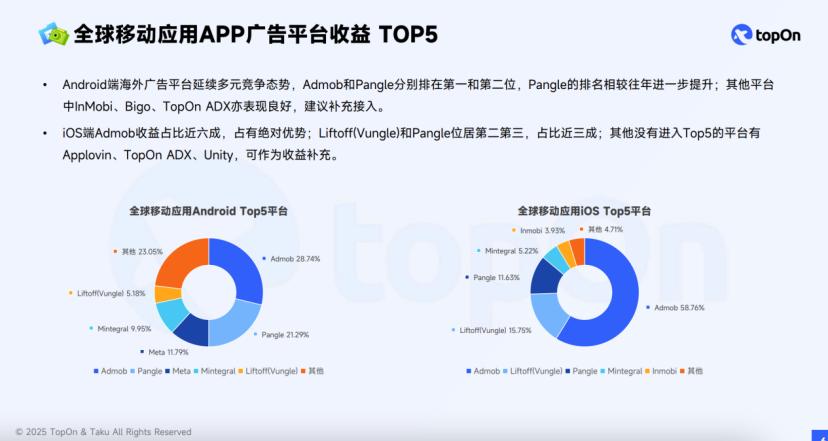
Core Insights - The report highlights a dual trend in mobile app advertising monetization for H1 2025, characterized by both "scale expansion and quality upgrade" [1] - The global advertising market is growing, with emerging markets driving new user growth and mature markets focusing on maximizing existing user value [2][3] Global Advertising Monetization Trends - Mature markets remain the primary battleground for ad monetization, but growth is stabilizing, while emerging markets are becoming new growth engines due to user influx and increased advertiser investment [2] - Different regions exhibit distinct advertising monetization patterns, with content-rich apps showing stronger monetization potential compared to tool and hardware apps [2] - The top five global mobile app advertising platforms for H1 2025 show a diverse ecosystem, with Google AdMob dominating iOS and Pangle gaining significant traction on Android [6] Domestic Advertising Monetization Trends - In China, the growth of mobile internet users is slowing, leading to a focus on deepening user value amidst intense competition [3] - The average monthly usage time for users in China reached 175.8 hours in H1 2025, reflecting a 6.2% year-on-year increase, indicating rising user engagement [3] - The advertising landscape in China is stable, with ByteDance's Pangle and Tencent's advertising alliance leading the market [29] Key Trends in Global Advertising Monetization - Trend 1: Non-gaming apps are increasingly adopting a hybrid monetization model combining ads and in-app purchases, enhancing user engagement and revenue [7][9] - Trend 2: Local advertising platforms are rising, effectively capturing regional traffic and complementing global giants [10][12] - Trend 3: Privacy regulations are shifting ad targeting towards user preferences and content relevance, enhancing user experience [17][18] - Trend 4: AI is driving operational efficiency in ad monetization, optimizing ad placement and frequency [19][21] - Trend 5: Emerging markets are experiencing rapid growth, necessitating localized advertising strategies to cater to unique user preferences [22][23] Key Trends in Domestic Advertising Monetization - Trend 1: Advertisers are focusing on high-quality users due to budget constraints, emphasizing user retention and monetization potential [30][31] - Trend 2: Different app categories are adopting tailored advertising styles, leading to significant revenue disparities [32][34] - Trend 3: IoT applications are increasingly integrating ad monetization, creating new revenue streams [35][36] - Trend 4: The advertising platform landscape in China is stabilizing, with a mix of major players dominating the market [37][39] - Trend 5: Chinese developers are increasingly looking to expand globally, adapting their strategies to local markets [40][42]

Interpublic Group Delivers Record Margins in Q2
The Motley Fool· 2025-07-22 22:09
Core Insights - Interpublic Group (IPG) reported a 3.5% organic revenue decrease in Q2, but achieved a record 18.1% adjusted EBITDA margin, indicating effective cost management and operational efficiency [1][3] - The company confirmed progress on its merger with Omnicom, projecting a 1%-2% decline in full-year organic net revenue for 2025, while forecasting an adjusted EBITDA margin above the previous guidance of 16.6% [1][8] Financial Performance - Adjusted EBITDA for Q2 reached $393.7 million, with a 350 basis-point year-over-year improvement in adjusted EBITDA margin, attributed to structural cost reductions and operational consolidation [2] - Headcount decreased by approximately 6% year-over-year, totaling 51,300, with restructuring charges amounting to $118 million and projected annualized structural savings exceeding $300 million [2] AI Integration and Revenue Generation - The adoption of the proprietary Interact AI platform has been rapid, with over half of employees utilizing it and 40% engaging daily, enhancing marketing workflows and client solutions [4] - The ASC (Agentic Systems for Commerce) AI tool has been piloted by nearly two dozen clients, showing double-digit percentage increases in impressions and sales, indicating potential for new revenue streams [4][5] Merger Progress and Client Stability - The merger with Omnicom is on track for a second-half 2025 close, having received FTC clearance in the U.S., with stable client support and business performance despite competitive speculation [6][7] - Share buybacks totaled $98 million year-to-date, limited by a $325 million annual cap imposed by the merger agreement [6] Future Outlook - Management anticipates a 1%-2% decrease in organic net revenue for 2025, expecting flat sequential results in Q3 and Q4, while the Omnicom transaction remains on track for completion [8]