Covered Call Writing

Search documents
Comparing the Protection from ITM Covered Calls versus Adding Protective Puts (The Collar Strategy) + New Member Discount Coupon
Thebluecollarinvestor· 2026-03-21 11:09
Comparing the Protection from ITM Covered Calls versus Adding Protective Puts (The Collar Strategy) + New Member Discount Coupon click ↑ 4 FeaturedIn bear, volatile and uncertain market environments, covered call writers turn to ITM call strikes and protective puts to create greater protection to the downside. In this article, the pros & cons of each hedging technique will be analyzed using a real-life example with NVIDIA Corp. (Nasdaq: NVDA).Why consider ITM call strikes in challenging market environments ...



Can We Use 2 Standard Deviation Implied Volatility When Portfolio Overwriting?
Thebluecollarinvestor· 2026-02-21 11:47
Core Insights - The article discusses the strategy of portfolio overwriting, which aims to generate additional income through option premiums while retaining underlying shares, with a focus on minimizing the risk of exercise to less than 1% [1]. Group 1: Standard Deviation and Implied Volatility - Standard deviation (SD) measures the average deviation of data points from the mean, which is crucial for understanding price movements in stocks [2]. - One standard deviation (1 SD) indicates that a stock's price is expected to move within a certain range 68% of the time, allowing traders to select strike prices based on their strategy goals [3]. - The application of 1 SD in portfolio overwriting involves selecting high strike prices to minimize the risk of exercise, estimated at approximately 16% [4]. Group 2: Application of 2 Standard Deviations - Two standard deviations (2 SD) double the range of 1 SD, indicating a stock is expected to move up or down significantly, with a 95% probability of staying within that range [7]. - For Intel Corp. (Nasdaq: INTC), using 2 SD suggests selecting strike prices above $50.00, resulting in an exercise risk of approximately 2.5% without exit strategies [12]. Group 3: Real-life Example with Intel Corp. - Intel's at-the-money implied volatility (IV) was reported at 74%, with expected price movements calculated for both 1 SD and 2 SD scenarios [5][10]. - The $43.00 strike price (1 SD) offers a bid price of $1.37, while the $50.00 strike price (2 SD) has a bid price of $0.69, indicating potential returns based on the selected strikes [8][16]. - The expected returns for the $43.00 strike are 3.87% over 33 days, annualized at 42.81%, while the $50.00 strike shows a return of 1.95%, annualized at 21.56% [16].

How to Incorporate High Implied Volatility Stocks into Conservative Covered Call Portfolios + Alan Interviewed by The Options Industry Council
Thebluecollarinvestor· 2026-02-07 11:19
Core Insights - High implied volatility (IV) stocks and ETFs can enhance covered call portfolios by providing high premium yields, but they also carry downside risks [1][9] - The article discusses strategies to utilize high IV securities while maintaining a focus on capital preservation [1][9] Investment Strategy - The Global X Uranium ETF (URA) is highlighted as a high IV ETF, trading at $49.43 on 9/22/2025, with the potential for in-the-money (ITM) covered calls to offer downside protection [2][5] - ITM covered calls can maximize returns as long as the stock price remains above the strike price [5][10] Option Analysis - The $49.00 near-the-money strike has an IV of 47%, which is significantly higher than the S&P 500, indicating a strong potential for returns [5][10] - Delta is a crucial metric in selecting ITM strikes, with a high Delta indicating a greater probability of the option expiring ITM [5][6] Trade Calculations - A deep ITM call strike at $42.00 shows a Delta of 90.6%, suggesting a 90.6% probability of expiring ITM, which aligns with the desired risk tolerance [10][11] - The breakeven price for the trade is calculated at $41.63, with a projected 26-day return of 0.88% and an annualized return of 12.37% [11] Risk Management - The downside protection from the time-value profit is estimated at 15.03%, making the trade appealing for those seeking a balance between risk and return [11]
Lowering Cash-Secured Put Breakeven Price Points Means Greater Protection to the Downside with Lower Premium Returns
Thebluecollarinvestor· 2025-12-20 12:49
Core Insights - The article discusses the strategy of lowering cash-secured put breakeven price points to provide greater downside protection, albeit with lower premium returns [1][4]. Group 1: Cash-Secured Put Strategy - In bear, volatile, or uncertain market conditions, structuring trades with lower breakeven price points is advisable, which results in lower initial time-value returns [1][4]. - It is essential to identify the minimum acceptable return for the greatest amount of downside protection before establishing trades [1][4]. Group 2: NVIDIA Corp. Example - A real-life example using NVIDIA Corp. (Nasdaq: NVDA) is analyzed, focusing on put options with different strike prices and their respective breakeven points [1][2]. - The $150.00 deep out-of-the-money (OTM) put has a bid price of $2.56 and a breakeven price point of $147.44, offering 10% protection to the breakeven [2][5]. - The $160.00 OTM put has a bid price of $5.25 and a breakeven price point of $149.75, providing 8.66% protection to the breakeven [2][5]. Group 3: Trade Metrics - The $150.00 put has an initial time-value return of 1.74%, annualized to 17.13%, while the $160.00 put has a return of 3.51%, annualized to 34.58% [5]. - The trade duration is 37 days, and the cash required per contract for the $150.00 put is $14,744, while for the $160.00 put, it is $14,975 [2][5].
How to Calculate and Archive Results for a Rolling-Out-And-Up Covered Call Trade
Thebluecollarinvestor· 2025-11-22 11:38
Core Insights - The article discusses the strategy of rolling-out-and-up covered call trades, particularly when the trade is expiring in-the-money (ITM), allowing investors to retain underlying shares while potentially increasing returns [1][3]. Group 1: Trade Details - A specific example of a covered call trade involving JPMorgan Chase (JPM) is provided, detailing the entry and exit strategies, including the buy and sell prices of options and shares [2][4]. - The initial trade involved buying 700 shares of JPM at $246.04 and selling call options with a strike price of $282.50 for a premium of $0.89 [4][5]. - The final calculations for the trade show a net unrealized return of 15.18% after closing the short call, with a final stock price of $286.87 at expiration [3][5]. Group 2: Financial Metrics - Initial calculations indicated a return of 0.36% with an annualized return of 2.81% and an upside potential of 14.82% [5][6]. - The trade adjustment involved a buy-to-close (BTC) of the original short call at $4.37, which was part of the rolling-out-and-up strategy [3][5]. - For the subsequent expiration on July 11, 2025, the entry stock price was $286.87, with a new call strike price of $290.00 and a premium of $2.42, indicating a potential return of 20.53% [6][8]. Group 3: Strategy Insights - The article emphasizes the importance of accurately calculating the cost-to-close and the premiums for rolling options to maintain clarity in trade management [7]. - The covered call writing strategy is presented as a low-risk approach to generating cash flow, tailored to achieve consistent market outperformance [10][11]. - The article suggests reducing the number of underlying securities and exit strategy considerations to streamline the investment process [11].

Beware of the Shiney Object When Establishing Covered Call Trades
Thebluecollarinvestor· 2025-11-01 17:15
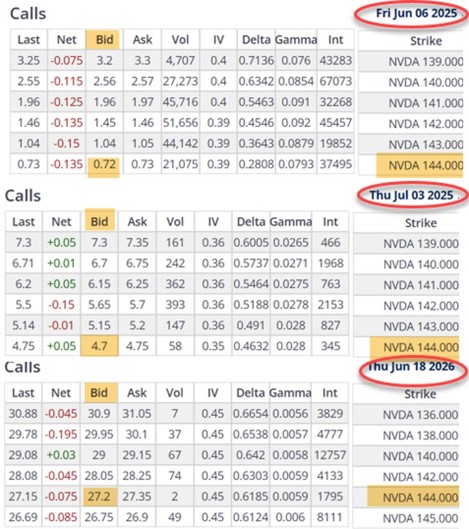
Core Insights - The article emphasizes the importance of focusing on annualized returns rather than premium dollar amounts when establishing covered call trades, referring to the latter as a "dollar distraction" that can mislead retail investors [1][7]. Summary by Sections Covered Call Trades - Retail investors often overlook annualized returns in favor of premium dollar amounts, which can lead to poor investment decisions [1]. - The article uses NVIDIA Corp. (Nasdaq: NVDA) as a case study to illustrate this point [1]. Option Pricing and Returns - On June 4, 2025, NVDA was trading at $141.39, with various call options available, including: - The 6/6/2025 $144.00 call with a bid price of $0.72 - The 7/3/2025 $144.00 call with a bid price of $4.70 - The 6/18/2026 $144.00 call with a bid price of $27.20 [4][6]. - The article highlights how the long-dated option's premium can be enticing but may not reflect the best investment choice [4][6]. Initial Calculations - Initial calculations for the three expiration dates show: - A 3-day return of 0.51% (annualized 61.96%) for the 6/6/2025 option - A 30-day return of 3.32% (annualized 40.44%) for the 7/3/2025 option - A 380-day return of 19.24% (annualized 18.48%) for the 6/18/2026 option [6]. - The article stresses the need to focus on annualized returns rather than just the dollar amount of premiums [6]. Investment Strategy - Investors should evaluate initial percentage returns in the context of the trade's time frame, noting that a 2% return over one month is more favorable than the same return over six months [7]. - The article warns against being distracted by high premium amounts from long-dated options and encourages a focus on annualized returns [7].
IGLD: Distorted Yield, Structural Deficiencies, Poorer Upside Participation
Seeking Alpha· 2025-08-06 22:25
Group 1 - The FT Vest Gold Strategy Target Income ETF (BATS: IGLD) aims to replicate a gold portfolio while employing partially covered call writing techniques to generate income [1] - IGLD is not expected to excel in capturing sharp upside rallies in the gold market [1] Group 2 - The article does not provide any specific financial data or performance metrics related to IGLD or the gold market [1]