
DRG/DIP支付改革

Search documents
医疗检验标准化赋能分级诊疗:从制度到技术的IVD市场全链条解析
思宇MedTech· 2026-01-14 07:19
Core Viewpoint - The article emphasizes the importance of standardization and mutual recognition in medical testing as a key direction for China's hierarchical diagnosis and treatment reform, reshaping the development landscape of the medical testing industry and presenting new market opportunities and challenges for IVD manufacturers [2][3]. Group 1: Hierarchical Medical System - China's medical hierarchical system is structured into a "three-level, nine-grade" system, categorizing hospitals into three levels, each further divided into three grades, with tertiary hospitals having an additional special grade [5]. - Each level of hospital has distinct functional characteristics: - Primary hospitals focus on community health services, managing common diseases and public health [6]. - Secondary hospitals serve as regional medical centers, providing specialized services and handling referrals from primary hospitals [6]. - Tertiary hospitals offer comprehensive medical services, including advanced specialty care and research, and serve as training centers [6]. Group 2: Policy and Development Trends - The hierarchical diagnosis and treatment system is a core component of China's medical reform, with a target of establishing 3,099 tightly-knit county medical communities by November 2025, covering 9.24 billion people [7]. - Specific regional goals have been set, such as in Henan Province, aiming for 65% of medical services to be provided at the grassroots level by 2025 [7]. Group 3: Hospital Distribution and Trends - As of the end of 2024, there are 1,093,551 medical institutions in China, with 38,710 hospitals. The growth rate of hospitals has slowed to 0.93%, primarily due to a significant slowdown in the growth of private hospitals [8]. - Tertiary hospitals are experiencing rapid growth, with an increase of 256 hospitals in 2024, reflecting a trend of concentrating quality medical resources at higher levels [8]. Group 4: Testing Department Standards and Equipment Requirements - Different levels of hospitals have varying standards and requirements for their testing departments, directly impacting the demand structure for IVD products [9]. - The construction and equipment standards for testing departments vary significantly across hospital levels, with tertiary hospitals requiring the most advanced and comprehensive equipment [10]. Group 5: IVD Demand Decoding - Primary hospitals are moving towards integrated and simplified equipment needs, with a focus on upgrading outdated devices and ensuring compliance with new standards [12]. - Secondary hospitals require modular and mid-level automated equipment to meet both routine and specialized testing demands, with a growing emphasis on laboratory information management systems [15]. - Tertiary hospitals focus on high-throughput and cutting-edge platforms, emphasizing the need for comprehensive automation and integration to support clinical research and advanced diagnostics [18]. Group 6: Revenue Structure Analysis - In 2023, the examination and testing revenue for secondary public hospitals accounted for approximately 30% of their total revenue, while for tertiary hospitals, it constituted about 29.59% of their medical service revenue [22]. - The income structure varies significantly across hospital levels, with primary hospitals relying on basic testing projects, secondary hospitals benefiting from specialized projects, and tertiary hospitals driving revenue growth through high-value specialized projects [23][24]. Group 7: Market Transformation in Primary Care - The focus of enhancing primary healthcare institutions is shifting from mere equipment updates to deeper system standardization and centralized operations [26]. - Standardization in testing is driven by the need for result mutual recognition and cost control, making standardized reagents and quality control systems essential for primary healthcare institutions [28]. - The "medical community" model is changing procurement and supply methods, leading to a market shift towards centralized purchasing and integrated solution offerings [30][31].


最新医保政策解析:手术和治疗辅助操作,统一收费框架!
思宇MedTech· 2025-12-08 12:20
Core Viewpoint - The article discusses the issuance of the "Guidelines for the Pricing of Surgical and Treatment Auxiliary Operations" by the National Medical Insurance Administration, which aims to standardize and categorize auxiliary surgical operations within the medical insurance system, enhancing transparency and adaptability to new technologies [2][3]. Policy Background - The introduction of a unified pricing guideline addresses structural challenges in China's medical service pricing system, such as regional disparities and the lack of standardized pricing for auxiliary operations [3]. - The guidelines represent the first systematic classification of auxiliary operations in surgery, covering advanced technologies like 3D imaging, navigation systems, and remote surgery [3][4]. Key Components of the Guidelines - The pricing project consists of seven core elements: project name, service output, price composition, additional charges, expansion items, pricing units, and pricing explanations [4]. - The guidelines include 36 auxiliary operations categorized into six systems based on service output attributes, facilitating understanding across disciplines [5][6]. Categories of Auxiliary Operations - **3D Technology Chain**: This category includes operations related to 3D reconstruction, modeling, and printing, which enhance pre-surgical planning and individualization of treatment [6][8]. - **Tracing and Imaging Enhancement**: This category focuses on technologies that improve intraoperative information clarity, such as tracers and advanced imaging techniques [7][9]. - **Energy Instrument Assistance**: This category includes various energy devices used in surgery, emphasizing the separation of technical costs from device usage [10][11]. - **Intraoperative Imaging Guidance**: This category standardizes the pricing of imaging guidance during surgery, enhancing its role in risk management [12][13]. - **Surgical Path Navigation**: This category includes navigation systems that provide real-time tracking and positioning during surgeries [14][15]. - **Surgical Robotics and Remote Surgery**: This category recognizes the role of robotic assistance and remote surgery as significant advancements in surgical capabilities [16][18]. Understanding the Pricing System - The guidelines emphasize that "service output" is the sole basis for establishing pricing projects, allowing for flexibility in technical paths as long as the output remains consistent [20]. - The guidelines allow for existing projects to accommodate technological improvements without the need for new pricing applications, reducing barriers to innovation [21][22]. Implications for Hospitals and Enterprises - The new pricing framework is expected to lead to a comprehensive restructuring of cost management, quality control, and payment mechanisms within hospitals [26][30]. - Hospitals will be better equipped to assess the real costs and values of auxiliary operations, promoting transparency and accountability in surgical practices [30][31]. - Enterprises will need to shift their focus from equipment-centric models to service output-oriented strategies, enhancing their data capabilities to comply with new regulatory requirements [36][38]. Observations on Systemic Evolution - The guidelines represent a significant shift from fragmented technical approaches to a cohesive capability system, facilitating clearer communication of technological value [44][45]. - The formal recognition of independent pricing for capabilities, such as robotic assistance, aligns with international trends towards technology-neutral and capability-oriented regulatory frameworks [46]. - The requirement for data retention and reporting will transform surgical practices from experience-based to data-driven methodologies, supporting future research and clinical improvements [47][48].

石四药集团(02005)公布中期业绩 股权持有人应占溢利约2.835亿港元 同比下降约58.7%
智通财经网· 2025-08-28 04:18
Core Viewpoint - The company reported a significant decline in sales and profits for the first half of 2025, with a focus on adapting to market challenges and enhancing product offerings to stabilize its business performance [1][2][3][4] Group 1: Financial Performance - The company achieved sales revenue of approximately HKD 21.47 billion, a year-on-year decrease of about 35.7% [1] - Profit attributable to equity holders was approximately HKD 283.5 million, down about 58.7% year-on-year [1] - Earnings per share were HKD 0.0962, with an interim dividend of HKD 0.05 per share [1] Group 2: Business Segments Infusion Business - Infusion sales volume decreased to approximately 715 million bottles (bags), a decline of 37% year-on-year, with sales revenue of HKD 1.199 billion, down 45% [1] - The company is focusing on product matrix development and digital transformation to enhance market positioning [1] Injectable Business - Ampoule water needle sales volume reached 17.818 million units, a year-on-year increase of 7%, but sales revenue fell by 57% to HKD 157 million [2] - Notable growth in specific products: Methylcobalamin injection sales increased by 61%, and Urapidil hydrochloride injection sales rose by 28% [2] Oral Formulations - Oral formulations achieved sales of HKD 296 million, a year-on-year increase of 16% [2] - New products contributed significantly, with sales of specific items like Rosuvastatin calcium tablets increasing by 32% [2] API Business - API sales amounted to HKD 361 million, a decline of 9.6% year-on-year, with caffeine sales down 15% [3] - The company is enhancing international collaborations and product registrations to mitigate market challenges [3] Export Business - The company reported a 42% increase in export volume for infusions, with significant growth in ampoule water needle and oral formulation exports [3] - The total export sales reached RMB 100.45 million, reflecting a 42% year-on-year increase [3] Packaging Materials - Sales of pharmaceutical packaging materials reached HKD 101 million, a year-on-year increase of 7.1% [4] - The company is focusing on enhancing its product offerings to meet market demands [4]
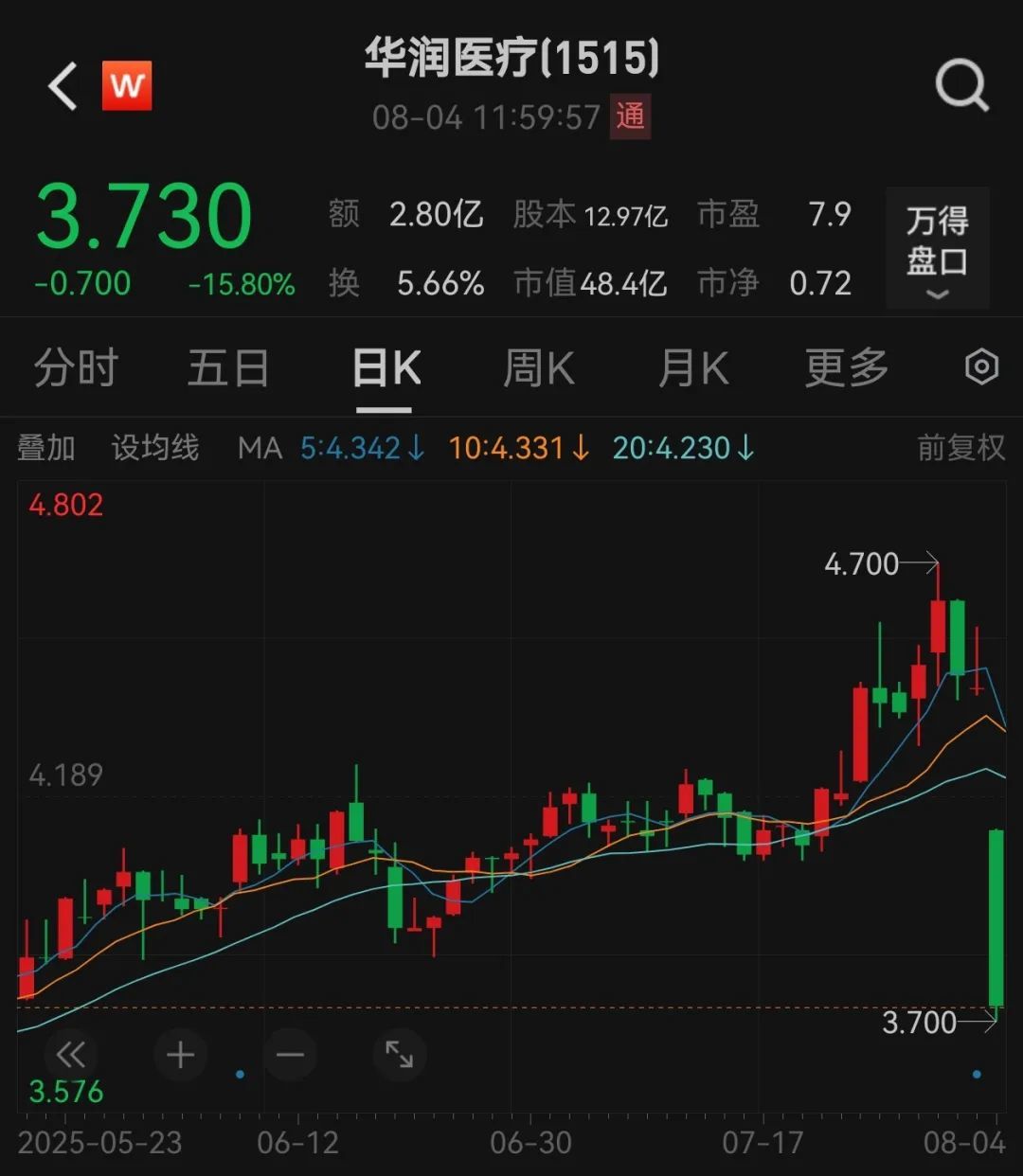
股价暴跌15%!坐拥至少9家三甲医院,华润医疗业绩大降
Mei Ri Jing Ji Xin Wen· 2025-08-04 06:09
Group 1 - The core business of hospitals is facing challenges in the first half of the year, with China Resources Medical (01515.HK) reporting a significant decline in patient visits and hospital admissions for 2024 [1][3] - The company anticipates a profit decline of approximately 20% to 25% for the first half of 2024, and a more severe drop of 55% to 60% when excluding one-time income from previous management fees and compensation [3] - The decline in profits is attributed to reduced average medical expenses due to healthcare insurance cost control, as well as the company's gradual exit from the investment-operation-transfer (IOT) model, which has impacted profit contributions [3] Group 2 - The company operates hospitals across 10 provinces, with at least 9 tertiary hospitals among its facilities [3][4] - The performance issues faced by China Resources Medical are not isolated, as International Medical (000516.SZ) also reported expected losses for the first half of 2025, influenced by market fluctuations and policy reforms [5] - International Medical's revenue for the first quarter of 2025 showed a decline of 14.99% year-on-year, with a net profit loss of 1.06 billion yuan, indicating broader industry challenges [5][6] Group 3 - The healthcare industry is undergoing significant changes with the full implementation of DRG/DIP payment systems, which are pressuring hospitals to reduce costs and improve efficiency [6] - Public hospitals are experiencing revenue pressure, while leading private hospitals may benefit from compliant operations, suggesting a potential market consolidation [6]
国际医学:提升精细化运营水平 发挥差异化优势 不断增强公司综合实力
Zheng Quan Shi Bao Wang· 2025-07-23 08:20
Core Insights - The DRG (Diagnosis-Related Group) payment reform in China is set to deepen in 2025, aiming to optimize resource allocation, control costs, and improve medical efficiency [1] - The DRG/DIP (Disease Value Payment) system will cover all eligible medical institutions by the end of this year, transitioning to a fixed payment model based on disease grouping rather than itemized billing [1] - The adjustment in payment policies may suppress average costs and hospitalization rates in the short term, but will encourage healthcare institutions to focus on refined management and cost control in the long term [2] Company Strategies - The company is focusing on high CMI (Case Mix Index) disease categories such as neurosurgery and oncology, while also undertaking complex medical projects to establish a leading advantage [3] - The company is implementing a differentiated strategy by expanding into high-value medical health markets, including specialized services in areas like aesthetic medicine, reproductive health, and proton therapy [3][4] - The company has developed a comprehensive health service platform that integrates medical services, rehabilitation, and elderly care, aiming to enhance operational efficiency and overall performance [5] Market Positioning - The company is actively pursuing multi-dimensional strategies to adapt to the changing healthcare landscape, emphasizing refined operations, cost control, and revenue structure adjustments [2] - The establishment of the proton therapy center, expected to be operational by the end of 2025, positions the company as a key player in advanced cancer treatment in the Northwest region [4] - The company is leveraging its medical capabilities to provide VIP services and comprehensive health management, enhancing its competitive edge in the market [4][5]
