ENSO

Search documents
拉尼娜状态持续 对我国影响几何?
Xin Hua She· 2025-12-16 02:03
Core Viewpoint - The La Niña phenomenon is expected to persist until early 2026, with a low probability of developing into a full La Niña event due to its anticipated duration being less than five months [2][3]. Group 1: La Niña Status and Predictions - The La Niña state was observed in October 2025 and is projected to last until early 2026 [2]. - The likelihood of this La Niña state evolving into a full La Niña event is relatively low, as it is expected to last less than five months [3]. Group 2: Weather Impacts on China - This winter, most regions in China are expected to experience temperatures close to or above the historical average, with significant fluctuations in temperature [4]. - The overall precipitation across the country is anticipated to be below average, with a spatial distribution of "more in the north, less in the south" [4]. Group 3: Regional Preparations and Risks - Regions such as Northeast, North China, Inner Mongolia, and Xinjiang may face severe weather events, including strong winds, temperature drops, and snowfall, necessitating preparations for potential agricultural and energy supply impacts [5]. - Areas in Southeast and East China are at risk of winter-spring droughts due to higher temperatures and lower precipitation, suggesting a need for improved water resource management [5]. - The significant temperature fluctuations may affect public health, particularly respiratory and cardiovascular conditions, requiring attention to health impacts [5].
今冬平均气温接近常年同期至偏高
Ke Ji Ri Bao· 2025-11-04 00:42
Group 1 - The average national temperature in China since October is 11.1℃, close to the normal level for the same period, exhibiting characteristics of "warm at the front and cold at the back" and "cold in the north and warm in the south" [1] - There has been an increase in the activity of cold air since October compared to September, with three cold air processes occurring, which is close to the normal level for the same period [1] - The monitoring of seasonal progress indicates that most northern regions have entered winter, with significant differences in the timing of winter onset compared to normal years [1] Group 2 - As of September, the equatorial central and eastern Pacific is in a neutral to slightly cold state regarding ENSO, with expectations of entering a La Niña state in the late autumn and lasting until early 2026 [2] - The forecast for this winter suggests that the national average temperature will be close to or slightly above the normal level, with overall less precipitation and a "more in the north, less in the south" distribution [2] - There is a low risk of widespread persistent low-temperature rain, snow, and freezing weather in southern regions this winter, with significant fluctuations in temperature expected [2]
中国气象局:预计秋季后期进入拉尼娜状态
Zhong Guo Xin Wen Wang· 2025-10-31 13:47
Core Insights - The China Meteorological Administration predicts the onset of La Niña conditions in late autumn, with significant temperature fluctuations expected during the winter season [1][2] Group 1: La Niña Conditions - La Niña is expected to develop in late autumn and persist until early 2026, with a lower probability of forming a prolonged La Niña event due to its anticipated short duration [2] - The equatorial central-eastern Pacific is forecasted to remain in a neutral-cool state until September 2025 [2] Group 2: Impact on Winter Climate - Under La Niña conditions, the average winter temperature across China is expected to be close to or above the normal levels, with overall reduced precipitation [2] - The distribution of precipitation is anticipated to be "more in the north, less in the south," with a lower risk of widespread low-temperature rain and snow events in southern regions [2] - Specific areas such as southeastern East China, eastern Central China, and eastern South China are expected to experience less precipitation [2]
我研究团队揭示西北干旱区东西部干湿变化分异的深层机制
Ke Ji Ri Bao· 2025-08-08 01:39
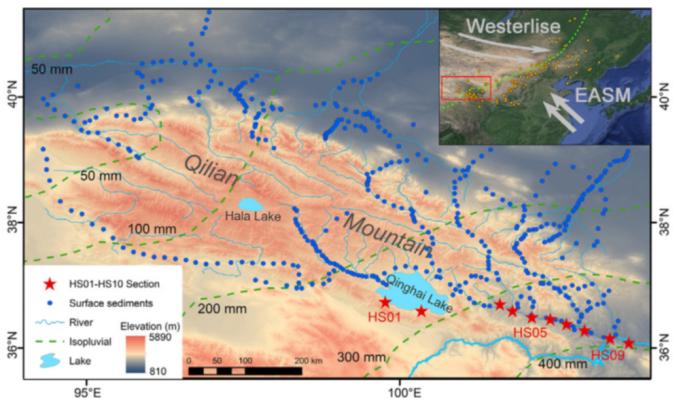
Core Insights - The research team led by Professor Li Yu from Lanzhou University successfully reconstructed the dry-wet variation process in the upper Yellow River region during the Holocene, revealing the main mechanisms controlling these changes over a long time scale [1][3][4] Group 1: Research Findings - The study published in the journal "Science Bulletin" highlights significant regional differences in water resource evolution in China's northwest arid areas, with the western region gradually becoming "warmer and wetter" since the 1960s, while the eastern upper Yellow River area has continued to experience "aridification" [3][4] - The research team established a lake evolution research network in the Qilian Mountains and accurately characterized the Holocene dry-wet evolution, noting that lake water levels rose from the late Ice Age to the early Holocene, peaked during the mid-Holocene, and have been declining since the late Holocene [3][4] Group 2: Climate Mechanisms - The primary controlling factor for the Holocene dry-wet changes in the region is identified as the interaction between tropical ocean and atmosphere (ENSO), with observations indicating a recent trend of warming and wetting in the northwest, but a potential increase in ENSO amplitude could alter hydrological patterns and increase the risk of extreme drought events [3][4] - The study also simulated the water cycle of lakes in the East Asia-Central Asia arid region since the last glacial maximum, revealing differing water resource evolution patterns on the eastern and western sides, attributed to variations in moisture transport from monsoons and westerly winds, as well as differences in lake evaporation effects [4]