拉尼娜状态

Search documents
武汉到底下不下雪?权威回应
Xin Lang Cai Jing· 2026-01-19 12:01
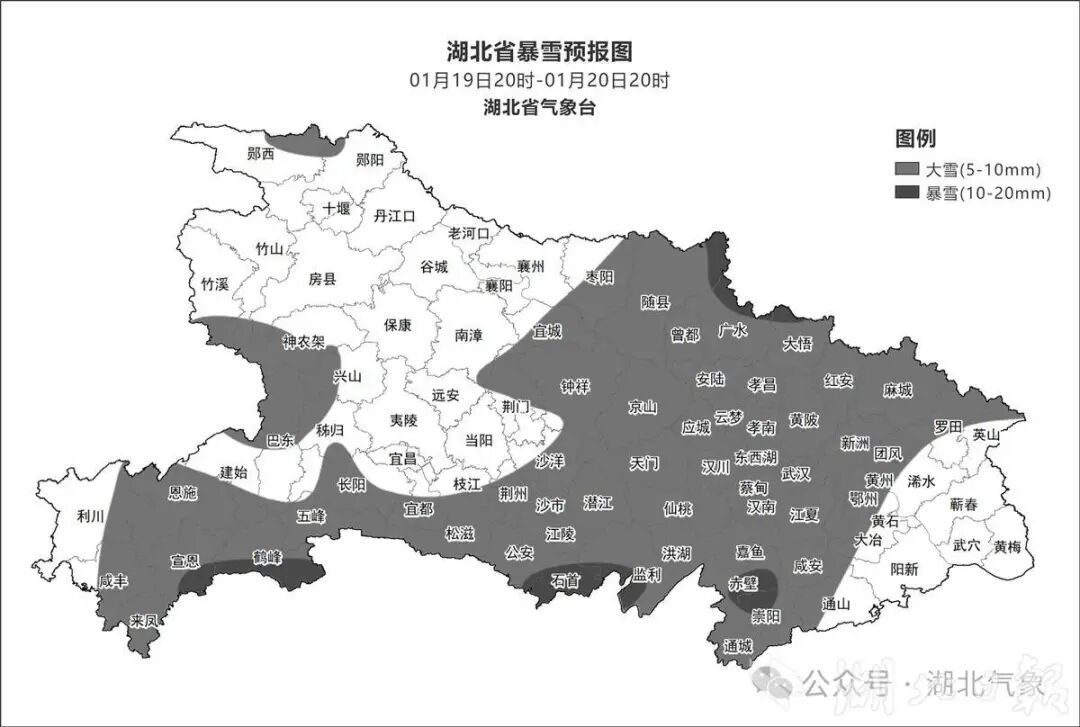
Core Viewpoint - The article discusses the unusual weather patterns in Hubei province, particularly in Wuhan, where expectations of snowfall have not been met, leading to public confusion and humor about the situation. The meteorological conditions are complex, with snow being delayed due to various atmospheric factors [1][3]. Weather Conditions - As of January 19, light snow has been reported in high-altitude areas such as Shiyan and Xiangyang, while Wuhan has experienced rain mixed with ice pellets, which quickly melted upon contact with the ground [3][4]. - The temperature in Wuhan dropped sharply from 15°C to 4°C within a day, with strong winds reaching up to 9-10 levels, contributing to the perception of a "snowless" winter [3][4]. Meteorological Explanation - The delay in snowfall is attributed to a "warm curtain" effect, where the necessary conditions for snow—cold air, warm moist air, and temperature layering—are not aligning properly. Ice crystals are forming at high altitudes but are melting into rain or ice pellets before reaching the ground [3][4]. - Urban heat effects in Wuhan, due to dense buildings and population, have raised local temperatures by 1 to 2°C compared to rural areas, further complicating snowfall predictions [4]. Forecast and Warnings - Meteorological authorities predict that pure snow will arrive in Wuhan on the evening of January 19, transitioning from rain to freezing rain and then to snow, with expected accumulation of 2 to 4 centimeters [5]. - A cold wave warning has been issued, with temperatures expected to drop to between -3°C and -5°C from January 20 to 22, increasing the risk of icy roads [5].

西红柿“身价暴涨” 原因何在?
Xin Hua She· 2026-01-17 02:40
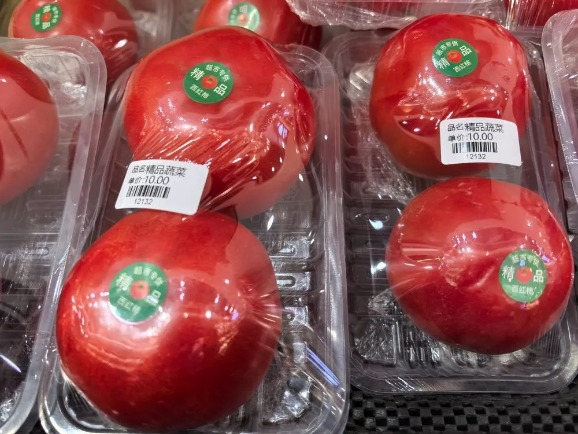
Core Viewpoint - The recent significant increase in tomato prices across various regions in China has raised consumer concerns and prompted investigations into the causes and potential future trends of vegetable prices [1][3]. Group 1: Price Trends - The average wholesale price of tomatoes rose to 8.61 yuan per kilogram from 4.76 yuan per kilogram year-on-year, marking an 80.9% increase [3]. - Retail prices for bulk tomatoes range from 5 to 7 yuan per pound, while packaged tomatoes are priced between 10 to 18 yuan per pound [1]. Group 2: Causes of Price Increase - The price surge began in the second half of the previous year, influenced by a combination of factors including reduced planting area due to previous low prices and adverse weather conditions affecting production [3][4]. - Continuous rainfall in northern production areas led to root damage and reduced fruit setting rates, further exacerbating the supply issues [3][4]. Group 3: Future Price Expectations - Experts predict that high tomato prices will persist until late March, followed by a seasonal decline [6]. - The demand for premium tomatoes is expected to remain strong due to pre-holiday stocking, while adverse weather conditions will continue to support prices [6].
今冬广西会遭遇“超级冷冬”吗
Guang Xi Ri Bao· 2025-12-18 03:16
Group 1 - The current La Niña state is characterized by cooler sea temperatures in the equatorial central and eastern Pacific, leading to concerns about a cold winter, with some suggesting it could be a "super cold winter" [1] - La Niña state does not equate to a La Niña event; a La Niña event is recognized only when the state persists for more than five months [1] - La Niña influences weather patterns by cooling the eastern Pacific and warming the western Pacific, resulting in drier conditions in the east and wetter conditions in the west [1] Group 2 - The probability of a winter similar to the severe cold disaster of 2008 is low, as this year features a La Niña state rather than a stronger La Niña event [2] - Predictions indicate that this winter will have normal to slightly stronger winds, with unfavorable conditions for widespread low-temperature rain and snow events [2] - The analysis suggests significant temperature fluctuations in Guangxi this winter, with potential for extreme low temperatures and reduced precipitation, leading to possible meteorological droughts [2]
今冬极端天气发生概率增大
Liao Ning Ri Bao· 2025-12-18 01:45
Group 1 - The La Niña phenomenon is characterized by a significant and sustained cooling of sea surface temperatures in the central and eastern equatorial Pacific, which can lead to various climate impacts [3] - The current La Niña state is expected to last until early 2026, but it is unlikely to develop into a La Niña event due to its duration being less than five months [3] - The average precipitation in Liaoning since the beginning of winter is 2.0 mm, which is 60% lower than the normal level, while the average temperature is -5.7°C, slightly lower than the historical average [3] Group 2 - La Niña years typically result in lower temperatures and increased precipitation in Liaoning, leading to a higher probability of extreme weather events such as cold waves and heavy rainfall [5] - The agricultural sector may face challenges due to snow and low temperatures affecting facility agriculture, while the energy sector must prepare for increased heating demand and potential peak energy usage [5] - The transportation sector needs to develop emergency plans to mitigate the impacts of rain, snow, and icy conditions on road traffic [5]

长春今冬降雪明显偏少 气象部门称属局地气候异常
Zhong Guo Xin Wen Wang· 2025-12-17 08:56
Core Viewpoint - The winter snowfall in Changchun and central-western Jilin Province is significantly below average, attributed to weak cold air and insufficient moisture transport, which is classified as a local climate anomaly rather than an El Niño effect [1][2]. Summary by Sections Snowfall Data - From November 1 to December 15, the average precipitation in Jilin Province was 15.7 millimeters, which is 37% less than the average for the same period, marking it as the 7th least snowy year since 2000, the 2nd least since 2010, and the least since 2020 [2]. Climate Conditions - The formation of snowfall requires the interaction of cold air and warm moist air. This year, the overall strength of cold air affecting Northeast China has been weak and moves quickly, making it difficult to establish a sustained low-temperature environment [2]. - The primary moisture source for Changchun's winter is the North Pacific and the westerly wind belt. However, this year, a dominant northerly airflow has blocked warm moist air, leading to insufficient moisture even when cold air is present [2]. El Niño and La Niña Effects - Since September, the sea surface temperatures in the equatorial Pacific have been persistently low, entering a La Niña state in November, but not reaching the criteria for a La Niña event. The current La Niña state has mainly resulted in increased temperature fluctuations in Northeast China and has suppressed moisture transport to the region, contributing to reduced precipitation [2]. Historical Context - Historically, December is a month with relatively low snowfall in Jilin Province, with some years experiencing no snow at all throughout the month. Therefore, the current "poor snow" phenomenon is not unprecedented [2]. Future Weather Forecast - From December 17 to 26, Jilin Province is expected to experience three precipitation events, with varying snowfall amounts across regions. Despite a slight increase in average precipitation over the next ten days, the snowfall amounts in the central-western regions are expected to remain low [4]. - The meteorological department has advised that the lack of snow may impact agricultural production, water resource management, ecological environment, and forest fire prevention. Recommendations include enhancing water resource management and preparing for agricultural irrigation [4].
赤道中东太平洋已进入拉尼娜状态 我国今冬冷暖起伏大
Ke Ji Ri Bao· 2025-12-17 01:29
Core Viewpoint - The recent monitoring by the National Climate Center indicates that the equatorial central and eastern Pacific has entered a La Niña state, which typically leads to lower winter temperatures in China. Public interest has surged regarding the potential for a "double La Niña" this winter and whether it will be a cold winter [1]. Group 1: Understanding La Niña - La Niña refers to a phenomenon where the sea surface temperatures in the equatorial central and eastern Pacific are abnormally cold. It is defined by the NINO 3.4 index, which indicates La Niña when the three-month average is less than or equal to -0.5°C [2]. - The current La Niña state is expected to persist until early 2026, but the likelihood of it developing into a full La Niña event is relatively low, making the occurrence of a double La Niña this winter unlikely [2]. Group 2: Climate Impact of La Niña - The occurrence of La Niña leads to significant global climate anomalies, particularly affecting China's climate. During La Niña winters, cold air from the north is more likely to move south, resulting in lower temperatures in central and eastern China [3]. - La Niña conditions can also lead to reduced precipitation in southern regions, increasing the risk of drought during the winter and spring [3]. - In the summer following a La Niña event, the position of the subtropical high in the western Pacific tends to shift northward, which can lead to increased rainfall in northern China but decreased rainfall in the Yangtze River basin, raising the risk of high temperatures and drought [3]. Group 3: Preparations for Winter - The forecast suggests that winter temperatures in China will be close to or slightly above the historical average, with significant fluctuations expected. Overall precipitation is predicted to be lower, particularly in southern regions [4]. - In northern areas, there may be risks of strong winds, severe cold, and heavy snowfall, which could impact agriculture and energy supply. Preparations for energy demand spikes and material reserves are recommended [4]. - Southern and eastern regions may face risks of winter-spring droughts due to higher temperatures and lower precipitation, necessitating improved water resource management and fire risk monitoring [4].

拉尼娜状态持续 对我国影响几何?
Xin Hua She· 2025-12-16 02:03
Core Viewpoint - The La Niña phenomenon is expected to persist until early 2026, with a low probability of developing into a full La Niña event due to its anticipated duration being less than five months [2][3]. Group 1: La Niña Status and Predictions - The La Niña state was observed in October 2025 and is projected to last until early 2026 [2]. - The likelihood of this La Niña state evolving into a full La Niña event is relatively low, as it is expected to last less than five months [3]. Group 2: Weather Impacts on China - This winter, most regions in China are expected to experience temperatures close to or above the historical average, with significant fluctuations in temperature [4]. - The overall precipitation across the country is anticipated to be below average, with a spatial distribution of "more in the north, less in the south" [4]. Group 3: Regional Preparations and Risks - Regions such as Northeast, North China, Inner Mongolia, and Xinjiang may face severe weather events, including strong winds, temperature drops, and snowfall, necessitating preparations for potential agricultural and energy supply impacts [5]. - Areas in Southeast and East China are at risk of winter-spring droughts due to higher temperatures and lower precipitation, suggesting a need for improved water resource management [5]. - The significant temperature fluctuations may affect public health, particularly respiratory and cardiovascular conditions, requiring attention to health impacts [5].
拉尼娜状态持续,预计今冬我国强降温和升温事件将频繁
Ren Min Ri Bao· 2025-12-16 01:31
Core Viewpoint - The current La Niña state in the equatorial central and eastern Pacific is expected to persist until early 2026, with a low probability of forming a significant La Niña event due to its duration being less than five months [1]. Group 1: La Niña State Definition and Duration - The La Niña state is defined by the NINO3.4 index, which indicates that when the three-month sliding average of sea surface temperature anomalies is less than or equal to -0.5 degrees Celsius, it is considered a La Niña state [1]. - The National Climate Center reports that as of December 15, the La Niña state is ongoing, and its duration is currently less than five months, making the likelihood of a significant La Niña event relatively low [1]. Group 2: Impacts of La Niña State - The ongoing La Niña state is expected to lead to colder temperatures in central and eastern China during winter, as the prevailing cyclonic circulation enhances the winter monsoon [1]. - There is a historical trend of warmer winter temperatures in China under La Niña conditions, with instances of warm winters occurring, such as in the winter of 2020/2021 [2]. - The cyclonic circulation may also suppress moisture transport from the northwest Pacific and South China Sea, leading to reduced precipitation and an increased risk of drought during the winter and spring [2]. Group 3: Weather Predictions for Winter - This winter, most regions in China are expected to experience temperatures close to or above the seasonal average, with significant fluctuations and frequent cold and warm events [2]. - Overall precipitation is anticipated to be below average, with a spatial distribution of "more in the north, less in the south" [2]. - Specific regions such as Northeast China, North China, Inner Mongolia, and Xinjiang may experience strong winds, significant temperature drops, and snowfall, while southern regions may face risks of drought due to low temperatures and reduced precipitation [2].
拉尼娜状态持续,对我国今冬有何影响?
Ren Min Ri Bao· 2025-12-15 22:52
Group 1 - The La Niña phenomenon has been observed in the equatorial central and eastern Pacific since October 2023, and it is expected to last until early 2026, although the likelihood of it forming a significant event is low due to its duration being less than five months [1] - La Niña conditions typically lead to colder temperatures in central and eastern China during winter, as the prevailing cyclonic circulation enhances the winter monsoon [1] - The current La Niña state may result in a warmer winter in China, with significant temperature fluctuations and overall reduced precipitation, particularly in southern regions [2] Group 2 - The impact of La Niña includes potential drought conditions in southern China due to suppressed moisture transport from the western Pacific and surrounding areas [2] - Specific weather patterns expected this winter include strong cold snaps and precipitation events in northern regions, while southern areas may experience higher temperatures and lower rainfall, increasing the risk of winter-spring droughts [2] - Preparations for potential meteorological disasters are advised as the La Niña state continues, with localized weather phenomena expected across various regions [2]
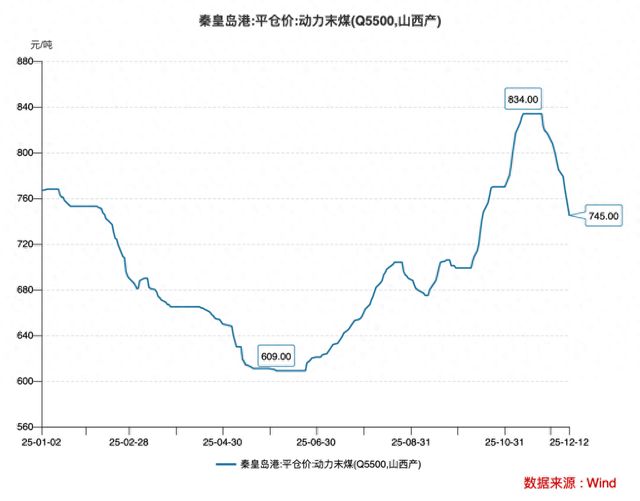
动力煤跌破800元/吨后持续下探,今年煤市旺季为何不旺?
Xin Lang Cai Jing· 2025-12-15 13:33
Group 1 - The core viewpoint of the articles indicates that thermal coal prices are continuing to decline, with the price at Qinhuangdao Port dropping below 800 yuan/ton and further decreasing to 745 yuan/ton as of December 12, marking a month-on-month decline of approximately 90 yuan/ton and a year-on-year decrease of about 50 yuan/ton [1][3] - The average price of thermal coal at Qinhuangdao Port for the year is reported to be 697.03 yuan/ton, which is over 150 yuan/ton lower than the average price for the entire year of 2024 [3] - The China Electricity Council attributes the pressure on the coal market to high inventory levels and lower-than-usual daily consumption, indicating a struggle between high inventory and weak demand against expectations for a winter peak in coal usage [3] Group 2 - On the supply side, coal production in China has seen stable growth this year, while import volumes have significantly decreased, with November coal imports down by 19.9% year-on-year [3][4] - In November, the coal production reached 4.3 billion tons, a slight year-on-year decrease of 0.5%, while the cumulative coal production from January to November was 4.4 billion tons, reflecting a year-on-year increase of 1.4% [3] - The inventory levels at northern ports have risen to approximately 29 million tons, an increase of nearly 600,000 tons or 25% since early November [5] Group 3 - Electricity production in November showed growth, but thermal power generation shifted from growth to decline, with a year-on-year decrease of 4.2% in industrial thermal power generation [4][5] - Renewable energy sources such as solar, wind, and hydropower have seen significant year-on-year growth, with solar power increasing by 23.4% and wind power by 22% [5] - The current high temperatures across the country have reduced the demand for coal during the winter peak season, leading to a bearish outlook for coal prices [6] Group 4 - Analysts from various securities firms suggest that coal prices will remain under pressure in the short term due to high inventory levels and insufficient demand from the winter heating season [6] - The potential for a rise in coal prices may depend on unexpected drops in temperatures in December and January, which could increase residential electricity demand and subsequently boost coal consumption [6]