
ETF命名标准化

Search documents
4000亿元ETF带头改名!头部ETF“实名制”进度如何了?
Sou Hu Cai Jing· 2026-01-08 11:46
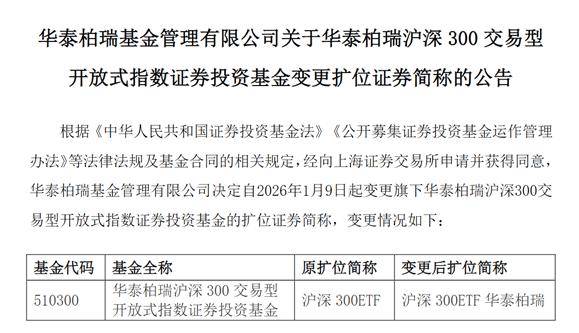
Group 1 - The core point of the article is the significant adjustment in the ETF market, highlighted by the renaming of Huatai-PB's CSI 300 ETF to "CSI 300 ETF Huatai-PB," effective from January 9, 2024, which is the largest stock ETF in the market with an asset management scale exceeding 400 billion yuan [1][3] - This renaming is part of a broader move towards standardization and transparency in the ETF market, as mandated by the revised business guidelines from the Shanghai and Shenzhen Stock Exchanges, requiring all existing ETFs to complete standardized naming by March 31, 2026 [3][4] - The current total scale of China's ETF market has surpassed 6 trillion yuan, with over a thousand products available, indicating a growing complexity for investors in distinguishing between similar ETFs [3][4] Group 2 - Major fund management companies are actively responding to the new naming regulations, with several leading firms already completing the adjustments; for instance, E Fund and Da Cheng Fund have all their existing ETFs named according to the new standards [4] - As of January 1, 2026, data shows that among the top twenty public fund institutions by ETF asset value, many have successfully implemented standardized naming for their ETFs, enhancing clarity for investors [4][6] - Huatai-PB's completion of standardized naming for its ETFs will increase the total number of its ETFs with standardized names to 21, all adopting the suffix "ETF Huatai-PB," thereby strengthening brand recognition [3][4]

ETF告别“同名混战” 规范命名提升辨识度
Zheng Quan Ri Bao· 2025-11-26 16:40
Core Viewpoint - The ETF market is undergoing a "standardization" transformation, driven by new regulations requiring existing ETFs to include the fund manager's identification in their names by March 31, 2026, impacting a market worth 5.6 trillion yuan [1] Group 1: Standardization and Regulation - The new regulation aims to promote high-quality development of index-based investment in the capital market, standardizing the ETF naming system and breaking the irrational competition over simple naming resources among fund companies [2] - A clear "core formula" for ETF naming has been established, requiring names to follow the structure of "core elements of the investment target + ETF + fund manager name," with enhanced ETFs needing to include an "enhanced" identifier [2][4] Group 2: Market Challenges and Solutions - The ETF market previously faced two main issues: lack of naming standards leading to confusion among similar products and a focus on the underlying index that obscured the fund manager's professional value [3] - The new naming regulations are designed to help investors accurately distinguish products and reduce the risk of misjudgment in information screening and trading [4] Group 3: Shift in Competitive Landscape - The ETF market competition is shifting from "name grabbing" to "brand highlighting," with fund managers needing to rely on their core strengths rather than simply securing catchy names [4] - Future core competitiveness will focus on three aspects: brand reputation, operational capabilities (including low fees and high liquidity), and distinctive positioning for smaller fund companies to create competitive advantages [4]
ETF命名标准化 嘉实旗下22只指数基金集体更名
news flash· 2025-06-16 00:49
Core Viewpoint - The standardization of ETF naming is being implemented, with a focus on clarity and reduced information screening costs for investors [1] Group 1: ETF Naming Standardization - The unified naming standard for ETFs is "Underlying Index + ETF + Manager Name" [1] - On June 17, 22 products from Harvest Fund, including 21 ETFs and 1 LOF, will undergo collective renaming [1] - This adjustment involves major indices such as CSI A series, rare earth, pharmaceuticals, and gold [1] Group 2: Industry Trends - The trend of renaming index products has been observed among public funds this year [1] - The new naming convention aims to enhance the clarity and recognition of index products [1] - The large-scale renaming of 22 index products is a first in the industry [1]