
LOF

Search documents
超30只ETF,批量跌停!
Zhong Guo Zheng Quan Bao· 2026-02-02 12:24
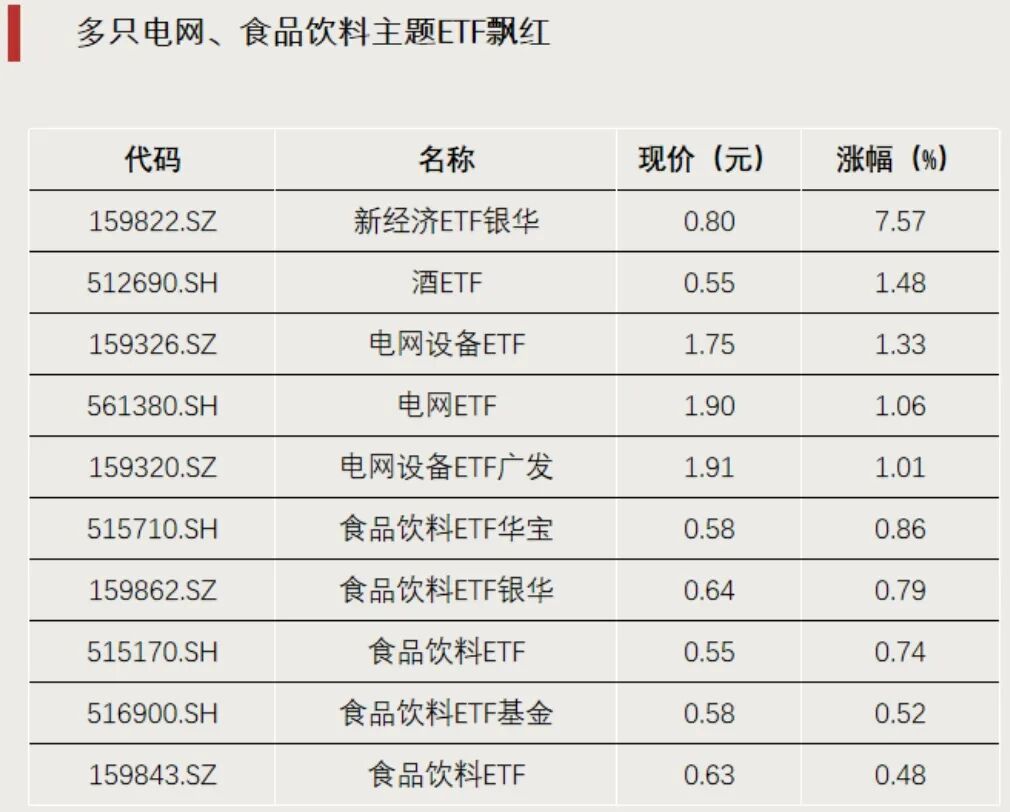
Market Overview - On February 2, over 30 ETF products hit the daily limit down, primarily from the gold and non-ferrous metal sectors, while ETFs related to electric grids, food and beverages, and banks showed resilience with gains [1][5] - The overall ETF market saw only about 50 products in the green at the close of trading [3] ETF Performance - The New Economy ETF by Yinhua (159822) recorded the highest single-day gain of over 7% on February 2 [3] - Several ETFs in the electric grid and food and beverage sectors demonstrated significant anti-drawdown characteristics, with notable performances including: - New Economy ETF Yinhua: 0.80 CNY, +7.57% - Food and Beverage ETF: 0.55 CNY, +1.48% - Electric Grid Equipment ETF: 1.75 CNY, +1.33% [4] Fund Flows - In January, multiple broad-based ETFs experienced significant net outflows, with a total exceeding 570 billion CNY from four major Hu-Shen 300 ETFs [8] - The specific net outflows for January included: - Huatai-PineBridge Hu-Shen 300 ETF: -190.84 billion CNY - E Fund Hu-Shen 300 ETF: -152.66 billion CNY - China Asset Hu-Shen 300 ETF: -137.59 billion CNY - Harvest Hu-Shen 300 ETF: -98.69 billion CNY [9] Market Sentiment - Current market conditions are characterized as a short-term emotional disturbance period, with expectations of a spring rally not yet concluded [3] - Analysts suggest that while there may be short-term volatility, the underlying logic supporting risk assets remains intact due to anticipated easing in 2026 and limited tightening actions from the Federal Reserve [3][7] Precious Metals Market - The precious metals market has seen a significant correction, attributed to a combination of speculative trading and increased margin requirements, leading to a technical clearing rather than a fundamental policy shift [6][7] - Despite recent volatility, long-term trends suggest continued support for precious metals due to weakening dollar credit and ongoing central bank purchases [7]

多只ETF、LOF罕见跌停
Xin Lang Cai Jing· 2026-01-30 12:51
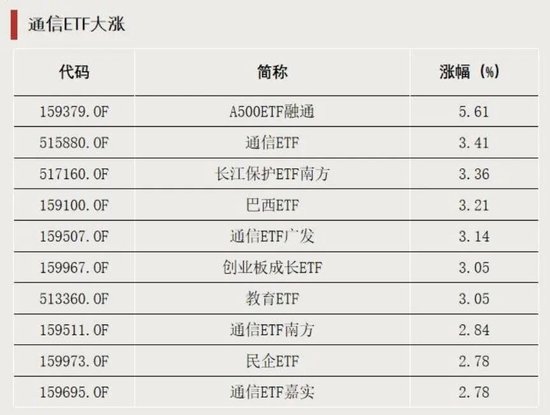
Group 1 - The precious metals, industrial metals, and minor metals sectors experienced a significant decline, with multiple gold and colored ETFs hitting the limit down [1][2][9] - Several LOF funds that had previously hit the limit up faced a limit down after resuming trading, indicating market volatility [10][18] - On January 29, gold and colored ETFs attracted substantial net inflows, while semiconductor-related ETFs also saw reverse positioning [11][15] Group 2 - The communication ETF sector showed a general increase, with several ETFs related to communication and artificial intelligence rising significantly [12][13] - Low-valuation sectors such as agriculture, forestry, and paper-making led the market gains, contrasting with the overall decline in precious metals [12] - The trading volume for gold ETFs surged, with the gold ETF reaching a transaction volume of 257.78 billion, significantly higher than the previous week's average of 71.07 billion [4][14] Group 3 - On January 29, various ETFs related to colored metals and gold saw net inflows exceeding 10 billion, indicating strong investor interest [15][17] - The semiconductor sector, despite its recent declines, attracted significant reverse investments, with notable inflows into semiconductor equipment ETFs [16][17] - The core logic supporting gold prices remains unchanged, driven by high geopolitical risks and the weakening of the dollar's credibility due to high U.S. government deficits [8][19]
投顾周刊:LOF集体狂欢后资金炒作退潮
Wind万得· 2025-12-27 22:20
Group 1 - Offshore RMB against USD broke the 7 mark, reaching a 15-month high at 6.9985 on December 25, with onshore RMB also nearing the 7 mark at 7.0053, indicating a potential continued appreciation of the RMB in the coming year, though not expected to be unilateral [2][4] - After a surge in LOF funds, a significant decline was observed on December 25, with multiple LOF funds hitting the limit down, including a drop of over 9% for several gold-related LOFs, leading to restrictions on subscriptions for various funds [2][4] - The Financial Regulatory Bureau released a unified information disclosure management method for asset management products, which aims to standardize disclosure rules across different types of financial products, enhancing investor protection [3][4] Group 2 - JD.com announced that 92% of its employees will receive year-end bonuses, with total bonus investment increasing by over 70% year-on-year, indicating a significant rise in compensation within the industry [4] - A new QDII fund is set to be launched by Dacheng Fund, with the issuance period from December 29 to February 4, amidst a scarcity of new QDII quotas affecting the issuance of such funds [4][5] Group 3 - The U.S. economy showed a substantial growth in Q3 with a real GDP annualized quarter-on-quarter increase of 4.3%, driven by strong consumer spending which accelerated to a growth rate of 3.5% [6][4] - Recent trends in global stock markets showed mixed results, with the Shanghai Composite Index rising by 1.88% and the Hang Seng Index by 0.50%, while U.S. markets also saw gains [7][4] Group 4 - Recent data indicated a decline in Chinese government bond yields, with 1-year, 5-year, and 10-year yields dropping by 9.5 basis points, 4.14 basis points, and 0.82 basis points respectively [9][10] - The recent week saw a general increase in fund indices, with the Wande All Fund Index rising by 1.43%, and specific categories like equity and mixed funds showing stronger performance [11][4] Group 5 - In the commodity market, precious metals saw significant gains, with COMEX gold rising by 3.98% and silver by 18.06%, while oil prices experienced a slight increase [12][4] - The dominance of fixed-income plus funds in bank financing products was highlighted, with 384 such funds accounting for 56.31% of the total number and 74.07% of the total scale [13][14] Group 6 - The trend of bank wealth management subsidiaries becoming the core financing entities reflects a concentration and specialization in China's banking system, with regional banks remaining active but limited in scale [15][4] - The recent issuance of wealth management products showed a strong performance in benchmark yields, with leading wealth management subsidiaries achieving higher returns [20][4]

告别“脸盲”困扰!ETF命名持续规范化
Guo Ji Jin Rong Bao· 2025-11-25 15:57
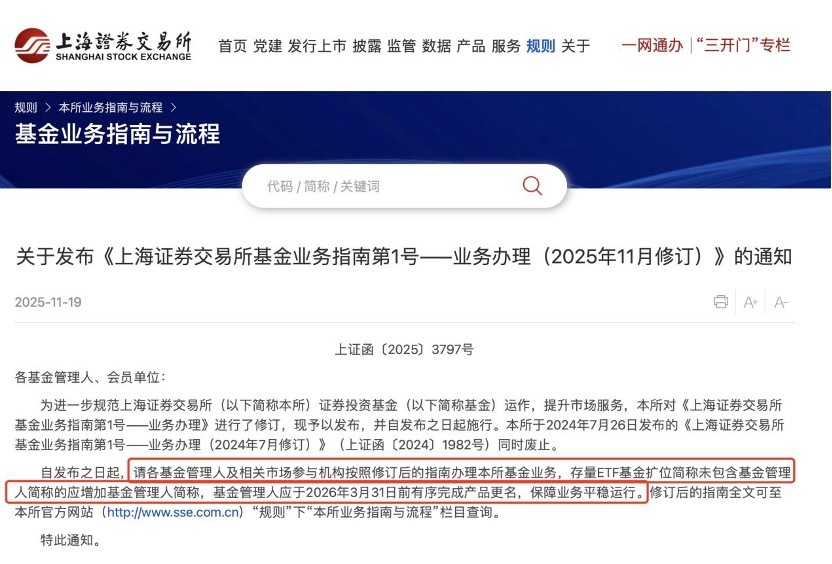
Core Viewpoint - The recent standardization of ETF naming by the Shanghai and Shenzhen Stock Exchanges aims to enhance product identification and reduce confusion in the market, addressing the issue of product homogeneity and low recognition [1][4][5]. Group 1: Standardization Guidelines - The revised guidelines require that ETF names include "investment target core elements + ETF" and the fund manager's abbreviation, with a deadline for existing ETFs to comply by March 31, 2026 [1][4]. - Other fund types such as LOF, FOF, and REITs also have specific naming requirements to reflect their core attributes [3][4]. - The guidelines emphasize clarity and alignment with actual investment targets to avoid misleading names [4][5]. Group 2: Industry Response - Major public fund institutions like E Fund, Huaxia, and Tianhong have begun to adjust their ETF names to align with the new standards, setting a benchmark for the industry [1][7][9]. - E Fund changed the names of 17 ETFs in January 2023, adopting the new naming structure [7]. - Other firms, including Huaxia and Jiashi, have also announced similar name changes for their ETFs throughout the year [8][9]. Group 3: Market Impact - The standardization is expected to improve product recognition and decision-making efficiency for investors, particularly benefiting novice investors by simplifying product selection [5][9][10]. - The initiative is seen as a crucial step towards the high-quality development of index investment in China's capital market [5][10].
ETF改名潮,千余只基金明年3月底前完成
Feng Huang Wang· 2025-11-24 07:33
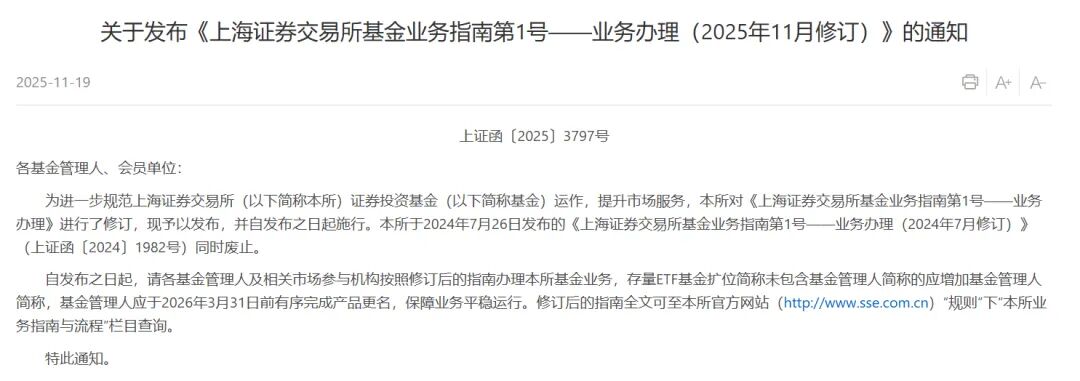
Core Viewpoint - The recent regulatory changes by the Shanghai and Shenzhen Stock Exchanges mandate a standardized naming convention for ETFs, enhancing product recognition and investor decision-making efficiency [2][4][8]. Group 1: Regulatory Changes - The revised guidelines require that the expanded abbreviations for ETFs must include the fund manager's name and follow specific naming structures, such as "core investment element + ETF" [4][5]. - Existing ETFs must complete their name changes by March 31, 2026, to comply with the new regulations [5][6]. Group 2: Market Impact - As of November 24, there are 1,367 ETFs in the market, with a significant increase in similar products leading to potential confusion among investors [5]. - Major fund companies like E Fund and Harvest have already begun adjusting their ETF names to align with the new standards, improving product clarity and investor experience [7][8]. Group 3: Industry Perspectives - Industry experts believe that the new naming conventions will enhance the identification of ETFs, allowing investors to better understand the underlying indices and the fund managers [8][9]. - The inclusion of fund manager names in ETF abbreviations is expected to reduce the likelihood of investors confusing similar products, thereby improving overall market efficiency [9][10].
本周热点:炒股后,才懂亲戚胆子有多大
集思录· 2025-11-07 13:01
Core Viewpoint - The article discusses various perspectives on investment strategies and experiences shared by individuals in the investment community, highlighting the challenges and opportunities in different investment avenues [1]. Group 1: Investment Strategies - The concept of becoming a "full-time investor" and exploring self-media as a potential avenue for sharing investment insights is presented [1]. - The experience of investing in the 华夏合肥高新 REIT is shared, where an expectation of a stable 5% return resulted in a loss exceeding 20% [1]. - The narrative of "young people running counters" reflects on the historical context of LOF discount arbitrage, indicating the complexities and risks involved in such strategies [1]. Group 2: Personal Investment Experiences - A personal anecdote illustrates the varying risk appetites among relatives when it comes to stock trading, emphasizing the psychological aspects of investing [1].

公募基金2025年二季报解读点评
2025-07-23 14:35
Summary of Key Points from the Conference Call Industry Overview - The report focuses on the public fund industry in China, specifically analyzing the performance and trends of various fund types in the second quarter of 2025. Core Insights and Arguments Public Fund Performance - In Q2 2025, the number and scale of newly launched active equity funds significantly increased, with an average fundraising scale of 520 million yuan, focusing on dividend value and technology growth [1][2] - Despite a market rebound, the overall share of active equity funds decreased by 2.2% due to redemptions of older products, maintaining a scale of 3.33 trillion yuan [1][2] - Fixed income plus products surpassed the levels of the second half of 2023, reaching 2.16 trillion yuan, with a notable expansion in mixed bond FOFs [1][2] Fund Categories - Active equity funds showed strong performance, with a 3.1% increase in the equity fund index, outperforming broad-based indices [1][5] - The new issuance of FOF products continued at a high level, with a total new scale of 18.6 billion yuan, leading to a 10% increase in the overall market scale of FOFs to 166.2 billion yuan [1][4] Investment Trends - Active equity funds increased their stock positions slightly, with a notable rise in holdings of Hong Kong stocks, which now account for 17% of their portfolios [3][26] - The communication and financial sectors received increased allocations, while consumer and manufacturing sectors saw reductions [27] Performance Metrics - The median returns for active equity funds in Q2 were strong, with ordinary stock, mixed equity, and flexible allocation products achieving median returns of 2.0%, 2.1%, and 1.8% respectively, all outperforming major indices [19][20] - Fixed income plus funds achieved positive returns across all subcategories, with convertible bond funds leading in performance [22][23] Additional Important Insights - The competitive landscape for FOF products shows a slight decrease in the market share of the top ten managers, which now account for 60.8% of the market [4][8] - The concentration of holdings in active equity funds has decreased, indicating a more diversified investment approach, with the CR10 and CR20 ratios at 17.5% and 25.8% respectively [28] - Notable stock holdings include Ningde Times, which remains the most favored stock among funds, despite a slight reduction in holdings [29] Market Dynamics - The passive index product market reached a total scale of 5.79 trillion yuan by the end of Q2, with a 12.6% quarter-on-quarter growth [11] - The issuance of passive stock products hit a historical high, with 109 new products launched in Q2 2025 [9][10] Sector-Specific Performance - The innovative pharmaceutical sector led the market in Q2, with corresponding theme funds achieving a median return of 10.1% [21] - The report highlights the strong performance of small-cap growth and value products, with median returns of 3.4% and 3.2% respectively [20] This summary encapsulates the key findings and insights from the conference call regarding the public fund industry, highlighting performance metrics, investment trends, and sector-specific dynamics.
ETF命名标准化 嘉实旗下22只指数基金集体更名
news flash· 2025-06-16 00:49
Core Viewpoint - The standardization of ETF naming is being implemented, with a focus on clarity and reduced information screening costs for investors [1] Group 1: ETF Naming Standardization - The unified naming standard for ETFs is "Underlying Index + ETF + Manager Name" [1] - On June 17, 22 products from Harvest Fund, including 21 ETFs and 1 LOF, will undergo collective renaming [1] - This adjustment involves major indices such as CSI A series, rare earth, pharmaceuticals, and gold [1] Group 2: Industry Trends - The trend of renaming index products has been observed among public funds this year [1] - The new naming convention aims to enhance the clarity and recognition of index products [1] - The large-scale renaming of 22 index products is a first in the industry [1]
支持符合条件的北交所上市公司依规在港交所上市 业内:助力形成“上市—成长—国际化”良性循环
Mei Ri Jing Ji Xin Wen· 2025-05-14 07:53
Group 1 - The Beijing Financial Street Service Bureau has proposed measures to enhance the capital market ecosystem and promote high-quality development of listed companies, particularly supporting the Beijing Stock Exchange (BSE) in improving its internationalization level and allowing eligible BSE-listed companies to list on the Hong Kong Stock Exchange (HKEX) [1][2] - The measures aim to strengthen the BSE's role in serving innovative small and medium-sized enterprises (SMEs) and enhance the effectiveness of inclusive finance [1][2] - The proposal includes establishing regular communication mechanisms with foreign exchanges and encouraging international financial institutions to participate in the development of the BSE [1][2] Group 2 - The measures will enrich the product system of the BSE, including support for the development of a government bond market, credit bond market, and research on publicly issued convertible bonds [2][3] - The expansion of index-based investments, including exchange-traded funds (ETFs), publicly offered real estate investment trusts (REITs), and asset securitization products, is expected to attract more long-term capital and enhance market activity [2][3] - The proposal also emphasizes supporting listed companies in increasing their technological innovation, with funding support based on R&D intensity, providing up to 2 million yuan in special funds per year for qualifying companies [3] Group 3 - The BSE primarily serves innovative SMEs, with over 90% of its listed companies being high-tech enterprises and nearly 80% from strategic emerging industries and advanced manufacturing [4] - More than half of the listed companies on the BSE are recognized as national-level specialized and innovative "little giant" enterprises [4]
中金:被动产品规模下行,宽基指数资金流出
中金点睛· 2025-04-24 23:40
Abstract 摘要 点击小程序查看报告原文 规模及竞争格局:产品规模上行趋势暂缓,宽基规模占比有所回落 被动产品规模上行趋势暂缓。 截至3月末被动产品整体规模5.14万亿元,总规模在近两年的上行趋势中首次出现单季度下滑,季度规模增速为-1.0%。结构 上,虽然一季度股票ETF新发规模不少,但由于产品资金净流出较多,整体上股票ETF相较上季度规模仅增长0.3%;债券型ETF则维持规模高增速,规模 增长21.2%,连续4个季度规模增速在20%以上;商品型ETF受益于黄金市场的持续走强,单季度大幅增长39.9%。此外,LOF和场外指数基金规模下降 8.2%;而货币型ETF规模下降6.1%。 产品集中度进一步下降。 无论是公司还是产品口径,被动产品集中度继上一季度下降后都出现进一步回落,行业CR5降至47.9%,产品CR10下降至 28.0%。我们认为长期来看集中度升高的趋势难以逆转,头部区域格局较为固定,目前竞争的加剧主要来源于大量新产品发行,尾部产品市占率扩充明 显。 权益产品发行热度攀升。 2025年一季度被动权益产品共计发行99只。季度发行数量创历史新高。同时总发行规模709亿元也有明显上升,总发行规模处 ...