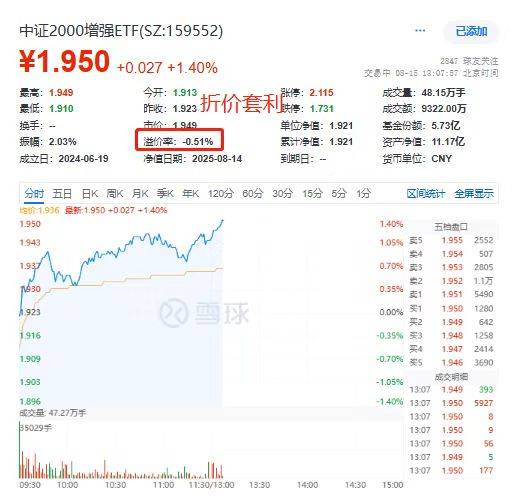
ETF折价套利

Search documents
为什么ETF会有溢价风险 ,在投资中应该怎么做呢?|投资小知识
银行螺丝钉· 2026-01-12 14:00
Group 1 - The article discusses the concept of premium risk in ETF trading, where the trading price can significantly exceed the net asset value (NAV) of the fund, leading to potential losses for investors [2]. - It explains that investors may pay 1.1 yuan for a fund with a NAV of only 1 yuan, resulting in wasted money due to premium risk [2]. - The article highlights that identifying ETF premium risk is straightforward, as ETFs have real-time net values (IOPV) available on financial terminals [3]. Group 2 - It suggests that investors should aim to buy ETFs at a discount, as this is more cost-effective [4]. - If an ETF shows a high premium on a given day, investors can opt to purchase an off-market index fund instead, which always transacts at NAV, eliminating premium risk [4]. - The article also describes an arbitrage strategy where investors can sell an ETF at a premium before market close and then purchase an off-market index fund at NAV, thus benefiting from the price difference [4]. Group 3 - The article notes that these strategies are particularly useful for novice investors who may not be familiar with ETFs and should consider starting with off-market funds [5].


50bps"捡漏"良机?中证2000增强ETF(159552)盘中罕见深度折价
Sou Hu Cai Jing· 2025-08-15 05:38
Core Viewpoint - The article highlights a rare trading opportunity in the China Securities 2000 Enhanced ETF (159552), which is currently trading at a significant discount to its net asset value (NAV), presenting an arbitrage opportunity for investors [1][2]. Group 1: ETF Pricing and Market Performance - The ETF experienced a discount of up to 0.5% compared to its NAV, allowing investors to purchase shares below their actual value [1]. - With a 0.5% discount, investors can gain an immediate profit of 50 CNY for every 10,000 CNY invested [1]. - The CSI 2000 Index has shown impressive performance with a year-to-date increase of 28%, while the Enhanced ETF has surged nearly 50% in the same period, indicating strong market recognition for small-cap growth styles [1]. Group 2: Arbitrage Mechanism - Industry insiders note that the arbitrage mechanism for ETF discounts is well-defined; institutional investors can engage in arbitrage through the subscription and redemption process, which helps narrow the discount [2]. - For retail investors, buying discounted ETFs in the secondary market and waiting for price recovery is a straightforward way to participate in arbitrage [2]. - While the current discount offers a good margin of safety, investors should remain aware of the overall volatility risks associated with small-cap valuations [2].