
Fed Rate Cuts

Search documents
The S&P 500 Is Down 2.5% But These 3 Bitcoin ETFs Didn't Get the Memo
247Wallst· 2026-03-18 12:30
The S&P 500 Is Down 2.5% But These 3 Bitcoin ETFs Didn't Get the Memo - 24/7 Wall St. S&P 5006,720.80 -0.14% Dow Jones46,980.00 -0.10% Nasdaq 10024,788.30 -0.19% Russell 20002,510.47 -0.41% FTSE 10010,384.80 +0.11% Nikkei 22554,413.00 -0.29% Investing The S&P 500 Is Down 2.5% But These 3 Bitcoin ETFs Didn't Get the Memo By Austin SmithPublished Mar 18, 8:30AM EDT Quick Read iShares Bitcoin Trust (IBIT) gained 5.43% and Bitwise Bitcoin ETF (BITB) gained 5.4% over the past month by holding actual Bitcoin dire ...


JPMorgan's Priya Misra: Higher oil prices for longer will drag on growth
CNBC Television· 2026-03-11 21:21
Oil once again the big driver of the action gaining 5% on continued threats to tankers in the straight of Hormuz despite a release of reserves from IEA countries. Shares of Caesar is making a big move late in the regular trading session on a report that Tilman Fertitta is in talks to buy the company for $7 billion. That's about 34 bucks a share higher than a recent bid from Carl Icon.>> Well, the rise in oil prices has investors cutting their outlook for Fed rate cuts this year, predicting higher inflation ...
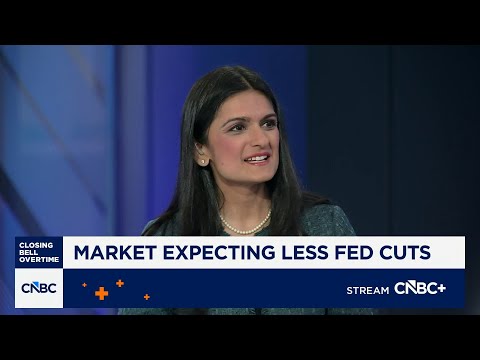
JPMorgan's Priya Misra: Higher oil prices for longer will drag on growth
Youtube· 2026-03-11 21:21
Market Overview - The Dow Jones Industrial Average fell nearly 300 points, with Sherwin Williams and Home Depot being the worst performers, while the S&P 500 remained mostly flat [1] - The NASDAQ managed to finish slightly in the green, driven by a 5% increase in oil prices due to ongoing threats to tankers in the Strait of Hormuz, despite a release of reserves from IEA countries [1] Corporate Developments - Caesars Entertainment's shares surged following reports that Tilman Fertitta is in talks to acquire the company for $7 billion, approximately $34 per share, which is higher than a recent bid from Carl Icahn [2] Interest Rates and Inflation - Investors are adjusting their outlook for Federal Reserve rate cuts this year, now predicting only about 30 basis points of cuts due to rising oil prices, which are expected to lead to higher inflation and potentially slower growth [3][4] - The rise in bond yields globally is contributing to the market's shift in expectations regarding rate cuts [3][4] Bond Market Insights - The U.S. bond market is experiencing a rise in yields, interpreted as a global inflation shock, with concerns that high oil prices could act as a drag on economic growth [5][6] - There is a belief that the Federal Reserve will still likely cut rates later this year, despite current inflationary pressures [6][14] - Recent corporate investment-grade bond issuance has been strong, with high demand and oversubscription for quality companies, indicating healthy credit market conditions [10][12] Sector Analysis - The hyperscaler sector, particularly those related to AI, is viewed positively due to lower debt levels, suggesting potential investment opportunities [11][12] - The market is advised to be cautious and selective in credit investments, focusing on borrower quality and covenant details [13]

ARMOUR Residential REIT(ARR) - 2025 Q4 - Earnings Call Transcript
2026-02-19 15:02
Financial Data and Key Metrics Changes - ARMOUR reported a total economic return of 10.63% for Q4 2025, benefiting from MBS spreads tightening and a lower interest rate environment [4] - GAAP net income available to common stockholders was $208.7 million, or $1.86 per share, while net interest income was $50.4 million [4] - Distributable earnings available to common stockholders were $79.8 million, or $0.71 per common share [4] - Quarter-end book value increased to $18.63 per common share, up 6.5% from September 30 [5] Business Line Data and Key Metrics Changes - ARMOUR's mortgage assets now total over $20 billion, with a portfolio growth of more than 10% from the end of Q3 2025 [9] - The portfolio remains nearly 100% agency MBS, agency CMBS, or DOS, with a net balance sheet duration of 0.14 years [12] - The company added over $3 billion of MBS pools and DOS across Q4 and early Q1 [12] Market Data and Key Metrics Changes - The market's appeal remains anchored in declining rate volatility and easing funding costs, supported by the Fed's efforts to lower rates [10] - Aggregate portfolio prepayments averaged 11.1 CPR through Q4 2025 and Q1 2026 to date, compared to 8.1 CPR in Q3 2025 [15] - The 30-year mortgage rate has remained in a tight 6%-6.3% band, recently shifting toward the low end of that range [15] Company Strategy and Development Direction - ARMOUR views agency MBS as a high conviction opportunity, with a focus on maintaining moderate leverage and a strong capital liquidity position [9] - The company aims to pay an attractive and stable dividend, with a medium-term outlook [20] - ARMOUR's strategy includes stress testing liquidity, applying systematic hedging, and deploying capital when opportunities arise [20] Management's Comments on Operating Environment and Future Outlook - Management expressed confidence in the positioning and strategy for 2026, anticipating continued favorable conditions for MBS [20] - The administration's focus on lowering mortgage spreads is expected to support a stable mortgage market [10] - Management noted that further declines in mortgage rates will require lower long-end Treasury yields, which have not declined in sync with front-end rate cuts [16] Other Important Information - ARMOUR raised approximately $3.8 million of capital by issuing preferred stock and $138 million under its common-at-the-market program [6][7] - The company has launched a new investor presentation to provide additional insights into the portfolio's transformation over time [20] Q&A Session Summary Question: Outlook for portfolio and interest-bearing assets growth in 2026 - Management indicated that growth depends on market behavior and capital raising opportunities [24] Question: Incremental returns on new investments given spread tightening - Current levered yield on thirty of fives is around 15%, with potential for additional returns from spread tightening and curve steepening [29] Question: Likelihood of further government actions to lower mortgage rates - Management noted that while some actions have been taken, further steps may introduce complexities that could counteract stability in mortgage spreads [34] Question: Current liquidity position and near-term outlook - Management confirmed liquidity is about 54% of total equity, reflecting moderate leverage and steady liquidity [37] Question: Risk of faster prepayments as mortgage rates lower - Management acknowledged increased prepayment risk but stated the portfolio is structured to mitigate this risk [39]

Dollar Rises as Currency Traders Bet on Fewer Fed Rate Cuts
Yahoo Finance· 2026-02-17 16:15
Group 1 - The dollar has increased for two consecutive days as traders speculate that the Federal Reserve may not implement three rate cuts in 2026 [1] - Hedge funds have reduced their bearish positions against the dollar, questioning whether economic data, particularly inflation, will lead to the anticipated interest-rate cuts [1][3] - Money markets are currently pricing in approximately 64 basis points of rate cuts by the end of the year [1] Group 2 - The Bloomberg Dollar Spot Index has maintained a slight gain despite the strengthening of the yen, indicating a temporary reprieve for the dollar [2] - Investors are currently the least exposed to the dollar since at least 2012, according to a survey by Bank of America Corp [2] - The dollar has weakened by about 10% since January 2025, influenced by unpredictable policies from President Trump, including a trade war [7] Group 3 - The stronger-than-expected jobs report for January has diminished the likelihood of "insurance" rate cuts in the spring, with expectations for cuts in June and September [4] - The closure of markets and a light economic data calendar allowed investors to rebalance, leading hedge funds to trim their dollar short positions [8] - Options markets show that near-term bearish sentiment on the dollar has eased, with front-end risk reversals at their least negative in nearly a month [8]
US CPI Fuels Fed Wagers, US Inflation Comes In Cooler Than Expected | Real Yield 2/13/2025
Youtube· 2026-02-13 20:41
Economic Overview - The U.S. economy is showing signs of strength with stronger-than-expected job growth and encouraging inflation data, leading to a positive outlook [1][3][6] - Despite the positive aggregate economic indicators, underlying consumer conditions remain a concern, suggesting that the reported job growth may be overstated by approximately 60,000 jobs per month [2][5] Interest Rates and Monetary Policy - The two-year yield has decreased to its lowest level since September 2022, influenced by job growth and cooler inflation [3][4] - There is a belief that monetary policy is tighter than necessary, with calls for lower interest rates to support economic growth [5][6] - Traders are pricing in a 50% chance of a third rate cut by December, although some analysts argue that this may be an overreaction to recent data [8][9] Inflation Insights - Inflation remains relatively contained, but core services are contributing to underlying inflation pressures [6][7] - The Federal Reserve is expected to focus on PCE data rather than CPI, with upcoming numbers likely to influence future rate decisions [6][8] - Concerns exist regarding the potential for inflation to persist, particularly as tariffs begin to impact consumer prices [28][30] Global Debt Market Trends - U.S. companies are increasingly engaging in reverse Yankee bond sales, raising significant amounts in non-dollar markets, with strong demand observed [40][42] - Alphabet's recent $5.5 billion sterling deal and Goldman Sachs' €7 billion sale highlight the trend of U.S. firms diversifying their funding sources [41][42] - The current yield environment shows U.S. dollar yields around 4.8%, while euro-denominated yields are approximately 3%, suggesting potential cost advantages for companies issuing in euros [44] Private Credit and Software Sector - The software sector is facing scrutiny due to fears of AI disruption, but some analysts view this as a potential buying opportunity [77][78] - Private credit firms are categorizing investments variably, raising questions about transparency and the actual exposure to software companies [79][80] - Despite concerns, many software companies are performing well, with most loans marked at par, although the evolving AI landscape poses future risks [82]

15 Most Favored REITs According to Hedge Funds
Insider Monkey· 2026-01-20 11:39
Industry Overview - The U.S. real estate market is normalizing in 2025 after volatility in the previous two years, with Fed's three consecutive rate cuts boosting investor motivation [1] - Morgan Stanley's 2026 outlook emphasizes that sector-specific and asset-level drivers will dominate market dynamics, predicting increased transaction activity due to demand-supply imbalances and favorable credit conditions [2] - Fitch Ratings provides a neutral outlook for U.S. equity REITs in 2026, noting financial discipline and encouraging fundamentals, with most REITs trading at discounts to their net asset values [4] Investment Opportunities - Real estate investment trusts (REITs) are making it easier for retail investors to access diverse real estate segments, appealing to those seeking frequent income and unique property types [3] - A methodology for identifying favored REITs includes screening U.S.-listed REITs with market capitalizations above $2 billion and excluding those with share prices below $5, focusing on stocks with at least 5% upside potential [7][8] Specific REIT Analysis - Independence Realty Trust (NYSE:IRT) has a share price of $17.26 with a potential upside of 18.4%, supported by 27 hedge fund holders [10] - Analysts maintain a positive outlook for IRT, with target price revisions indicating upside potential of 27.5% and 16% from different analysts, driven by expected improvements in lease rates and easing supply-side conditions [11][12] - Kimco Realty Corporation (NYSE:KIM) has a share price of $21.06 and a potential upside of 12.2%, also backed by 27 hedge fund holders [14] - Analysts express optimism for KIM, with target price adjustments suggesting upside potential of around 19% and 23.5%, supported by positive forecasts for various property types [15][16]



Understanding the Jobs Market Freeze: What It Means for Workers and the Economy
FX Empire· 2026-01-14 12:00
Group 1: Employment Trends - Companies are hesitant to hire due to uncertainty from tariffs, leading to only 50,000 new jobs created in December, while unemployment slightly decreased from 4.5% to 4.4% [1][5][19] - Worker shortages are prevalent in sectors like construction, healthcare, and hospitality, making it difficult for businesses to fill positions despite having job openings [3][6][14] - Wages have increased, with a 3.8% annual growth, forcing businesses to pay competitive salaries, which adds to the cost of hiring [4][19] Group 2: Economic Dynamics - The current labor market is characterized as a "low-hire, low-fire" economy, where companies are reluctant to expand payrolls or conduct layoffs due to past experiences during the COVID recovery [5][20][21] - The Federal Reserve faces challenges as traditional rate cuts may not stimulate hiring due to ongoing labor shortages, leading to a cautious approach on monetary policy [7][15][21] - Financial markets are reacting to the disconnect between optimistic rate cut expectations and the current labor data, which does not support such optimism [8][22][24] Group 3: Market Implications - Equities, bonds, and precious metals are trading at or near record highs based on expectations of multiple Fed rate cuts, which may not materialize [22][24][25] - If the Fed maintains a cautious stance with only one rate cut, bond yields may rise sharply, impacting bondholders negatively [23][24] - The U.S. dollar has weakened due to expectations of aggressive Fed easing, but if these expectations are adjusted, the dollar may strengthen [26]

JPMorgan’s 5% Bond ETF Looks Like A Coiled Spring Right Now
Yahoo Finance· 2026-01-07 18:41
Core Viewpoint - Emerging market bonds are becoming increasingly attractive for yield-seeking investors in 2026, particularly through the iShares J.P. Morgan USD Emerging Markets Bond ETF (EMB), which offers a 5.5% dividend yield [2][3]. Group 1: Performance and Yield - The EMB fund delivered a 13% return in 2025 but has seen minimal movement in early 2026, with only a 0.07% increase year-to-date [2][3]. - The fund holds 658 emerging market bonds and has a total asset value of $15.7 billion, with a low expense ratio of 0.39% [7]. Group 2: Political and Economic Factors - The recent surge in Venezuelan defaulted bonds, which rose to 43 cents on the dollar following President Nicolás Maduro's removal, highlights how quickly political risk can change and unlock value for investors [3][8]. - The Federal Reserve's interest rate decisions are crucial for EMB's performance, with expectations for rate cuts that could enhance the attractiveness of EMB's yield compared to U.S. Treasury yields [4][5]. Group 3: Market Dynamics - Historically, emerging market bonds tend to rally when the Federal Reserve adopts a dovish stance, and the current outlook suggests potential rate cuts from the current 3.50% to 3.75% range [4][5]. - As U.S. Treasury yields decline, the 5.5% yield from EMB becomes more appealing, potentially leading to increased inflows from investors moving away from lower-yielding developed market bonds [5][6].