
Financial fraud

Search documents
IDFC First Bank fraud case: 11 accused arrested so far, 100 bank accounts frozen
The Economic Times· 2026-03-12 16:57
Core Viewpoint - A significant fraud case involving IDFC First Bank has been uncovered, where fake companies were created to illegally divert government funds into multiple bank accounts [1][10]. Group 1: Fraud Details - The fraud is estimated to involve Rs 590 crore, with unauthorized transfers from various government department accounts to accounts held by fictitious companies [10]. - Entities identified in the investigation include R S Traders, Cap Co Fintech Services, SRR Planning Gurus Pvt Ltd, and Swastik Desh Project [2][10]. - More than 100 bank accounts suspected of being linked to fraudulent transactions have been frozen [2][10]. Group 2: Investigation Progress - A Special Investigation Team (SIT) has been formed under senior IPS officer Ganga Ram Punia to investigate the case, following an FIR registered on February 23 [5][10]. - The investigation has revealed the involvement of 12 bank accounts linked to eight government departments, with 10 accounts at IDFC First Bank and two at AU Small Finance Bank [6][10]. - So far, 11 individuals have been arrested, including six bank employees, four private individuals, and one government official, with 10 currently in judicial custody [6][10]. Group 3: Evidence and Assets Seized - Investigators have conducted raids at 16 locations, recovering crucial documents related to property purchases allegedly made with proceeds from the fraud [7][10]. - Over 25 electronic devices, including mobile phones and laptops, have been seized for forensic examination [7][10]. - Six luxury vehicles, including three Toyota Fortuners, two Innovas, and one Mercedes, suspected to have been purchased with illicit funds, have also been confiscated [7][10]. Group 4: Manipulation of Records - The accused are alleged to have manipulated banking records by creating fake debit memos and transferring funds without valid authorization [8][10]. - Forged bank statements were prepared to facilitate the transfer of funds to accounts linked to the accused or their relatives [9][10]. - A large volume of records from banks and relevant departments is being analyzed to trace both authorized and unauthorized transactions [9][10].



Rs 590-crore question: How ex-branch head & relationship manager 'masterminded' IDFC FIRST Bank scam linked to Haryana government funds
The Economic Times· 2026-02-25 14:26
Core Viewpoint - A significant fraud case involving IDFC First Bank has emerged, leading to the arrest of four individuals, including two former bank employees, as part of an investigation into financial irregularities related to government accounts [1][12]. Group 1: Arrests and Individuals Involved - The arrested individuals include Ribhav Rishi, Abhay Kumar, Swati Singla, and Abhishek Singla [2]. - Ribhav Rishi previously headed the bank's Sector 32 branch and left his position six months ago, while Abhay Kumar, a relationship manager, resigned in August of the previous year [3]. - Swati Singla and her brother Abhishek Singla run a partnership firm named Swastik Desh Project, which reportedly received approximately Rs 300 crore [3][5]. Group 2: Fraud Details and Financial Impact - The fraud was revealed after discrepancies were found in accounts linked to Haryana government departments, with IDFC First Bank disclosing a total fraud amount of Rs 590 crore [6]. - The bank has repaid 100% of the principal and interest to the affected Haryana government departments, totaling Rs 583 crore [6]. Group 3: Government and Legal Response - Haryana Chief Minister Nayab Singh Saini stated that the government would take strict action against those involved, indicating that the irregularities were primarily associated with the bank's Chandigarh branch [7]. - An FIR was registered under the Prevention of Corruption Act, with charges including criminal breach of trust, cheating, forgery, and criminal conspiracy [8]. - A Special Investigation Team (SIT) has been formed to conduct a detailed investigation into the matter [8]. Group 4: Inquiry Findings and Future Actions - A committee established by Haryana's Development and Panchayats Department uncovered alleged forgery and procedural lapses involving officials from IDFC First Bank and AU Small Finance Bank [9]. - The Haryana government has officially de-empanelled IDFC First Bank and AU Small Finance Bank from participating in government business as of February 18 [10]. - The investigation is ongoing, with authorities examining the full trail of transactions and potential involvement of additional individuals [11].
Florida woman out $21K after entering an investment deal with a 'trustworthy' man. How to spot signs of financial fraud
Yahoo Finance· 2026-02-17 14:00
Core Insights - Investment scams are prevalent, with significant financial losses reported by consumers, highlighting the need for increased awareness and protective measures in the financial industry [5]. Group 1: Case Study of Investment Fraud - Jessica Gipson, a Florida resident, invested $21,000 based on a promise of a tenfold return, which turned out to be a scam [1][2]. - The scammer, Alex Lee Moore, provided a one-page contract but failed to deliver any returns, leading Gipson to pursue legal action [2][3]. - Despite her efforts, including filing a police report and a lawsuit, Gipson has not recovered her investment, illustrating the challenges victims face in seeking justice [3][4]. Group 2: Financial Fraud Landscape - The Federal Trade Commission reported that consumers lost $4.6 billion to investment scams in 2023, with losses increasing to $5.7 billion in 2024 [5]. - The median loss for victims of these scams was over $9,000, indicating a significant financial impact on individuals [5]. - Prosecuting investment fraud is difficult, with federal prosecutors filing charges in only 24% of white-collar criminal referrals in 2025, underscoring the challenges in the legal system [5].
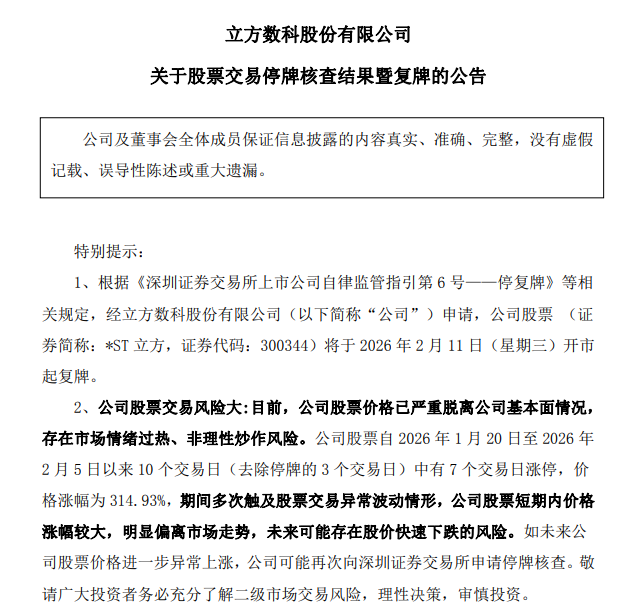
3倍股价异动股,核查完成!明起复牌
Zhong Guo Zheng Quan Bao· 2026-02-10 14:52
Core Viewpoint - *ST Lifan has experienced significant stock price volatility, leading to a suspension of trading for verification, with a notable price increase of 314.93% from January 20 to February 5, 2025 [3] Group 1: Stock Trading and Regulatory Actions - The company announced that its stock will resume trading on February 11, 2025, after completing the verification process [1] - The Shenzhen Stock Exchange issued a risk warning regarding *ST Lifan's stock due to substantial price fluctuations and multiple triggers of abnormal trading standards [3] - The company confirmed that there are no undisclosed significant matters related to the company by its controlling shareholders and actual controllers, and they did not trade the company's stock during the period of abnormal fluctuations [3] Group 2: Financial Performance - For the period of January to September 2025, *ST Lifan reported an operating income of 203 million yuan, a year-on-year decrease of 0.44%, and a net profit attributable to shareholders of -62.21 million yuan, compared to -51.59 million yuan in the same period last year [4] - The company anticipates a net loss of 180 million to 210 million yuan for the full year of 2025, according to its annual performance forecast [4] - The company's internal control over its 2024 annual financial report received a negative audit opinion from Zhongxing Caiguanghua Accounting Firm [4] Group 3: Company Background and Legal Issues - *ST Lifan is a digital technology cloud service provider focused on new digital infrastructure construction, offering comprehensive services from software and hardware products to overall solutions for industry and government clients [5] - The company received a notice of administrative penalty and market entry prohibition from the Anhui Securities Regulatory Bureau, indicating that its financial data for annual reports from 2021 to 2023 may have involved false records, with over 500 million yuan in suspected false revenue for 2021 and 2022 combined [5] - The company is at risk of being forcibly delisted due to serious financial misconduct as per the regulations of the Growth Enterprise Market [5]

Class Action Filed Against Ardent Health, Inc. (ARDT) - March 9, 2026 Deadline to Join - Contact The Gross Law Firm
Prnewswire· 2026-01-29 14:00
Core Viewpoint - The Gross Law Firm has issued a notice to shareholders of Ardent Health, Inc. regarding potential legal action due to allegations of misleading financial practices and insufficient liability insurance [1]. Group 1: Allegations Against Ardent Health - The complaint alleges that Ardent Health did not rely on detailed reviews of historical collections for determining the collectability of accounts receivable, instead using a 180-day cliff for reserving accounts, which inflated reported receivables [1]. - It is claimed that Ardent Health's financial position was materially false and misleading due to the delayed recognition of losses on uncollectible accounts [1]. - The company reportedly did not maintain sufficient professional malpractice liability insurance to cover claims arising from its operations, particularly in the New Mexico market, where social inflationary pressures in medical malpractice cases have been increasing [1]. Group 2: Class Action Details - Shareholders who purchased shares of ARDT between July 18, 2024, and November 12, 2025, are encouraged to register for the class action, with a deadline of March 9, 2026, to seek lead plaintiff status [2]. - Once registered, shareholders will receive updates through a portfolio monitoring software regarding the status of the case [2]. - Participation in the case incurs no cost or obligation for the shareholders [2]. Group 3: About Gross Law Firm - The Gross Law Firm is a nationally recognized class action law firm dedicated to protecting the rights of investors affected by deceit and illegal business practices [3]. - The firm aims to ensure companies adhere to responsible business practices and seeks recovery for investors who suffered losses due to misleading statements or omissions [3].

House, feds launch probe into Ilhan Omar finances after reported jump from $0 to $30M, raising concerns
Yahoo Finance· 2026-01-21 21:45
Core Viewpoint - House Republicans are investigating Rep. Ilhan Omar's household finances, which reportedly increased significantly, with her family's net worth potentially reaching $30 million [1]. Group 1: Investigation Details - The inquiry focuses on Omar's husband, Tim Mynett, whose political consulting firm has worked with Democratic-aligned organizations. Oversight Chair James Comer is questioning the legitimacy of the income and its rapid accumulation [2]. - Comer has indicated that the committee may consider subpoenaing Mynett as part of the investigation [2]. Group 2: Context of the Investigation - The investigation occurs amid heightened scrutiny in Minnesota, where federal authorities are addressing significant public funds fraud schemes, with over 90 individuals charged since 2021 and estimated losses reaching up to $9 billion [4]. - The fraud cases are linked to a COVID-era scheme involving a nonprofit, Feeding Our Future, accused of submitting fraudulent meal reimbursement claims, with losses estimated at nearly $250 million [4]. Group 3: Political Implications - Although Omar has not been accused of wrongdoing in the fraud cases, the scale of fraud in her district has intensified Republican scrutiny of her household's financial activities [5]. - The FBI was briefed during the Biden administration regarding concerns about a network of companies associated with Omar's husband [6].
FAT Brands pushed to the brink by legal storm and mounting debt
Yahoo Finance· 2026-01-14 16:17
Core Viewpoint - FAT Brands is facing significant financial and legal challenges, including a lawsuit from franchisees alleging mismanagement of marketing funds and liquidity issues that could lead to bankruptcy [5][6][31]. Financial Situation - FAT Brands disclosed over $1.26 billion in debt and reported only $2 million in cash and $10 million in restricted cash, indicating a precarious liquidity position [5][31]. - The company is in discussions with bondholders to restructure its balance sheet, but the complexity of its debt tied to individual brands may prolong the process [4][32]. Legal Challenges - The Round Table Owners' Association filed a lawsuit against Round Table Franchise Corporation (RFTC), alleging breach of contract and misuse of advertising funds, claiming significant financial harm to franchisees [1][2]. - This lawsuit is part of a broader pattern of legal issues for FAT Brands, including previous lawsuits from franchisees and an SEC investigation into financial practices [6][10][12]. Franchisee Relations - Franchisees report delays in receiving critical soda rebates from Pepsi and Dr Pepper, which are essential for cash flow, with claims that FAT Brands is behind on payments [18][19]. - Franchisees have expressed dissatisfaction with the company's communication regarding operational issues, leading to unrest and plans to withhold royalty payments until owed rebates are received [30][27]. Company History and Acquisitions - FAT Brands has expanded rapidly through acquisitions, but this growth has come with significant debt and legal challenges, including allegations of financial fraud against its founder [6][12][13]. - The company has faced scrutiny for its management practices, with franchisees alleging that funds intended for marketing have been misused for unrelated expenses [7][8].
Scammers are staking out Americans' front doors in a wily new debit card scheme. How the scam works and what to do
Yahoo Finance· 2025-12-24 14:07
Core Insights - Financial fraud, particularly involving debit cards and checks, is a growing concern for consumers, with check fraud increasing by 10% in 2024 compared to the previous year [2][5]. Group 1: Debit Card Fraud - Debit cards are more frequently targeted by fraudsters than credit cards, leading to increased vulnerability for consumers [5]. - New scams are emerging, where victims are misled into destroying their debit cards while leaving the chip intact, which scammers then retrieve to access funds [3][4]. - Consumers face limited protections with debit cards; losses can escalate significantly if fraud is reported late, with potential losses reaching the entire stolen amount if reported after 60 days [6][7]. Group 2: Check Fraud - Check fraud is also on the rise, with consumers advised to report fraud within specific timeframes to minimize losses [8]. - Recommendations for preventing check fraud include using permanent markers for writing checks and opting for electronic payments to maintain a record of transactions [15]. Group 3: Fraud Prevention Measures - Consumers are encouraged to take proactive steps to protect against debit card and check fraud, such as monitoring bank accounts regularly and avoiding unsolicited communications that appear to be from banks [10][13]. - Installing security measures like mailbox locks and security cameras can help deter mail theft, which is a common method for obtaining checks and debit cards [11][12]. - Utilizing services like Aura for online scam tracking and fraud alerts can enhance consumer protection against online fraud, which has seen a significant increase in losses [16][17].
Ming-Chi Kuo Fires Back At Nvidia 'Fraud' Critics, Says Claims Are Built On 'Factual Errors' — 'Far From Being Evidence...'
Yahoo Finance· 2025-11-25 11:45
Core Viewpoint - Ming-Chi Kuo, a notable tech analyst, defends NVIDIA Corporation against allegations of financial misconduct, particularly regarding its Days Sales Outstanding (DSO) and inventory levels, asserting that these metrics are consistent with industry standards and not indicative of fraud [1][2]. Group 1: DSO Analysis - Kuo argues that the increase in DSO is reasonable as receivables are becoming more concentrated among a few large customers, reflecting their bargaining power [3]. - Critics have misjudged NVIDIA's DSO by comparing it to inappropriate peer groups; when compared to suppliers serving the same cloud service providers, which typically have DSOs exceeding 60-70 days, NVIDIA's figures are more aligned [4]. Group 2: Inventory Examination - Kuo addresses concerns regarding a 32% quarter-over-quarter increase in inventory for Q3 FY26, clarifying that NVIDIA's Q2 FY23 inventory had actually risen by approximately 23% QoQ, not declined [5]. - The recent inventory surge is attributed to a significant ramp-up in upstream capacity at TSMC, particularly linked to the mass production of the new Blackwell B300 GPU, indicating preparation for strong demand rather than fraudulent activity [5]. Group 3: Criticism Context - Kuo's defense comes amid scrutiny of NVIDIA's financial practices, with independent researcher Shanaka Anslem Perera highlighting potential red flags, including an 89% increase in accounts receivable, extended payment cycles, and weaker cash conversion compared to peers [6].
