
L2与L4双轮驱动

Search documents
单芯片城市NOA方案量产,轻舟智航公布L4无人物流战略
Xin Lang Cai Jing· 2026-01-25 04:52
Core Insights - Lightyear Zhihang announced that as of January, over 1 million passenger cars equipped with its assisted driving system have been produced [2] - The company introduced its NOA (Navigation Assisted Driving) solution based on the Horizon Journey 6M chip, which has a computing power of 128 TOPS, marking it as the first city NOA solution to be mass-produced using this chip [2] - The CEO predicts that 2026 will mark the beginning of a "golden decade" for autonomous driving, with city NOA features expected to become standard in mainstream vehicles within five years [2] Technology Strategy - Lightyear Zhihang emphasizes a dual strategy of L2 and L4 driving, asserting that both levels share foundational technology [2] - The company introduced its "VLA + World Model" unified technical architecture, aimed at enhancing the understanding of complex environments and human behavior logic, which is essential for advancing to higher levels of autonomous driving [2] Business Expansion - Lightyear Zhihang has officially entered the L4-level unmanned logistics sector and formed a strategic partnership with Chery Commercial Vehicles [3] - The company plans to leverage its technical and engineering experience from passenger vehicle production to develop unmanned logistics products for mass production, with pilot operations already underway in Zhejiang and Anhui [3] - Industry analysts note that Lightyear Zhihang's trajectory reflects current market competition, highlighting the rapid adoption of advanced driving features and the exploration of new commercial avenues such as Robotaxi and unmanned logistics [3]

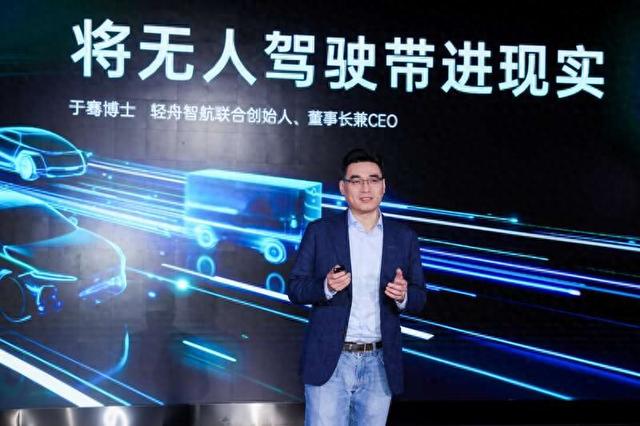
轻舟智航于骞:无人驾驶是打开物理世界通用智能的突破口
Zheng Quan Ri Bao Wang· 2026-01-23 14:01
Core Insights - The transition from assisted driving to autonomous driving is accelerating, with QCraftDAY2026 marking a significant milestone for QCraft, showcasing its production progress and strategic vision for sustainable development in the autonomous driving industry [1][2] Group 1: Production Milestones - QCraft has achieved a cumulative production of over 1 million units of its passenger car assisted driving system, entering the million-unit production club, with a notable increase in delivery capability [1] - The time taken to grow from 500,000 to 1 million units was only 8 months, compared to nearly three years for the previous 500,000 units, indicating significant improvements in engineering capabilities and supply chain coordination [1][2] Group 2: Technological Advancements - QCraft launched the first city NOA (Navigation on Autopilot) solution based on a single journey 6M chip, marking a breakthrough in high-level assisted driving technology [2] - The "QCraft乘风2.0" solution was introduced, creating a multi-tiered product matrix from highway NOA to city NOA, with plans to add over 50 new models in 2026, most of which will feature city NOA capabilities [3] Group 3: Safety and User Experience - Users of the "QCraft乘风" system have accumulated over 2.5 billion kilometers of assisted driving, with nearly 100 million uses of smart parking assistance, and an AEB (Automatic Emergency Braking) false trigger rate of less than once every 400,000 kilometers [3] - The system has reportedly helped users avoid over 146,000 potential accidents annually, reflecting its reliability in real traffic environments [3] Group 4: Strategic Direction - QCraft is pursuing a dual strategy of L2 and L4 development, introducing a unified architecture that enhances the system's reasoning and prediction capabilities for complex traffic scenarios [4] - The company has entered the unmanned logistics sector, proposing a "production equals operation" model to lower the barriers for developing unmanned logistics products [4] Group 5: Global Expansion - QCraft is accelerating its international presence with offices in Beijing, Suzhou, and Munich, focusing on markets in Europe, East Asia, and the Middle East [5] - The company is adapting to various multi-chip platforms and international safety standards, leveraging its experience in China's complex traffic environment to gain a competitive edge globally [5]