Memory price increase

Search documents
受存储涨价压力,2026年全球手机产量恐下行
WitsView睿智显示· 2026-02-12 09:53
Core Viewpoint - The global smartphone production is expected to decline by 10% in 2026 due to rising memory prices, potentially dropping to 1.135 billion units, with a pessimistic scenario predicting a decline of 15% or more [2][3]. Group 1: Market Impact - The significant increase in memory prices, with contract prices for 8GB+256GB models expected to rise nearly 200% in Q1 2026 compared to the same period in 2025, has led to the BOM cost share of memory in smartphones increasing from 10-15% to 30-40% [5]. - Brands are likely to raise terminal prices to maintain operations and may need to adjust product configurations to cope with the ongoing surge in memory prices [5]. Group 2: Brand Performance - Samsung, as the leading smartphone brand and a major player in the memory industry, is expected to see a decline in production, but the drop will be less severe due to its vertical integration advantages [5]. - Apple, with a higher proportion of high-end models, is better positioned to absorb rising memory costs and has a consumer base more accepting of price adjustments, providing some support for its production performance [5]. - Xiaomi and Transsion, which focus on lower-end models, are more sensitive to cost fluctuations and are expected to experience significant production cuts in 2026 due to the ongoing rise in memory prices [5]. Group 3: Competitive Landscape - Vivo, Oppo, Xiaomi, and Honor will face not only memory cost pressures but also strong competition from Huawei, which is expected to have the smallest production adjustment among brands and may even see growth due to its flexible pricing strategy [6]. - The current decline in terminal demand is attributed to rising memory prices, but the overall functionality of electronic devices has reached a level that satisfies most consumer needs, leading to longer replacement cycles and reduced upgrade momentum [6].



全球内存行业:内存价格上涨推动企业盈利增长-上调2025年第四季度及后续盈利预期,反映大宗商品内存价格前景向好
2025-12-29 01:04
Summary of Key Points from the Conference Call Companies Involved - **Samsung Electronics** (Ticker: 005930 KS) - **SK Hynix** (Ticker: 000660 KS) Core Insights and Arguments - **Samsung Electronics**: - Current market cap is KRW 658.9 trillion with a target price of KRW 160,000, indicating an upside potential of 44.0% from the current price of KRW 111,100 [1] - The company maintains a "Buy" rating, reflecting positive sentiment towards its future performance [1] - **SK Hynix**: - Current market cap is KRW 428.1 trillion with a target price of KRW 880,000, suggesting an upside potential of 49.7% from the current price of KRW 588,000 [1] - The company also holds a "Buy" rating, indicating strong confidence in its growth prospects [1] Industry Dynamics - **DRAM Market**: - Total shipment of DRAM is projected to grow from 24,352 million GB in 2022 to 69,290 million GB by 2027, reflecting a compound annual growth rate (CAGR) of approximately 28% [5][5] - The total shipment value of DRAM is expected to increase significantly from USD 78.83 billion in 2022 to USD 481.06 billion by 2027, with notable fluctuations in year-on-year growth rates [5][5] - Average Selling Price (ASP) for DRAM is forecasted to rise from USD 3.2/GB in 2022 to USD 6.9/GB by 2027, indicating a recovery in pricing power [5][5] - **NAND Market**: - Total shipment of NAND is expected to grow from 635 billion GB in 2022 to 2,085 billion GB by 2027, with a CAGR of approximately 42% [5][5] - The total shipment value of NAND is projected to increase from USD 49.98 billion in 2022 to USD 241.30 billion by 2027 [5][5] - ASP for NAND is expected to stabilize around USD 0.9/8GB by 2027, reflecting a recovery in pricing trends [5][5] Additional Important Insights - **Market Performance**: - Samsung Electronics has shown a strong performance with a 12-month absolute return of 104.2% [44] - SK Hynix has also performed well, with a 12-month absolute return of 249.0% [96] - **Forecast Adjustments**: - Target prices for both Samsung Electronics and SK Hynix have been increased, reflecting improved market conditions and growth expectations [40][91] - **Investment Sentiment**: - Both companies are rated as "Buy," indicating a favorable outlook from analysts and potential for significant returns in the memory semiconductor sector [1][1] This summary encapsulates the key points from the conference call, focusing on the companies involved, their market positions, and the broader industry dynamics.
TrendForce集邦咨询:预计2026年第一季度存储器涨势持续强劲
智通财经网· 2025-12-11 09:15
Core Insights - The global terminal products are facing significant cost challenges due to anticipated substantial increases in memory prices in Q1 2026, leading to price adjustments and reduced sales forecasts for smartphones and laptops [1] - Memory components are increasingly impacting the BOM cost of consumer electronics, prompting companies like Apple to reconsider pricing strategies for new devices [1] - The rise in memory prices will force laptop brands to adjust product mix, procurement strategies, and regional sales layouts, particularly affecting high-end lightweight laptops [1] Group 1: Smartphone Market - Memory's share in BOM cost for smartphones is expected to rise significantly, impacting pricing strategies for brands, especially in the Android market [1] - Android brands, which target the mid-to-low price segments, will likely increase new device pricing and adjust old device prices or supply cycles to mitigate losses [1] - The high-end smartphone segment will see a slowdown in the push towards higher memory configurations, with 12GB gradually disappearing from mid-range models [2][4] Group 2: Laptop Market - The consumer laptop market is currently supported by existing inventory of finished and low-cost memory, allowing for stable pricing in the short term, but significant price adjustments are expected by Q2 2026 [2] - Brands are adopting "spec reduction" or "upgrade delays" as necessary strategies to balance costs, particularly affecting DRAM configurations [2] - High-end laptops will maintain a memory configuration of 16-64GB, while mid-range products will trend towards 8GB, and low-end laptops will remain at 8GB without further reductions [4]
研报 | 预计2026年第一季度存储器涨势持续强劲,智能手机、笔电品牌启动价格上修与规格降级
TrendForce集邦· 2025-12-11 09:02
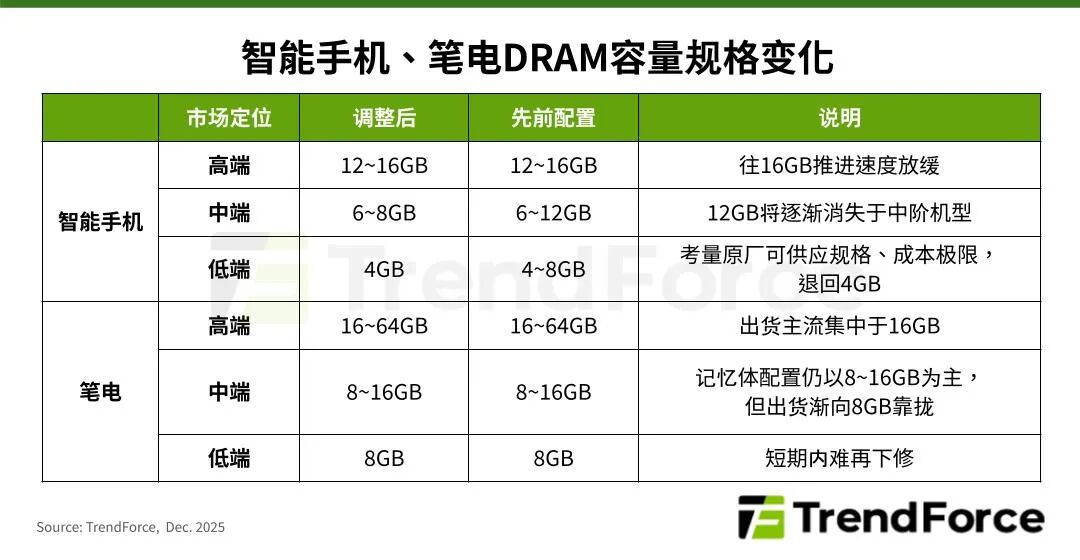
Core Insights - The article highlights the anticipated significant increase in memory prices in Q1 2026, which will lead to cost challenges for global end products, particularly in the smartphone and laptop industries. This situation is expected to result in price adjustments and specification reductions, concentrating resource advantages among a few leading brands [2][3]. Memory Price Impact on Smartphones - Memory components are increasingly affecting the BOM cost of consumer electronics like smartphones and PCs. For instance, the iPhone series will see a notable rise in memory's share of BOM cost, prompting Apple to reconsider new device pricing and potentially reduce or eliminate price cuts on older models [2][3]. - Android brands, which target the mid-to-low price market, will also face pressure to raise new device prices and adjust old device pricing or supply cycles due to the soaring memory prices [2][3]. Adjustments in Laptop Market - Laptop brands are expected to modify their product mix, procurement strategies, and regional sales layouts in response to rising memory prices. High-end lightweight laptops, which typically have mobile DRAM soldered onto the motherboard, will likely experience the most significant price pressure [3]. - The consumer laptop market may maintain existing pricing in the short term due to inventory support but is expected to enter a notable price adjustment phase by Q2 2026 [3]. Specification Adjustments - Brands are increasingly adopting "spec reduction" or "upgrade postponement" as necessary strategies to balance costs, particularly with DRAM, which has a high cost share. High-end and mid-range products will see DRAM capacity specifications converge towards the market's minimum standards, slowing down enhancement speeds [3]. - The low-end market will be the most affected price segment, with smartphones expected to revert to a predominant 4GB configuration in 2026. Low-cost laptops will face limitations in DRAM configuration adjustments due to processor and operating system requirements [3][4]. Summary of Adjusted Specifications - **Smartphones**: - High-end: 12-16GB (slower progression towards 16GB) - Mid-range: 6-8GB (12GB gradually disappearing) - Low-end: 4GB (returning to 4GB due to supply and cost limits) [4] - **Laptops**: - High-end: 16-64GB (mainstream shipments concentrated at 16GB) - Mid-range: 8-16GB (shifting towards 8GB) - Low-end: 8GB (short-term adjustments unlikely) [4]