MoE(混合专家)架构

Search documents
老黄开年演讲「含华量」爆表,直接拿DeepSeek、Kimi验货下一代芯片
3 6 Ke· 2026-01-07 01:35
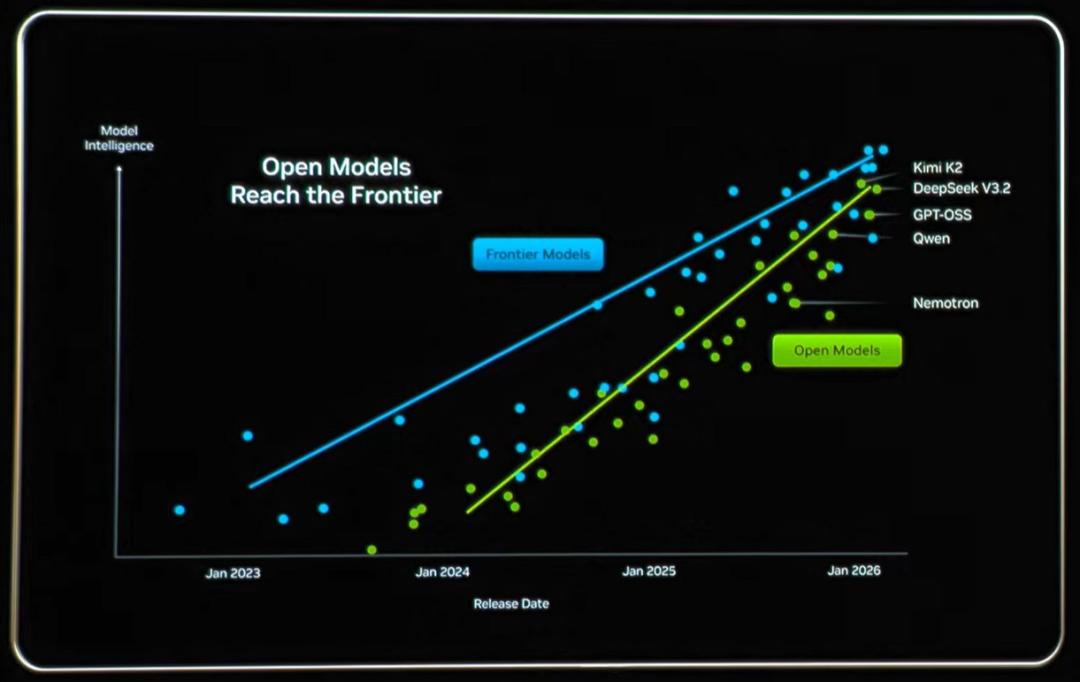
Core Insights - The presentation at CES 2026 highlighted the significant advancements of Chinese AI models, particularly Kimi K2 and DeepSeek, which are now competing closely with closed-source models in performance [1][8] - The introduction of the MoE (Mixture of Experts) architecture has become a mainstream choice, with over 60% of open-source AI models adopting this structure since 2025, leading to a substantial increase in intelligence levels [16][31] Group 1: Model Performance and Advancements - Kimi K2 Thinking's inference throughput increased tenfold, with token costs dropping to one-tenth of previous levels, indicating a shift towards a "price parity era" for AI inference [4][6] - DeepSeek-R1 and Kimi K2 represent top-tier attempts under the MoE architecture, significantly reducing computational load and memory bandwidth requirements [2][12] - The performance of Kimi K2 Thinking was validated in tests, showing a tenfold increase in performance on the GB200 NVL72 platform [9][19] Group 2: Global Recognition and Impact - DeepSeek and Kimi K2 were recognized in a rigorous benchmark test, with Kimi K2 Thinking achieving the title of "best-performing non-U.S. model" due to its low misguidance rate [21][24] - The rapid development of Chinese open-source models is closing the gap with the strongest closed-source models, providing a significant first-mover advantage [31] - The increasing international acceptance of Chinese AI models is evidenced by endorsements from prominent figures in the tech industry, indicating a growing influence in the global market [24][33] Group 3: Trends and Future Directions - The transition from high benchmark scores to practical usability is evident, with models like Qwen evolving from being known for high scores to being recognized for their quality [32] - The emergence of features such as "interleaved thinking" in Kimi K2 Thinking reflects a trend towards more sophisticated model capabilities, enhancing their applicability in real-world scenarios [34] - The rise of open-source models is pressuring U.S. closed-source giants, as the value proposition of paid models becomes harder to justify against the performance of open-source alternatives [35]



AI大模型独角兽招股书深度拆解:MiniMax to C,智谱 to B
Hua Er Jie Jian Wen· 2025-12-22 03:57
Core Insights - Two Chinese AI unicorns, Zhiyu and MiniMax, submitted their IPO applications to the Hong Kong Stock Exchange within 48 hours, showcasing different commercialization paths in the AI large model sector [1] - The IPO documents reveal distinct business models: MiniMax focuses on consumer-driven applications, while Zhiyu emphasizes enterprise-level services [8][9] Group 1: Business Models - MiniMax's business model is centered around "AI Native Apps," with significant revenue growth projected from $758,000 in 2023 to $21.8 million in 2024, and reaching $38 million in the first nine months of 2025, accounting for 71.1% of total revenue [3][4] - MiniMax's average monthly active users (MAU) are expected to surge from 3.1 million in 2023 to 27.6 million by September 2025, with paid user numbers reaching 1.77 million and average revenue per paid user (ARPPU) increasing from $6 to $15 [4][5] - Zhiyu AI focuses on enterprise services, with local deployment revenue reaching 162 million RMB by June 2025, constituting 84.8% of total revenue [10][11] Group 2: Financial Performance - MiniMax's gross margin improved from -24.7% in 2023 to 12.2% in 2024, and further to 23.3% in the first nine months of 2025, indicating effective cost control and revenue growth [18][27] - Zhiyu AI reported a gross margin of 50%, with local deployment services achieving a high margin of 59.1% in the first half of 2025, although its cloud deployment business faced declining margins [20][25] Group 3: R&D Investments - Both companies are heavily investing in R&D, with Zhiyu AI's R&D expenses reaching 1.595 billion RMB in the first half of 2025, resulting in a staggering R&D expense ratio of 835.4% [25][26] - MiniMax's R&D expense ratio decreased from over 2000% in 2023 to 337.4% in the first nine months of 2025, reflecting improved operational efficiency as revenue grows [27] Group 4: Market Focus - MiniMax is highly globalized, with only 26.9% of its revenue coming from mainland China in 2025, while Zhiyu AI primarily targets the domestic market, focusing on state-owned enterprises and large institutions [30][32] - The shareholder structures of both companies include major tech players, with MiniMax backed by Alibaba and Tencent, while Zhiyu AI has a more diversified investor base including state-owned funds [32][33] Group 5: Future Outlook - Both companies have sufficient cash reserves to continue their technological advancements, with MiniMax holding approximately $1 billion and Zhiyu AI having 2.55 billion RMB in cash equivalents [34] - The IPO submissions signal a shift in the Chinese AI industry from a focus on technology to a more commercialized approach, with both companies vying to become leaders in the large model sector [34]