
Neutral Interest Rate

Search documents
Chicago Fed President Goolsbee: Several more rate cuts possible if inflation proves to be transitory
Youtube· 2026-02-17 14:23
Inflation Report Insights - The recent inflation report shows a headline inflation rate of 2.4% and a core inflation rate of 3.6% annually, indicating some progress but also raising concerns about persistent inflation in services [1][3][7] - The core inflation figure suggests that while there are positive signs, the overall inflation trend remains around 3%, which is a point of concern for future monetary policy [7][9] Tariffs and Inflation - The impact of tariffs on inflation is notable, with goods that have higher tariffable content showing increased inflation rates. However, there is hope that this effect may be transitory [4][6] - The assessment indicates that the Federal Reserve may need to consider the implications of tariffs on inflation trends, particularly if they do not spread to services [6][7] Future Monetary Policy - There is a belief that if inflation trends can stabilize around 2%, there may be room for further rate cuts in 2026. However, evidence of a return to 2% inflation is necessary for this to occur [7][11] - The concept of neutral interest rates is discussed, with a loose target around 3% being suggested, which aligns with the Fed's long-term rate projections [8][9] Consensus and Leadership at the Fed - Concerns are raised about the ability of certain Fed members to achieve consensus on monetary policy decisions, which could impact future actions [12][14] - The reputation and experience of key figures within the Fed are acknowledged, suggesting that their influence may play a role in navigating these challenges [13][14]


Fed’s Miran Says More Than Full Point of Cuts Needed in 2026
Yahoo Finance· 2026-01-06 14:17
Core Viewpoint - Federal Reserve Governor Stephen Miran advocates for interest rate cuts exceeding one percentage point in 2026, citing that current monetary policy is restrictive and hindering economic growth [1][2]. Group 1: Interest Rate Cuts - Miran believes that over 100 basis points of cuts are justified this year, emphasizing that the current policy is clearly restrictive [2]. - The Federal Reserve recently cut interest rates for the third consecutive time, but further reductions are not guaranteed in the near term [2]. - Policymakers are divided on inflation and labor market outlooks, with a median estimate indicating one cut for 2026 [2]. Group 2: Neutral Rate Perspectives - Other Fed officials suggest that interest rates may be nearing a neutral level that neither stimulates nor restrains economic growth [3]. - Richmond Fed President Tom Barkin noted that current rates are "within the range of its estimates of neutral" [4]. - Minneapolis Fed chief Neel Kashkari expressed that rates are "pretty close to neutral" given the resilient economic growth [4]. Group 3: Current Rate Levels - The central bank's benchmark interest rate is currently set between 3.5% and 3.75%, with neutral level estimates among policymakers ranging from 2.6% to 3.9%, and a median estimate of 3% [5]. - Barkin highlighted the need for finely tuned judgments in policy to balance progress on both sides of the Fed's mandate [5]. Group 4: Labor Market and Inflation - The low hiring rate raises concerns about further deterioration in the labor market, while inflation has been above target for nearly five years, leading to fears of higher inflation expectations becoming entrenched [6].
美联储2026年降息次数,明天非农一锤定音?债市分歧加剧
Hua Er Jie Jian Wen· 2025-12-15 13:31
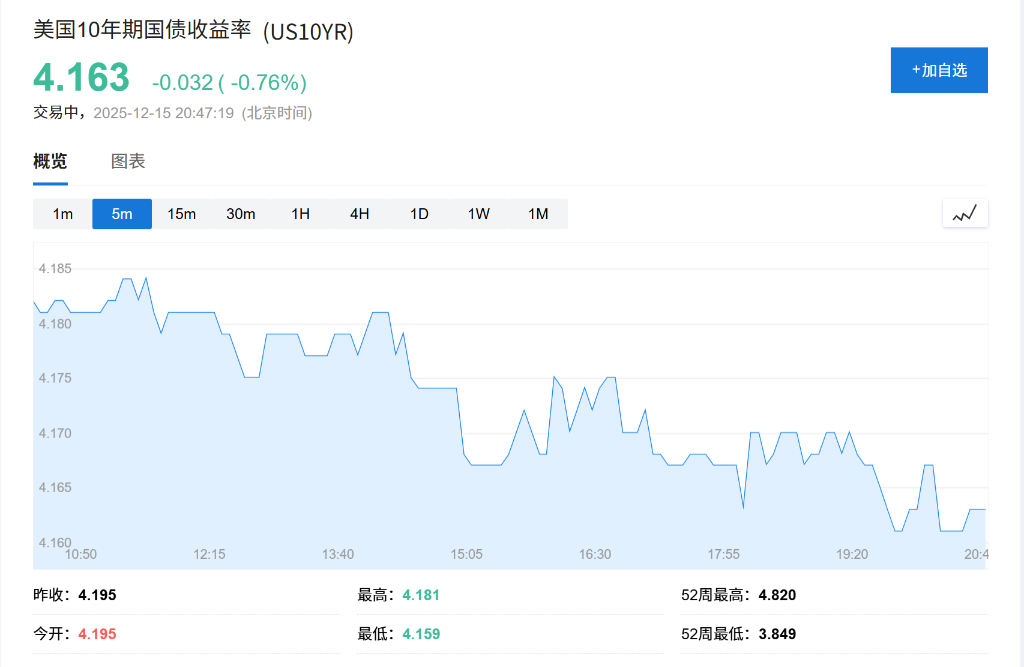
Core Viewpoint - The debate over the Federal Reserve's monetary policy path for 2026 is intensifying, with the U.S. bond market awaiting key economic data to gauge the central bank's next moves [1] Group 1: Market Expectations - Bond traders are betting on two rate cuts by the Federal Reserve next year, despite inflation remaining high, indicating a significant divergence from the Fed's own guidance [1][2] - The market is pricing in a potential drop in the federal funds rate to around 3.2% during this easing cycle [6] - The yield curve is steepening, with the 2-year Treasury yield at 3.51% and the 10-year yield at approximately 4.16%, reflecting complex expectations for future economic growth and policy easing [2] Group 2: Upcoming Economic Data - The non-farm payroll report set to be released on December 16 is viewed as a critical data point that could influence the bond market's trajectory [4][5] - Bloomberg's median forecast suggests an increase of 50,000 jobs in November, down from 119,000 in September, with a rising unemployment rate of 4.4%, the highest since 2021 [4] - A weaker-than-expected jobs report could lead to a shift in market expectations for rate cuts, potentially moving the timeline for the first comprehensive cut from June to April [4] Group 3: Diverging Opinions Among Investors - There is a split among institutional investors regarding the interpretation of upcoming data, with some believing it will necessitate significant rate cuts, while others caution against overreacting due to data collection disruptions caused by the government shutdown [5] - DWS Americas' fixed income head anticipates that the labor market's direction will directly influence interest rates, while WisdomTree's fixed income strategist warns that if November's data is similar to September's, it could trigger a sell-off in bonds [5] Group 4: Leadership Changes and Political Pressure - The upcoming leadership change at the Federal Reserve, with Powell's term ending in May, adds another layer of uncertainty to market expectations, especially with political pressures for lower rates [7] - The internal divisions within the Fed regarding the policy path are becoming more public, with some members opposing rate cuts until more inflation data is available [7]
Australia's financial conditions influenced by global factors, central banker says
Yahoo Finance· 2025-11-26 02:06
Core Insights - The Reserve Bank of Australia (RBA) acknowledges that global factors significantly influence Australia's financial conditions, with low equity risk premia and credit spreads indicating potentially easier conditions than expected [1][2] - There is uncertainty regarding the neutral interest rates, which have not decreased since the pandemic and may have even increased [2][4] Financial System Structure - The Australian financial system, primarily bank-dominated, suggests that capital market developments may have less impact on financial conditions compared to economies like the United States [2] International Market Review - There is minimal evidence of a significant shift away from U.S. dollar assets, although some market participants are managing increased risks associated with the U.S. dollar [3] - Central banks in emerging markets have been increasing their gold reserves since the freezing of Russian reserves in 2022, indicating a continuing trend [3] Monetary Policy Context - The RBA has reduced interest rates three times this year to 3.6%, but a surge in inflation during the third quarter has led to expectations that financial conditions may no longer be restrictive [4] - Financial markets currently imply less than a 50% probability of an additional rate cut by the RBA in May next year [4] - The RBA is focused on determining the neutral rate, which is crucial for balancing economic stimulation and inflation control within the target band of 2-3% [4]
美联储声明解读:降息重启,分歧仍存-US Economics-What the Fed Said – Differences remain as rate cuts resume
2025-10-09 02:00
Summary of Key Points from the Conference Call Industry Overview - The discussion primarily revolves around the U.S. economic outlook and Federal Reserve monetary policy, particularly focusing on interest rate adjustments and their implications for the economy. Core Insights and Arguments 1. **Divergent Views Among Fed Officials**: There is a notable division among Federal Reserve officials regarding the economic outlook and the appropriate monetary policy, with some advocating for significant rate cuts while others express concerns about inflation risks [1][5][6]. 2. **Rate Cut Proposals**: A group of 10 Fed officials supports cutting rates by 75 basis points or more, aligning with Chair Powell's view on employment risks. Conversely, 9 officials favor smaller cuts, citing inflation concerns [1][5]. 3. **Powell's Evolving Stance**: Fed Chair Powell's perspective has shifted towards a more dovish approach, recognizing downside risks to employment and suggesting that further rate cuts are necessary to achieve a neutral policy stance [5][6]. 4. **Miran's Dovish Position**: Stephen Miran argues for a more aggressive rate cut of 150 basis points, suggesting that current policy rates are overly restrictive and should be lowered to around the mid-2 percent range [2][7]. 5. **Targeting Repo Rates**: There is a discussion about potentially shifting the Fed's target from the effective federal funds rate to a more representative repo rate, with no immediate urgency for this change [3][23][24]. 6. **Factors Influencing Neutral Rate**: Miran identifies several factors that could lower the neutral interest rate (r*), including slower population growth, reduced deficits due to new tax policies, and increased credit supply from loan guarantees [8][10]. 7. **Output Gap and Inflation**: Miran's analysis suggests that deregulation and tax policy changes could widen the output gap, while slower shelter inflation could lead to a significant reduction in overall inflation rates [11][12]. Additional Important Points 1. **Cautious Fed Officials**: Some Fed officials, including Barkin and Goolsbee, express caution regarding further rate cuts, highlighting the need for more data on inflation trends before making decisions [15][18][21]. 2. **Market Expectations**: The market is pricing in a series of rate cuts, with expectations for the policy range to decrease over the next year [27][30]. 3. **Long-Term Considerations**: The potential transition to targeting repo rates is expected to take time, with discussions likely extending over a year before any changes are implemented [24][25]. This summary encapsulates the key discussions and insights from the conference call, focusing on the U.S. economic outlook and the Federal Reserve's monetary policy strategies.