
Sell America

Search documents
X @Bloomberg
Bloomberg· 2026-03-05 06:36
The war in Iran is forcing investors to reevaluate one of their most profitable stock strategies, leading some to conclude that the “Sell America, Buy Asia” trade has reached an inflection point https://t.co/86KqGXwWMD ...
Why Investors Are Looking Beyond The U.S. Market
Youtube· 2026-03-04 21:10
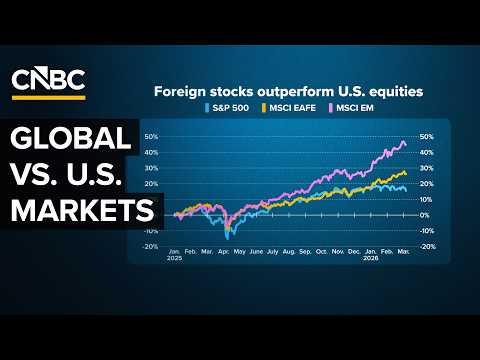
Market Performance - International equities outperformed U.S. equities in 2025, with developed international markets gaining 32% and emerging markets posting 34%, compared to the S&P 500's return of nearly 18% [1] - This trend of international markets outperforming the U.S. is expected to continue into 2026 and beyond [1] Investor Behavior - Investors are increasingly diversifying their portfolios by increasing exposure to global markets due to rising fiscal and geopolitical risks in the U.S. [3] - Conversations with investors indicate a strong interest in understanding how to reduce concentration in U.S. markets, particularly in U.S. private markets [3] Economic Factors - The U.S. dollar weakened by more than 9% in 2025 and is expected to weaken further, motivating investors to buy more international stocks [7] - A weaker dollar enhances the value of overseas profits when converted into U.S. dollars, boosting returns for international investments [8] Market Sentiment - There is a growing sentiment that the U.S. market is facing uncertainty, particularly with large companies transitioning from asset-light to asset-heavy models, leading to concerns about future returns on capital [4] - The "Sell America" sentiment reflects fears of a weaker dollar, higher U.S. interest rates, and deteriorating relations with trading partners, although this trend has not gained significant momentum recently [6] Long-term Outlook - Global markets are expected to continue outpacing the U.S. market, with forecasts suggesting years of international outperformance [9] - Many global investors are considering how to diversify their investments away from the U.S. and are looking for long-term opportunities in non-dollar-denominated markets [10]


Why Investors Are Looking Beyond The U.S. Market
CNBC· 2026-03-04 21:00
International equities outpaced U.S. equities in 2025, reversing the U.S. market's longstanding dominance. The S&P 500 returned nearly 18%, whereas developed international markets gained 32% and emerging markets posted 34%. And it looks like this trend will continue to 2026 and beyond.Investors are taking note and have increased their exposure to global markets. I'm a markets investing reporter for CNBC, and I've been following trends in both domestic and global markets. In this video, I break down the key ...
The ‘Sell America’ trade inflicted ‘lasting damage’ on the U.S. dollar, ING says
Yahoo Finance· 2026-02-16 10:53
Economic Overview - The U.S. economy grew at an annualized rate of 4.4% last year, with inflation declining and the stock market up nearly 12% over the last 12 months, suggesting strong confidence in the U.S. dollar [1] - Despite these positive indicators, the U.S. dollar is in decline, down 9.4% over the last 12 months and nearly 10% for 2025 against a basket of foreign currencies [2] Currency Performance - The dollar has lost 8% of its value against the British pound over the last 12 months, despite the U.K.'s annual economic growth being only 1.3% [2] - The dollar is down nearly 12% against the euro over the last 12 months, with each dollar buying only 84 cents in Paris [3] Market Sentiment - Equity traders are favoring European markets, with the Stoxx Europe 600 up nearly 4% year-to-date, while the S&P 500 is down 0.14% [4] - The "Sell America" trade is still in effect, indicating that despite a technically robust U.S. economy, there are headwinds affecting the dollar [4] Labor Market Concerns - Rising unemployment and weak hiring are contributing to the dollar's decline, with potential downward revisions expected for January job creation numbers [5][6] - The Federal Reserve's mandate to support the labor market may lead to new rounds of cheaper money, with expectations of two more interest rate cuts this year, which could further deter investment in dollar assets [6] Investor Confidence - Recent improvements in the U.S. macroeconomic picture have not been sufficient to restore confidence in the dollar, as indicated by ongoing market reactions [7]
Investors look beyond US hedge funds for the first time since 2023, Barclays says
Reuters· 2026-02-06 14:44
Core Viewpoint - Investors are planning to reduce their exposure to U.S. hedge funds for the first time since 2023, influenced by discussions surrounding the "Sell America" trade [1] Group 1 - The trend of decreasing investment in U.S. hedge funds marks a significant shift in investor sentiment [1] - The discussions about the "Sell America" trade have gained traction, indicating a potential change in market dynamics [1] - This shift could reflect broader economic concerns and changing investment strategies among institutional investors [1]

X @The Economist
The Economist· 2026-02-04 19:31
There is a lot more going for them than “sell America” https://t.co/jQlHgigZhL ...
How dollar disorder could be a wake-up call for global investors
Reuters· 2026-02-03 14:59
Core Viewpoint - The U.S. dollar is experiencing significant volatility due to unpredictable government policies and concerns over Federal Reserve independence, leading to potential capital flight and a reassessment of U.S. assets by global investors [1]. Group 1: Dollar Volatility and Market Impact - The dollar has seen a decline of almost 2% in one week in January, reaching four-year lows, before rebounding sharply, which has caused turmoil in the metals market [1]. - Gold prices fell by 5% following the dollar's rebound, marking its largest daily drop since the early 1980s, while silver and copper also experienced significant declines from recent peaks [1]. - The global currency market, valued at nearly $10 trillion a day, has become more volatile, with the euro/dollar exchange rate volatility reaching its highest level since July [1]. Group 2: Investor Sentiment and Asset Management - Foreign investors hold approximately $70 trillion in U.S. assets, having more than doubled their holdings over the past decade, but are now reassessing their exposure due to the dollar's instability [1]. - A disorderly decline of the dollar, defined as a 5% monthly loss, could lead to a drastic sell-off of long-dated Treasuries and tighten U.S. financial conditions significantly [1]. - Investment managers are shifting towards a neutral stance, reducing exposure to stocks and gold, and employing options strategies to hedge against uncertainty in Treasury yields [1].
X @Bloomberg
Bloomberg· 2026-02-02 14:28
Are investors really ready to `Sell America'? Here's why walking away isn’t so simple. https://t.co/g1leWnivam ...
Market Open: Wall Street records keep Oz shares in rally; key inflation print today | Jan 28
The Market Online· 2026-01-27 21:09
Market Overview - Australian shares are expected to advance at open, continuing the Week 5 rally, driven by the S&P 500 setting records and anticipation for upcoming inflation data [1][2] - Analysts describe the upcoming quarterly inflation report as "make or break," with expectations set at a threshold of 0.8% for potential RBA rate hikes [2][3] Company News - BHP has reclaimed its position as Australia's most valuable listed company, surpassing Commonwealth Bank, with a year-over-year increase of +26%, while CBA has seen a decline of over -20% since mid-CY25 [5] - DroneShield has experienced a -12% drop this week due to a reported shrinkage in its sales pipeline, although it remains up +35.7% year-to-date [5] - Humm Group's investor Akat Investments has requested an investigation by the Takeovers Panel regarding Credit Corp's offer from the previous year, focusing on the takeover's timeline [5] Commodities and Forex - The Australian dollar is trading at 70 cents to the U.S. dollar, a level anticipated for CY26, reached sooner than expected [7] - In commodities, Iron Ore is down -0.1% at $103.55 per tonne, Brent Crude is up +2.9% at $67.44 per barrel, Gold is priced at $5,166 per ounce, and US natural gas futures have retreated -4% to $6.49 per gigajoule [7]


'Sell America' has sparked a FOMO-fueled rush to gold and silver among everyday investors
Business Insider· 2026-01-24 10:15
Market Performance - Gold and silver were among the best-performing investments in 2025, with gold increasing by 73% and silver by 194% since the beginning of the year [5][10] - Retail investors poured a net average of $15 million into gold and $7 million into silver investments daily throughout the year [5] Investor Sentiment - Many investors expressed concerns about volatility in US markets, leading to increased interest in precious metals as a hedge against inflation and economic uncertainty [2][10] - The "Sell America" narrative contributed to a fear of missing out (FOMO) among investors, driving them towards gold and silver [15][16] Online Activity - Gold and silver saw significant online discussions, with the SPDR Gold Shares ETF being the third most talked-about investment on r/WallStreetBets [6] Retail Demand - Bullion Exchanges reported a doubling of clientele in 2025, with many first-time buyers lining up to purchase metals [11] - The CEO of Bullion Exchanges noted that the firm could have seen a 200% growth if not for limited capacity and metal shortages [12] Market Dynamics - The rally in gold and silver prices was influenced by both traditional investors and newer entrants driven by FOMO [15][16] - Concerns about a potential market correction are present, with estimates suggesting gold could drop by 9% and silver by 31% if the hype subsides [17]
