To B产业

Search documents
江苏增速为何比广东快?
首席商业评论· 2025-11-22 03:36
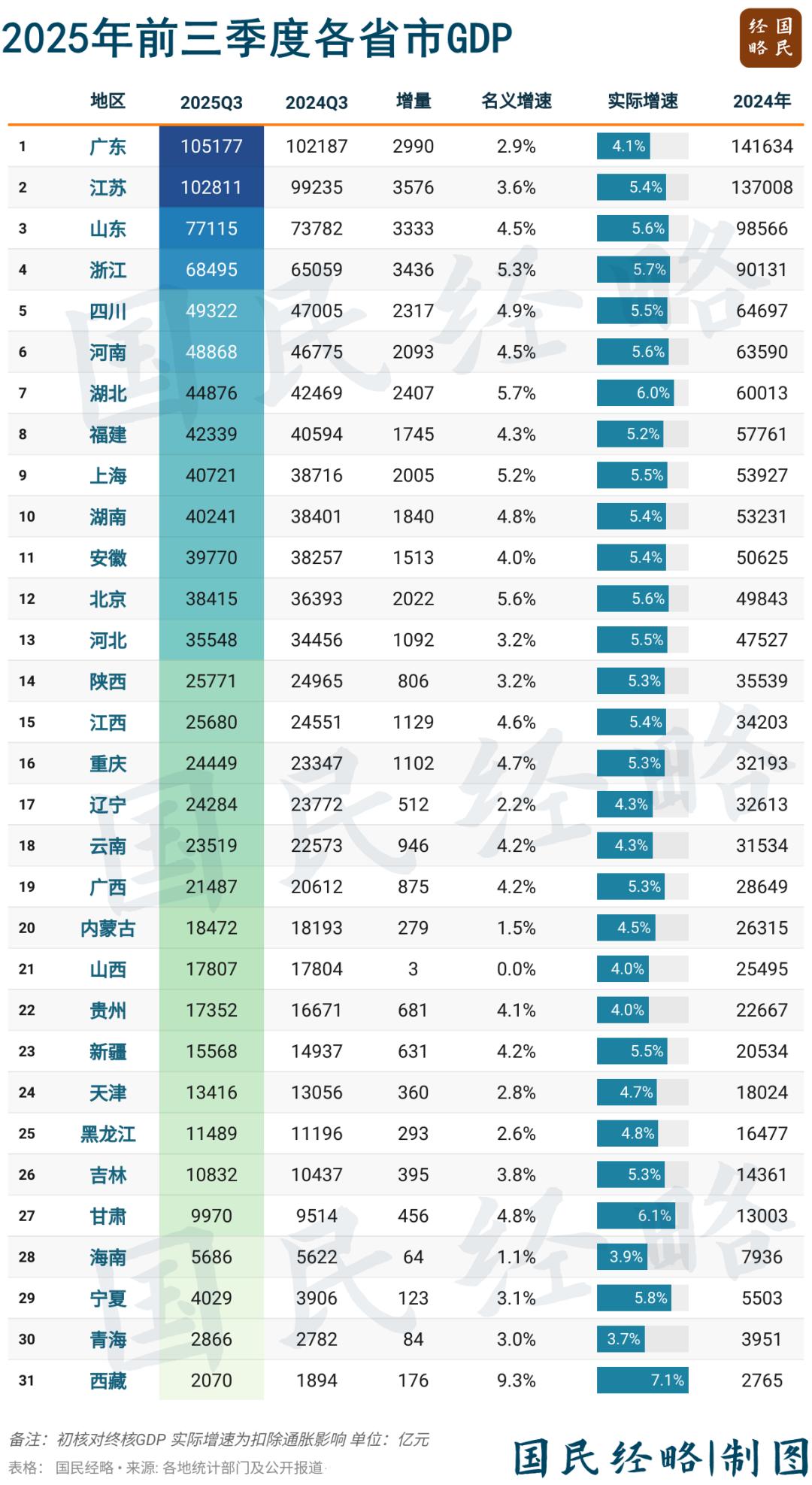
Core Viewpoint - The article discusses the economic competition between Guangdong and Jiangsu provinces, highlighting the narrowing GDP gap and the reasons behind Jiangsu's faster growth compared to Guangdong [4][6][18]. Economic Data Summary - In Q3 2025, Guangdong's GDP reached 10.52 trillion, while Jiangsu's was 10.28 trillion, with a gap of only 236.6 billion [5][6]. - Jiangsu's GDP growth rate is higher than Guangdong's, attributed to differences in industrial structure, with Jiangsu focusing more on B2B industries [7][10]. Industrial Structure Analysis - Guangdong's economy is more consumer-oriented (To C), excelling in sectors like mobile phones and home appliances, while Jiangsu is stronger in industrial intermediate goods (To B) like integrated circuits and solar cells [10][11]. - The impact of external market fluctuations is more pronounced on Guangdong due to its higher exposure to consumer preferences [10][11]. Real Estate Impact - The slowdown in Guangdong's growth is linked to the decline of key cities like Guangzhou and Foshan, heavily affected by the real estate downturn [11][12]. - In 2024, real estate investment in Jiangsu decreased by 10.3%, while Guangdong saw a sharper decline of 18.2% [11]. Comparative Economic Indicators - Despite Jiangsu's GDP growth, Guangdong leads in several economic indicators, including fiscal revenue, bank deposits, and the number of listed companies [13][14]. - Guangdong's tax revenue in 2023 was 21,638 billion, significantly higher than Jiangsu's 15,586.8 billion [14][15]. Innovation and Research - Guangdong's Shenzhen-Hong Kong-Guangzhou innovation cluster ranks first globally, indicating strong technological transformation capabilities [15]. - However, Jiangsu shows higher research output, as reflected in the "2025 Natural Index" rankings [15]. Population and Fiscal Challenges - Guangdong has a larger population (127.8 million) compared to Jiangsu (85.26 million), but its per capita fiscal expenditure is lower, indicating potential challenges in public service provision [18][19]. - The high influx of migrant workers in Guangdong adds pressure on public services, which may not be adequately addressed [19].

江苏增速为何比广东快?
3 6 Ke· 2025-11-20 02:44
Core Insights - The economic competition between major provinces in China, particularly Guangdong and Jiangsu, is intensifying, with Jiangsu showing faster GDP growth compared to Guangdong [2][4][15] Economic Performance - In Q3 2025, Guangdong's GDP reached 10.52 trillion, while Jiangsu's was 10.28 trillion, with a narrowing gap of 2.37 billion [3][4] - Jiangsu's GDP growth rate was 3.6% nominally and 5.4% in real terms, while Guangdong's was 2.9% nominally and 4.1% in real terms [2][3] Industry Structure - The difference in growth rates is attributed to the industrial structures of the two provinces, with Guangdong focusing more on consumer-oriented (To C) industries and Jiangsu on business-oriented (To B) industries [5][7] - To C industries are more susceptible to market fluctuations, while To B industries tend to have more stable demand due to long-term business relationships [7][8] Real Estate Impact - The real estate sector has a more significant negative impact on Guangdong, with a projected decline of 18.2% in 2024 compared to Jiangsu's 10.3% [9][10] Fiscal and Economic Indicators - Guangdong leads in various economic indicators, including tax revenue, with 21,638 billion in 2023 compared to Jiangsu's 15,586.8 billion [10][13] - Guangdong has a higher number of listed companies and a greater total market capitalization compared to Jiangsu [13][14] Innovation and Research - Guangdong's tech innovation cluster, including Shenzhen, Hong Kong, and Guangzhou, ranks first globally, indicating strong technological transformation capabilities [12][14] - Jiangsu, however, has a higher research output compared to Guangdong, as indicated by the "2025 Natural Index" [12] Population and Public Spending - Guangdong has a larger population (127.8 million) compared to Jiangsu (85.26 million), but its per capita fiscal spending is lower, indicating potential challenges in public service provision [17][18] - The high influx of migrant workers in Guangdong adds pressure on public services, which may not be adequately addressed [18]