Trade Risks

Search documents
Silver tops gold as investors’ go-to hedge against trade tensions
Yahoo Finance· 2026-02-25 20:00
Group 1 - Silver has outperformed gold in 2023, with a nearly 30% gain in silver futures compared to a 20% rise in gold, marking a record 10 consecutive monthly gains for silver [3][1] - The current global environment, characterized by slowing growth and rising geopolitical tensions, has increased investor interest in silver as a hedging asset [1][4] - Silver's dual nature as both an investment and an industrial metal contributes to its appeal, making it a preferred hedge over gold in recent times [2][6] Group 2 - Trade risks, including a temporary 10% global tariff from Washington and potential increases to 15%, have heightened fears of renewed trade confrontations, driving demand for safe-haven assets like silver [4][5] - Ongoing geopolitical tensions, particularly in Eastern Europe and security issues in Mexico, are reinforcing the attractiveness of precious metals, with investors closely monitoring U.S.-Iran nuclear negotiations [5][4] - Despite its recent gains, silver prices have fallen nearly 21% from a record high of $115.504 on January 26, including a significant one-day drop of 31% on January 30, the largest since March 1980 [5][6]
X @Bloomberg
Bloomberg· 2025-10-22 04:30
Chinese sovereign bonds are luring buyers as speculation grows that the nation’s central bank will ease monetary policy before the end of the year to support the economy in the face of trade risks https://t.co/0vFcOnyy4K ...
Chinese Stocks Drop as Trade Risks Bite
Barrons· 2025-10-17 08:50
Group 1 - Chinese stocks experienced a decline, with the Shanghai Composite Index falling by 1.95% to close at 3839.75, the Shenzhen Composite Index dropping by 2.7% to 2396.92, and the ChiNext Price Index decreasing by 3.4% to 2935.37 [1] - Despite the recent downturn, China's equity market has been one of the best-performing Asian stock markets this year, although analysts from HSBC have noted that risks to the rally are increasing [2]
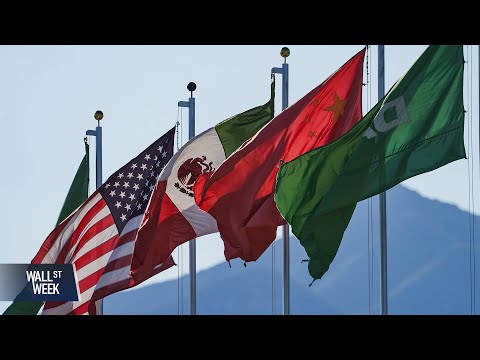
Mexico’s Nearshoring Boom Faces Trade Risks
Bloomberg Television· 2025-09-27 12:00
Nearshoring and Trade Dynamics - Companies are relocating production from China to Mexico, driven by factors like the North American Free Trade Agreement (NAFTA) and its successor, USMCA [2][3] - Chinese companies are establishing plants in Mexico to compete, forcing existing companies to improve competitiveness [3][4] - The USMCA agreement is up for review in 2026, with China's role in North American supply chains being a key issue [9][10] - Tariffs on Mexican exports could lead to higher prices for US consumers due to the integrated nature of the economies [12] Investment Climate and Risks - Investors are concerned about issues like judicial reform and security in Mexico, which are creating uncertainty [5][6][7] - Homicide rates remain high, and extortion and kidnappings have increased, contributing to investor uncertainty [6][7] - Investment in Mexico has been frozen due to uncertainty, despite the search for alternatives to Asia [8] - Mexico aims to increase its share of North American imports to approximately 25% through integration with the US, contingent on attracting private capital [17] Automotive Industry and Tariffs - Tariffs on steel, aluminum, and auto imports, particularly those imposed by the US, are disrupting the automotive supply chain [18][19][20] - Parts can cross the border multiple times during the manufacturing process, making the industry vulnerable to tariffs [20] - Canada imports more vehicles from Mexico than from the US for the first time in 30 years [24] - The industry advocates for tariff-free movement of vehicles and parts within North America to ensure competitiveness and lower consumer costs [29][30] - Stronger North American content rules and penalties for non-compliance are needed, along with measures to encourage OEMs in Europe, Japan, and Korea to manufacture more vehicles in North America [26][27] - The industry suggests keeping China out of the North American automotive market due to concerns about unfair competition [28]

X @Bloomberg
Bloomberg· 2025-07-04 23:31
South Korea’s parliament approved a $23.3 billion extra budget as President Lee Jae Myung seeks to revive an economy struggling with weak consumption and mounting trade risks from US tariffs https://t.co/J9ytaqJYwh ...
'Headline Risk' Lurks as TSM Shines Bright on AI Demand
Benzinga· 2025-04-18 15:20
Core Insights - Taiwan Semiconductor Manufacturing Co. (TSM) reported a remarkable first quarter, exceeding Wall Street expectations with a revenue of $25.53 billion, a 41.6% year-over-year increase, and an EPS of $2.12, surpassing the consensus of $1.82 [2][3] - Despite strong fundamentals driven by AI demand, TSM's stock is facing technical challenges, trading below key moving averages, indicating bearish signals [4][7] Financial Performance - First quarter revenue reached $25.53 billion, exceeding expectations of $23.92 billion [2] - EPS was reported at $2.12, significantly above the consensus estimate of $1.82 [2] - TSM projected second quarter revenue between $28.4 billion and $29.2 billion, supported by ongoing demand for AI processors [2] Market Position and Sentiment - TSM's strong results highlight its critical role as a supplier to Nvidia, suggesting positive momentum for the semiconductor sector [3] - However, the stock is showing technical warning signs, including a "Death Cross" formation, which indicates potential downward pressure [4] Risks and Challenges - Concerns exist regarding the sustainability of TSM's sales growth, with a pre-tariff buying rush potentially inflating short-term results [5] - Ongoing trade tensions and tariff uncertainties pose significant risks to the semiconductor industry, which could impact future performance [6][7]