Yield curve control

Search documents
This is How the Coming Global Debt Crisis Ends (Got Bitcoin?)
Bitcoin Bram· 2026-01-29 17:00
In a world of unlimited money printing and new taxes on unrealized gains, the only way to win is to own assets your government cannot print or debase. In this episode, I'm joined by Jeroen Blok, a professional investor with over 20 years of experience managing institutional wealth. Today we're unpacking his new book, The Great Rebalancing in three parts.From the systemic failure of the 6040 portfolio to the scarce asset solution involving Bitcoin and gold. We discuss why safe government debt has become a we ...


Precious metals are going to party like it’s the 1970s, reckons Albert Edwards
Yahoo Finance· 2025-12-17 12:43
Core Viewpoint - The investment outlook for gold and other precious metals is optimistic, with the potential for continued growth rather than a bubble scenario [1][2]. Group 1: Gold Market Analysis - Albert Edwards attributes the rising gold prices to government "fiscal incontinence" and expectations of quantitative easing (QE) and yield curve control (YCC) [3]. - The notion of gold being in a bubble is challenged by Bloomberg strategist Simon White, who argues that geopolitical events, such as the freezing of Russian forex reserves, have led emerging market central banks to shift their reserves from dollars to gold [4]. - Journalist Edward Chancellor notes the absence of "irrational exuberance" typically seen in bubbles, highlighting that many Wall Street banks have gold price targets significantly lower than current spot prices, and that speculators are more focused on cryptocurrencies than gold [5]. Group 2: Historical Context and Future Outlook - Edwards suggests that the current gold market may resemble the price behavior of the 1970s, when gold prices surged during a period of high inflation [6]. - Despite being a long-time bear on equities, Edwards acknowledges the positive predictions for U.S. equities made by SocGen's strategist Manish Kabra, indicating a nuanced view of the market [7].
Garcia: A slowdown in Japan will ultimately flow back to the U.S.
CNBC Television· 2025-12-08 12:32
Japanese Bond Market Analysis - Japanese 30-year bond market is experiencing significant activity, with the 10 to 30-year spread nearly twice the normal spread over the last 25 years, reaching almost 160 compared to the usual 85 [2] - Japan is undergoing a normalization of its monetary policy after a period of yield curve controls and deflation [3][10] - The rise in Japanese bond yields could lead to a slowdown in the Japanese economy [7] Carry Trade Implications - Estimates suggest a $500 billion carry trade exists, and rising Japanese yields could cause capital to flow from the US back to Japan [5] - The unwinding of the carry trade is expected to continue as the US lowers interest rates and Japan raises them [10] Bond Samurai Influence - "Bond Samurai" are influencing the Japanese government to slow down quantitative tightening and adjust bond issuance towards the long end [6] - If the Japanese government doesn't heed the "Bond Samurai's" advice, rates could rise further, leading to a significant economic slowdown that could impact the US [7] US Market Impact - US real rates are approximately 100 basis points too high on the long end [11] - High US real rates could lead to a continued economic slowdown in the US unless they are lowered quickly [12]
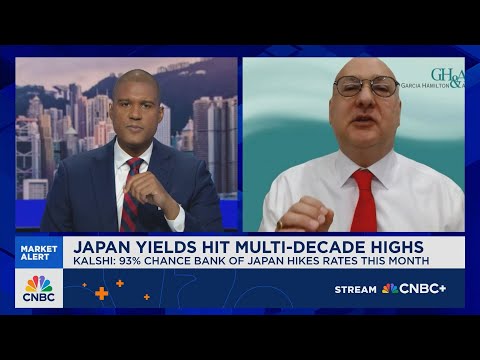
Bank of Japan faces a policy dilemma as government bond yields keep hitting new highs
CNBC· 2025-12-04 04:08
Core Viewpoint - The Bank of Japan is facing a critical decision regarding its monetary policy as rising government bond yields threaten to disrupt its normalization process and impact economic growth [1][3]. Group 1: Bond Yields and Economic Impact - The yield on the benchmark 10-year Japanese government bonds (JGBs) reached 1.917%, the highest since 2007, while the 20-year and 30-year JGB yields hit 2.936% and 3.436%, respectively, marking levels not seen since 1999 [2]. - Japan's inflation has remained above the Bank of Japan's 2% target for 43 consecutive months, complicating the decision to raise rates amidst rising bond yields [3]. - Rising bond yields are expected to increase borrowing costs, further straining Japan's fiscal situation, which already has the highest debt-to-GDP ratio globally at nearly 230% [4]. Group 2: Government Stimulus and Debt Concerns - The Japanese government is preparing to implement its largest stimulus package since the pandemic, which raises concerns about the country's increasing debt levels [5]. - The new debt issuance of 11.7 trillion yen to finance the supplementary budget is 1.7 times larger than that issued under the previous administration [5][6]. Group 3: Global Market Implications - The unwinding of yen-funded leveraged carry trades due to a hawkish BOJ rate hike and disappointing U.S. macro data led to a significant sell-off in global stocks, with Japan's Nikkei index dropping 12.4% in August 2024 [7]. - Rising Japanese yields have narrowed the rate differential, raising concerns about another potential unwind of carry trades, although experts believe a repeat of the 2024 market meltdown is unlikely [8][9]. - Structural flows from retail allocations in pension funds and life insurance are expected to anchor foreign holdings, making large-scale repatriation of funds into Japan improbable [10].

Wall Street Brunch: Hooray For DevDay
Seeking Alpha· 2025-10-05 18:16
Economic Impact of Government Shutdown - The government shutdown is predicted to last nearly 21 days, with a 64% chance of exceeding 15 days and a 40% chance of lasting more than 25 days [3] - Goldman Sachs estimates that each week of the shutdown will reduce fourth-quarter annualized real GDP growth by approximately 0.15 percentage points, with a corresponding positive effect on growth in the first quarter if the shutdown ends before then [4] AI Sector Developments - OpenAI, backed by Microsoft, reached a private market valuation of $500 billion, making it the world's most valuable startup [6] - Speculation surrounds OpenAI's upcoming DevDay event, where CEO Sam Altman may unveil a new AI-powered browser, potentially named Aura, to compete with Google's Chrome [5] Earnings Reports and Company Performance - PepsiCo is expected to report EPS of $2.26 on revenue of $23.86 billion, with activist investor Elliott Management advocating for strategic changes to improve bottling efficiencies [8] - Delta Air Lines is forecasted to post EPS of $1.53 with revenue of $15.94 billion, with analysts noting its strong execution compared to peers, presenting a potential buy opportunity [9] Cryptocurrency Market Trends - Bitcoin has surpassed $125,000 for the first time, driven by strong inflows into bitcoin ETFs and renewed institutional interest [11] Consumer Sentiment and Economic Indicators - The upcoming FOMC minutes will be closely monitored, with an 85% chance of two more quarter-point rate cuts this year [10] - The University of Michigan will release its preliminary measure of October consumer sentiment, following a decline in consumer confidence to a five-month low [10] Pharmaceutical Developments - Costco will offer weight loss medications Wegovy and Ozempic at half the list price to its members, following a partnership with Novo Nordisk [12]


When the world’s largest asset manager and the ‘bond king’ both agree — run to gold, silver and bitcoin
Yahoo Finance· 2025-09-22 23:22
Core Viewpoint - The article discusses the concept of financial repression, where the government benefits from low interest rates on savings while inflation erodes purchasing power, leading to a loss of real wealth for savers [2][6][7]. Group 1: Financial Repression and Its Implications - Financial repression is described as a strategy used by the government to manage its $37 trillion debt by ensuring that savings earn less than inflation, effectively allowing the government to benefit from the difference [2][6]. - The article highlights that the U.S. money supply has been growing at an annual rate of 7%, which significantly diminishes the real purchasing power of savings [6][18]. - Historical context is provided, noting that during periods of financial repression, such as from 1942 to 1951, bondholders lost substantial purchasing power while real assets preserved value [18][8]. Group 2: Investment Strategies - The article advocates for a shift from traditional savings and bonds to hard assets like gold, silver, and bitcoin as a hedge against financial repression [19][21]. - It suggests a portfolio allocation of 10% in gold and silver and 10% in bitcoin, while advising against long-term bonds [21][22]. - The rising interest in gold and silver is noted, with gold prices increasing over 40% in the current year, indicating a broader market recognition of the need for real assets [16][19]. Group 3: Digital Currency and Stablecoins - The introduction of stablecoins, particularly Tether's new U.S. dollar-backed coin USA₮, is discussed as a mechanism that could further entrench financial repression by mandating users to lend money to the government [14][12]. - The article raises concerns about the implications of stablecoins on traditional financial systems, suggesting that they could force individuals into low-yield Treasury bills [15][14]. - Tether's strategy of accumulating gold while promoting stablecoins is highlighted, indicating a potential divergence between the digital currency market and traditional asset management [15][16].

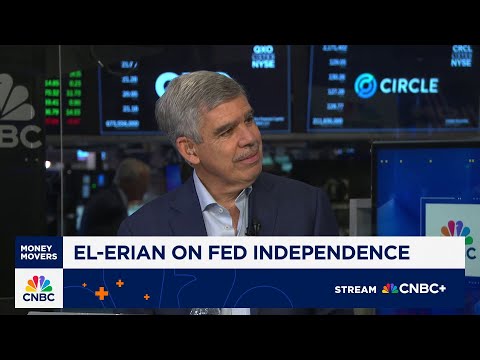
Allianz's El-Erian: 'Amazing' how muted market reaction has been to Fed independence attacks
CNBC Television· 2025-08-27 16:06
Market Reaction & Fed Independence - The market reaction to attacks on Fed independence has been muted, with a steepening yield curve [1][2] - The market has decoupled sovereign issues (tariffs, Fed independence, fiscal policy) from corporate performance, focusing on productivity enhancements [4][5] - The "buy the dip" mentality, conditioned over time, contributes to market resilience [7][8][9] Economic Outlook - The US economy is slowing, but not dramatically [10][12] - The bond market's shift to absolute space (demanding higher compensation) and tariffs posing a bigger threat to global growth are major risks [11] - The industry anticipates the Fed will cut rates and inflation will remain persistently above 2% [12] - Companies are prioritizing resilience over efficiency, contributing to inflationary pressures [13] Policy & Global Trade - The market is taking a slower ramp-up approach to policy changes, like tariffs, compared to immediate announcements [7] - Secondary sanctions on countries trading with Russia (e.g., India at 50% tariffs) raise questions about potential implications for China [8] - The industry believes the Fed is unlikely to change its 2% inflation target, despite potentially living with higher inflation [13][14]