Trump tariffs

Search documents
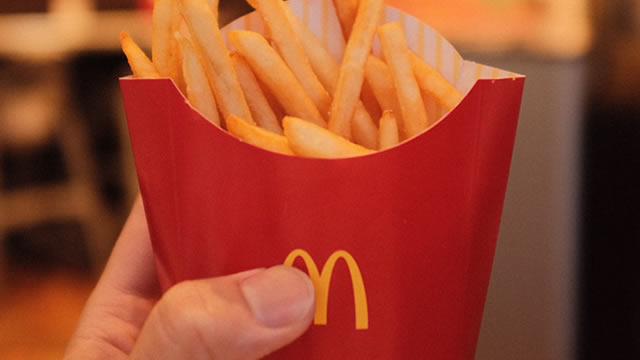
Trade War's Secret Sauce: How McDonald's $5 Meal Deal Is Feeding A Billion-Dollar Boom
Benzinga· 2025-08-07 18:15
Core Insights - McDonald's $5 meal deal is becoming a significant macro hedge for investors amid rising grocery costs due to tariffs and global uncertainty, contributing to a nearly 5% stock price increase over the past month [1][2]. Sales Performance - The $5 meal deal has driven U.S. same-store sales up by 9% in Q2 2025, showcasing strong consumer demand for value amidst economic pressures [2][4]. Competitive Advantage - While competitors like Chipotle face challenges with rising prices, McDonald's is capitalizing on its recession-resilient brand, appealing to budget-conscious consumers and investors alike [3][4]. Economic Context - The timing of the meal deal coincides with the impact of tariffs, which are increasing costs for consumers, positioning McDonald's as a value leader in the fast-food industry [4][5]. Future Considerations - There are concerns that rising ingredient costs due to tariffs may affect profit margins, making the sustainability of the $5 deal a point of interest for investors, particularly ahead of the upcoming earnings call on October 29 [5]. Investment Strategy - Analysts suggest buying McDonald's stock under $275 to benefit from the value-menu trend, with additional opportunities in Yum Brands under $130 and the Consumer Staples Select Sector SPDR Fund for those looking to hedge against food inflation [6].


X @Bitcoin Archive
Bitcoin Archive· 2025-08-01 21:06
Market Impact - Nearly $1 billion in Bitcoin and crypto liquidations occurred today [1] - Liquidations are attributed to Trump tariffs and weak job data [1]
X @BBC News (World)
BBC News (World)· 2025-07-31 02:51
Financial Impact - Ford anticipates approximately $2 billion in costs this year due to Trump tariffs [1]

X @Bloomberg
Bloomberg· 2025-07-27 09:17
Investment Strategy - Experts suggest keeping investment strategies simple and focusing on long-term gains in India [1] Global Trade Impact - Trump's tariffs are reshaping the global trade landscape, influencing investment decisions in emerging markets like India [1]
US auto sales rise before #Trump tariffs set in #politics
Bloomberg Television· 2025-07-03 14:18
Market Trends - Major automakers, including Ford, General Motors, Honda, and Toyota, reported sales figures for the second quarter [1] - Initial surge in car sales driven by consumers anticipating President Trump's tariffs [1][2] - Car sales experienced a slowdown in June after the tariffs were implemented [2] - The market is bracing for tougher times ahead for consumers, dealers, and manufacturers [3] Impact of Tariffs - Tariffs led to a "buying bonanza" as Americans sought to purchase cars before prices increased [1] - The surge in sales was followed by a "hangover" or payback in June as the effect of tariffs wore off [2]

Trump tariffs are not the right solution, says professor and author Baldwin
Bloomberg Television· 2025-06-10 05:00
Trade Policy Disruption - The report highlights a significant and disruptive trade action taken on April 2nd, characterized as an attempt to break through the established world trading system [1] - This action involved the imposition of large-scale tariffs, violating numerous WTO rules and existing trade agreements [1] - The tariffs were described as "big, bold, and everywhere at once," indicating a comprehensive and immediate impact [1] Impact on International Relations - The action is portrayed as a departure from traditional trade negotiation and reform efforts [1] - It is characterized as a sweeping disruption of the way the world trading system operates [1]

Apple's highest-end iPhone could see $350 price hike in U.S. on Trump tariffs, analyst predicts
CNBC· 2025-04-07 19:27
Core Viewpoint - The implementation of President Trump's reciprocal tariffs is expected to significantly increase the retail prices of Apple's iPhone models, particularly the iPhone 16 Pro Max, which could see a price hike of up to $350 in the U.S. market, raising concerns about consumer purchasing power and Apple's market valuation [1][3]. Price Impact - The iPhone 16 Pro Max currently retails for $1,199, and UBS analysts predict a nearly 30% price increase for units manufactured in China [2]. - The iPhone 16 Pro, priced at $999, may experience a smaller price increase of $120 if produced in India [2]. Market Reaction - Apple's shares have dropped 20% over the last three trading days, resulting in a loss of over $675 billion in market capitalization due to fears surrounding the impact of the tariffs on pricing and consumer demand [3]. Cost Absorption and Production Challenges - Analysts from Morgan Stanley estimate that Apple could absorb additional tariff costs of approximately $34 billion annually, but the diversification of production to other countries may not provide the expected flexibility due to potential tariffs on those locations as well [7]. - UBS analysts highlighted uncertainty regarding how increased costs will be shared with suppliers and the extent to which these costs can be passed on to consumers [4]. Global Pricing Strategy - JPMorgan Chase analysts predict a potential global price increase of 6% for Apple products to offset U.S. tariffs, while Barclays analysts suggest that without price adjustments, Apple could face a 15% reduction in earnings per share [6]. - Morgan Stanley estimates that Apple may raise prices across its product lines in the U.S. by 17% to 18% following the tariff announcement [8]. Production Location Considerations - Apple, heavily reliant on manufacturing in China, faces significant exposure to trade tensions, with a potential incoming tariff rate of 54% on products manufactured there [5]. - The feasibility of relocating iPhone production to the U.S. is deemed nearly impossible by supply chain experts, with predictions that such a move could result in an iPhone costing as much as $3,500 [6].

Nasdaq in Bear Market: Buy the Dip in ETFs?
ZACKS· 2025-04-07 18:01
Group 1 - President Trump enacted a two-step tariff strategy starting April 5, imposing a baseline tariff of 10% on imports from various countries [1] - The stock market reacted negatively, particularly the Nasdaq Composite, which fell 5.8% on April 4 and was down 22% from its December record, entering a bear market [2][3][10] - Major tech stocks like Apple, NVIDIA, and Tesla experienced significant declines due to their exposure to China and the impact of retaliatory tariffs [4][12] Group 2 - Concerns are rising that the investment boom in AI infrastructure is outpacing actual demand, with Alibaba's co-founder warning about oversupply [7] - Microsoft has canceled certain data center projects despite earmarking $80 billion for expansion in 2024, indicating potential oversupply issues [7] - Despite bearish sentiment, major tech companies are committed to over $300 billion in capital expenditures, suggesting potential buying opportunities [8] Group 3 - The Nasdaq 100's price-to-earnings (P/E) ratio has declined from 41.24X in early September 2024 to 29.27X at the end of March 2025, indicating valuation corrections [9][11] - The Nasdaq-100-based ETF Invesco QQQ Trust shows a bullish signal as the 50-day moving average has risen above the 200-day moving average [13] - Investors with a strong risk appetite may consider Nasdaq-100-based ETFs like Invesco QQQ Trust, which currently holds a Zacks Rank 3 (Hold) [14]


JPMorgan CEO Jamie Dimon says Trump tariffs will boost inflation, slow an already weakening U.S. economy
CNBC· 2025-04-07 10:15
Core Viewpoint - JPMorgan Chase CEO Jamie Dimon highlighted that the tariffs announced by President Trump are likely to increase prices on both domestic and imported goods, which could further slow down an already weakening U.S. economy [1][2]. Group 1: Tariff Impact - The newly announced tariffs are expected to have significant short-term inflationary effects on both imported and domestic goods due to rising input costs and increased demand for domestic products [2]. - Dimon expressed uncertainty about whether the tariffs will lead to a recession, but he confirmed that they will slow down economic growth [2]. Group 2: Market Reaction - Dimon is the first major Wall Street bank CEO to publicly comment on Trump's tariff policy during a time of significant market volatility, with U.S. equities experiencing their worst week since the onset of the Covid pandemic [3]. - The announcement of tariffs has caused a shock in global markets, leading to a notable decline in stock prices [3]. Group 3: Uncertainties and Recommendations - Dimon noted that Trump's tariff policy has introduced numerous uncertainties, including effects on global capital flows, the dollar, corporate profits, and responses from trading partners [4]. - He emphasized the importance of resolving tariff issues quickly to mitigate cumulative negative effects that could be difficult to reverse over time [5].


Technology stocks fall for a second session after Trump tariffs, led by Tesla and Nvidia
CNBC· 2025-04-04 16:01
Core Insights - Technology stocks experienced significant declines due to fears of a global trade war following retaliatory tariffs from China [1][3] - The Nasdaq Composite is on track for its worst week since 2020, with the Magnificent Seven group losing over $1 trillion in market value [4][5] Company Performance - Tesla and Nvidia saw substantial losses, dropping more than 9% and 7% respectively, following a decline of over 5% the previous day [2] - Apple faced a 5% loss, accumulating a week-to-date drop of over 11%, pressured by new tariffs affecting its secondary manufacturing locations [2] - Meta Platforms decreased by 4%, while Amazon, Alphabet, and Microsoft each dipped more than 1% [3] - Oracle fell by 5%, and AppLovin and Palantir Technologies experienced significant declines of 15% and 11% respectively [3] Sector Impact - The VanEck Semiconductor index dropped 7%, with Marvell Technology leading the decline at 11% [5] - Major semiconductor companies like Lam Research, Qorvo, Advanced Micro Devices, and Intel fell more than 7%, while Micron Technology lost 12% on Friday, marking a quarter of its value lost week-to-date [5] - Concerns are rising that widespread tariffs could negatively impact demand in the semiconductor sector, despite it being excluded from the recent tariffs [4]