
Property Management

Search documents
FirstService Residential launches new resident insurance solution in partnership with VIU by HUB
Prnewswire· 2026-02-18 16:08
FirstService Residential launches new resident insurance solution in partnership with VIU by HUB [Accessibility Statement] Skip NavigationDANIA BEACH, Fla., Feb. 18, 2026 /PRNewswire/ -- FirstService Residential, North America's leading property management company, is proud to announce the launch of a new resident insurance solution designed to close the insurance coverage gap, offer more choice, and simplify life for residents and boards at the communities it manages. This new program is delivered through ...



TD Securities Raises its Price Target on FirstService Corporation (FSV) to $217 and Maintains a Buy Rating
Yahoo Finance· 2026-02-13 21:12
FirstService Corporation (NASDAQ:FSV) is included in our list of Real Estate Investing for Beginners: 10 Best Stocks to Buy. TD Securities Raises its Price Target on FirstService Corporation (FSV) to $217 and Maintains a Buy Rating On February 5, 2026, TD Securities raised its price target on FirstService Corporation (NASDAQ:FSV) to $217 from $211 previously and maintained a Buy rating. The firm said fourth-quarter results should ease investor concerns tied to roofing and restoration headwinds and descri ...
长沙发布2025年第四季度物业“红黑榜” 19家企业登“红榜”6家进“黑榜”
Chang Sha Wan Bao· 2026-02-12 13:32
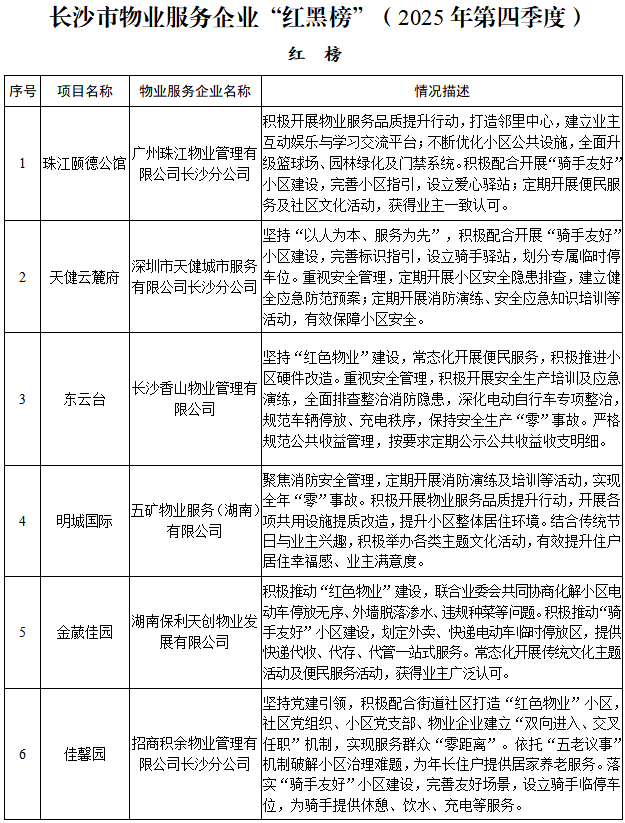
长沙晚报掌上长沙2月12日讯(全媒体记者 刘嘉)12日,长沙市住房和城乡建设局、长沙市精神文明建 设办公室联合发布2025年第四季度物业服务企业"红黑榜"及"重点监管"企业名单。19家企业荣登"红 榜",6家企业被列入"黑榜",14家企业被列入"重点监管"范围。 19家企业登"红榜"彰显服务标杆 在2025年四季度开展的高层建筑消防安全管理、物业服务质量提升、公共收益管理、文明小区建 设、"友好小区"建设等工作中,珠江颐德公馆、天健云麓府、东云台、明城国际、金葳佳园、佳馨园、 龙湖春江天玺、四季美景、省出版局宿舍小区、恒大绿洲、仁和雨花家园、帝辰观澜荟锦、长房星珑 湾、恒广国际景园、陶然居、碧桂园城市花园二期、新月半岛外滩、愿景壹号院、盛翠豪庭等19个项目 的物业服务企业表现突出,成为行业标杆,登上"红榜"。 其中,广州珠江物业管理有限公司长沙分公司服务的珠江颐德公馆,积极开展物业服务品质提升行动, 打造邻里中心,全面升级篮球场、园林绿化及门禁系统,并配合开展"骑手友好"小区建设,设立爱心驿 站,获得业主一致认可。 招商积余物业管理有限公司长沙分公司服务的佳馨园,坚持党建引领,建立"双向进入、交叉任职"机 制 ...
节前观望情绪浓厚,个股涨跌分化
Xin Lang Cai Jing· 2026-02-11 04:19
Group 1 - The three major indices opened lower, with the Shanghai Composite Index down 0.1%, the Shenzhen Component Index down 0.17%, and the ChiNext Index down 0.24%, followed by narrow fluctuations and a significant decrease in trading volume compared to the previous day [1] - In terms of real estate, January's second-hand housing transaction volume remained flat month-on-month and the year-on-year decline narrowed, with a 3% month-on-month decrease in the transaction volume index for 80 cities and a 3% year-on-year decrease [1] - The transaction price index for second-hand residential properties saw a significant narrowing of the month-on-month decline to -0.6%, indicating a potential investment opportunity in the real estate and property management sectors [1] Group 2 - The optical fiber sector is experiencing a strong growth cycle driven by AI computing infrastructure and domestic communication policies, leading to simultaneous increases in both price and demand [2] - The Ministry of Industry and Information Technology is promoting the construction of high-speed optical fibers and ultra-low loss fibers, which supports the domestic optical communication industry's upgrade and opens long-term growth potential [2] - The current optical fiber sector benefits from four major advantages: policy support, explosive demand, improved supply-demand dynamics, and technological upgrades, making it a core focus in the optical communication field [2]
FirstService (FSV) Q4 2025 Earnings Transcript
Yahoo Finance· 2026-02-04 17:09
Some voluntary and a few involuntary all primarily due to pricing. These cancellations will impact our revenue, but have little impact on profitability. We expect to be at the bottom end of our mid-single-digit range at 3% or 4% for Q1. This is unrelated to our core community management business which we believe will carry the division to mid-single-digit organic growth for the year. Moving on to FirstService Brands. Revenues for the quarter were down 3% in aggregate, and 7% organically, with organic growth ...
FirstService Declares 11% Increase to Quarterly Cash Dividend
Globenewswire· 2026-02-03 15:45
Core Viewpoint - FirstService Corporation has announced an 11% increase in its quarterly cash dividend, reflecting strong earnings and cash flow growth, and a commitment to returning value to shareholders [1][2]. Dividend Announcement - The quarterly dividend is set at US$0.305 per Common Share, up from US$0.275, and will be payable on April 7, 2026, to shareholders of record as of March 31, 2026 [1]. - The annualized dividend will increase to US$1.22 from US$1.10, marking over a decade of annual dividend growth of at least 10% [2]. Company Overview - FirstService Corporation is a leader in the North American property services sector, operating through two main platforms: FirstService Residential and FirstService Brands [4]. - The company generates approximately US$5.5 billion in annual revenues and employs over 30,000 people across North America [5]. - FirstService's shares are traded on NASDAQ and the Toronto Stock Exchange under the symbol "FSV" and are included in the S&P/TSX 60 Index [5].

Does This Property Management Stock Look Mispriced After a New $8 Million Buy?
The Motley Fool· 2026-01-23 10:51
Company Overview - FirstService is a leading provider of property management and essential property services across North America, managing a diverse portfolio of residential and commercial assets [6] - The company operates through two segments: FirstService Residential, which focuses on recurring property management contracts and ancillary services, and FirstService Brands, which includes franchise and company-owned service locations [8] - As of January 20, the market capitalization of FirstService is $7.36 billion, with a revenue of $5.48 billion and a net income of $138.55 million for the trailing twelve months [4] Recent Transactions - On January 20, Jacobson & Schmitt Advisors disclosed the purchase of 49,829 additional shares of FirstService, increasing its total position to 144,994 shares, valued at approximately $8.11 million [2] - This transaction reflects an increase in the fund's position value in FirstService by $4.42 million, influenced by trading activity and share price changes [2] Financial Performance - The latest quarterly results indicate a 4% year-over-year revenue increase to $1.45 billion, with adjusted EBITDA rising to $164.8 million, up 3% [10] - Adjusted EPS for the quarter was reported at $1.76, reflecting an 8% increase, driven by steady execution despite challenges [10] - The Residential division showed strong performance with an 8% revenue growth and margin expansion due to new contract wins and labor efficiency gains [10] Investment Appeal - The increase in Jacobson & Schmitt's stake in FirstService highlights the company's stability and recurring, needs-based demand, which is appealing to long-term investors [9] - Despite shares lagging over the past year, the fundamentals of the company remain solid, with reduced debt levels and strong cash flow [11]

PURE Property Management and HomeRiver Group Merge, Secure $80 Million in Growth Capital
Prnewswire· 2026-01-22 11:00
PURE HomeRiver will operate as the nation's largest third-party single-family rental (SFR) property management company LOS GATOS, Calif., Jan. 22, 2026 /PRNewswire/ -- PURE Property Management and HomeRiver Group today announced their merger, operating as PURE HomeRiver. Combined, PURE HomeRiver manages over 40,000 properties across 80+ local offices in 200+ markets and adjacent cities across 35+ states, with the vision of making renting and investing simple, smart, and more satisfying. Continue Reading PUR ...

中国物业管理与服务 - 2026 展望:在温和增长中把握阿尔法机会-China Property Management & Services -2026 Outlook Navigating Moderate Growth with Alpha Opportunities
2026-01-20 03:19
Summary of Conference Call on China Property Management & Services Industry Industry Overview - The property management and services (PMC) industry in China is expected to experience moderate growth in 2026 due to ongoing headwinds such as pressure on management fees and cash collection [1][2] - The industry is transitioning to a new growth phase, moving away from legacy issues, although cash collection pressures and management fee weaknesses persist [2] Key Insights - **Earnings Growth Forecast**: The forecast for earnings growth from 2025 to 2027 is 3%, 5%, and 7% year-on-year, respectively, with an average topline growth of approximately 5% [3] - **Performance Divergence**: Companies with strong service quality and solid asset bases are expected to outperform, while those relying on lower quality projects may struggle [2] - **Focus on High-Quality Names**: Recommendations include prioritizing companies like CR Mixc and GTS for their asset quality and decent dividends, with CGS identified as a tactical investment opportunity [4] Financial Metrics - **Management Services (PMS)**: PMS is projected to be the main growth driver with a 7% CAGR from 2025 to 2027, supported by diversified third-party expansion [3] - **Valuation Changes**: Price targets and ratings for various companies have been adjusted, with CGS seeing a 16% increase in price target due to improved cash flow and dividend visibility [11] Company-Specific Updates - **A-Living**: Earnings estimates for 2025-2027 have been revised down by 3%, 7%, and 7% due to a slower recovery in city services and the termination of low-quality projects [11] - **CGS**: Earnings estimates have been revised up by 3%, 5%, and 7% for the same period, reflecting lower SG&A and better-than-expected margin pressure [11] - **CR Mixc**: Earnings estimates have been adjusted down by 2%, 4%, and 7%, but the price target has been increased by 5% due to strong shopping mall performance [11] - **Onewo**: Earnings estimates have been revised down by 6%, 15%, and 28% due to rising margin pressure and liquidity risks from Vanke [11] Market Dynamics - **Cash Collection Pressure**: The average cash collection is expected to decline by 2-3 percentage points in 2025, impacting overall growth [2] - **Legacy Issues**: The impact of legacy issues is diminishing, with PMCs now focusing on independent growth engines and third-party projects [13][14] - **Property Sales Decline**: National property sales have dropped significantly, with expectations of further contraction in 2026, albeit at a milder pace [15][16] Investment Recommendations - **Order of Preference**: The preferred companies include Greentown Service, CR Mixc, and Poly Property Services, with A-Living and Sunac Services rated as underweight [12] - **Dividend Yields**: Companies like CGS and CR Mixc offer attractive dividend yields of approximately 8% and 4-5%, respectively [4][12] Conclusion - The China PMC industry is navigating through a challenging environment with moderate growth expectations. Companies that can maintain high service quality and adapt to changing market conditions are likely to emerge as leaders in this evolving landscape.

老物业赖着不走 业主可拒付物业费
Xin Lang Cai Jing· 2026-01-14 22:45
Core Viewpoint - The article discusses the legal issues surrounding the transition of property management companies in residential communities, highlighting the challenges faced by residents when the original property management refuses to vacate and continues to demand fees after the contract has expired [3][4]. Group 1: Legal Framework - The "Civil Code of the People's Republic of China" clearly defines the responsibilities and boundaries of property management companies, stating that upon contract termination, the original company must vacate the premises within a reasonable timeframe and hand over relevant materials to the new management [4]. - If the original property management fails to comply, they cannot demand payment for services rendered after the contract termination and may be liable for damages incurred by the homeowners [4]. Group 2: Resident Challenges - Residents are facing difficulties when the original property management company does not leave after the contract ends, leading to issues such as delayed garbage collection and maintenance of public facilities [3]. - Homeowners are concerned about paying fees to the original management, fearing that doing so may result in financial loss if the company does not vacate [3]. Group 3: Legal Actions and Recommendations - It is recommended that the homeowners' committee send a formal notice to the original property management specifying the vacate date and handover details, and if they do not comply, homeowners can refuse to pay fees and pursue legal action [4]. - The original property management's claim that the decision to hire a new company is invalid due to voting irregularities is legally unfounded, as they do not have the standing to challenge the homeowners' committee's decisions [5].