白色家电

Search documents
2025年A股十大最惨板块,跌麻了
Ge Long Hui· 2025-12-30 11:30
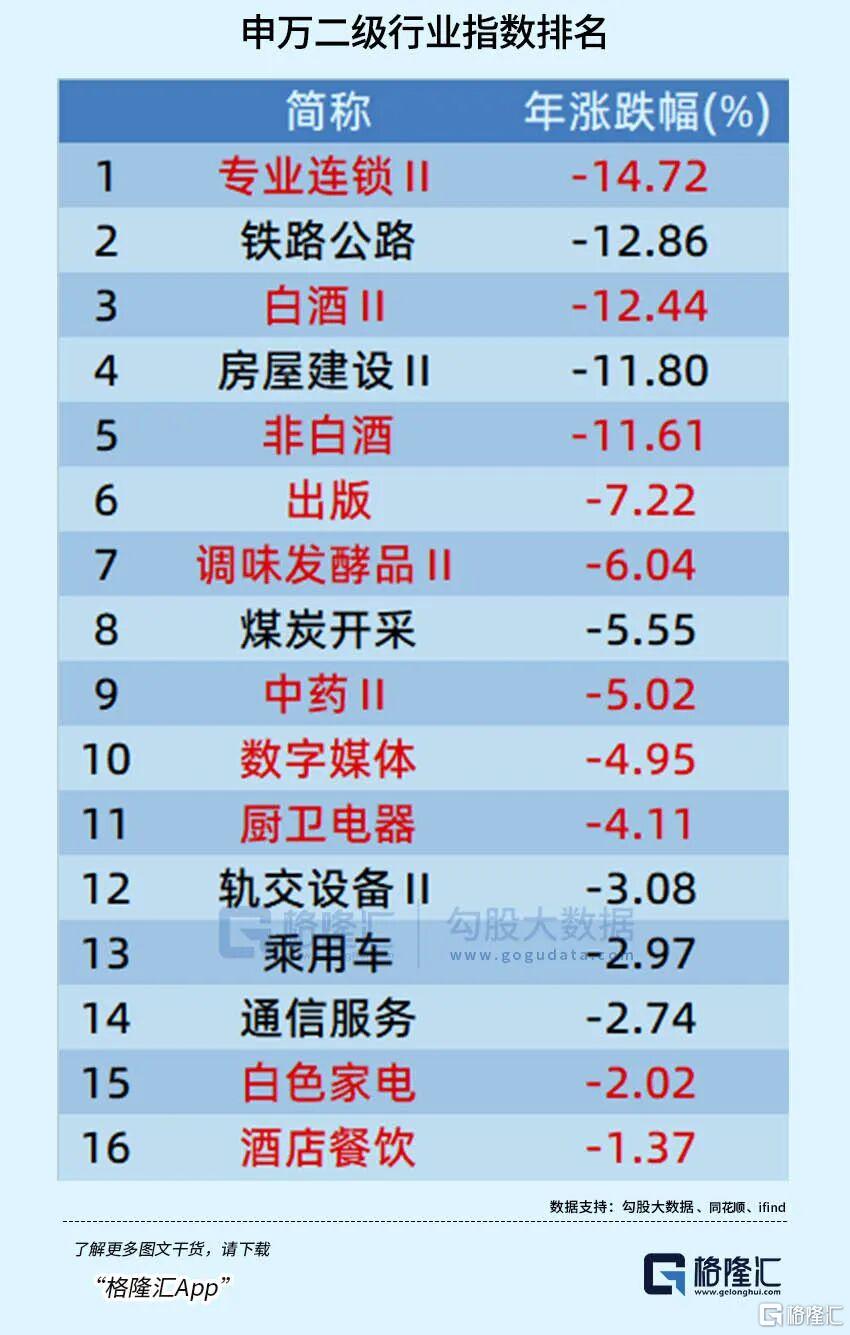
Core Viewpoint - The consumer sector has faced significant challenges in the past year, with many sub-sectors experiencing declines despite overall market growth. The focus on domestic demand and consumption has not translated into positive performance for many consumer-related industries [1][5]. Consumer Sector Performance - In the first half of the year, 10 out of 16 declining industries were from the consumer sector, indicating a broader trend of underperformance [1]. - The white liquor sector, a key component of the consumer market, has seen a year-to-date decline of 12.44%, with major brands like Wuliangye experiencing significant drops in revenue and profit [6][9]. - The professional chain sector has been particularly hard-hit, with a year-to-date decline of 14.72%, exemplified by the struggles of companies like Renrenle [16][20]. White Liquor Sector - The white liquor industry is facing its eighth consecutive year of production decline, with both volume and price dropping simultaneously [10]. - Wuliangye reported a 10.26% decline in revenue and a 13.72% drop in net profit for the first three quarters, marking its first negative growth in a decade [9]. - The industry is shifting from a growth-driven model to one focused on consumer choice, with a need for companies to adapt to changing consumer preferences [15]. Professional Chain Sector - The professional chain sector is experiencing a crisis, with many physical stores closing and traditional business models failing [16][20]. - Renrenle, once a leading private supermarket, has seen its market value plummet and is now facing delisting due to ongoing financial struggles [21][24]. - The shift towards online shopping and personalized consumer demands has further exacerbated the challenges faced by traditional retail chains [24][25]. Non-White Liquor Sector - The non-white liquor sector, including beer and wine, has also faced declines, with the beer segment seeing a notable drop in sales and profits [27][32]. - Budweiser APAC reported an 8.2% decline in domestic sales and a 24.4% drop in net profit, reflecting broader industry challenges [32][33]. - The market is witnessing a trend of cross-industry competition, with liquor companies diversifying into new beverage categories [34]. Publishing Sector - The publishing industry has shown resilience despite a 10.4% decline in the overall market for printed books, with listed companies managing to increase net profits by 14.65% [43][44]. - However, leading companies like Zhongwen Media are struggling, with significant revenue and profit declines due to changes in educational material procurement policies [45][48]. Seasoning Sector - The seasoning industry has faced a 6.04% decline, with companies like Qianhe Flavor struggling due to falling revenues and a loss of consumer trust [51][55]. - The industry is experiencing a shift in consumer preferences and increased competition, necessitating a reevaluation of business strategies [60]. Traditional Chinese Medicine Sector - The traditional Chinese medicine sector is facing challenges, with companies like Pian Zai Huang reporting significant declines in revenue and profit due to rising costs and regulatory pressures [61][66]. - The industry is undergoing a transformation as companies seek to innovate and diversify their product offerings [70]. Digital Media Sector - The digital media industry has seen a 4.95% decline, with companies like Mango TV reporting significant drops in revenue and profit due to changing consumer behaviors and market dynamics [71][74]. - The sector is grappling with the need to adapt to new content consumption trends while facing pressure from traditional advertising models [75]. Kitchen and Bathroom Appliances Sector - The kitchen and bathroom appliance sector has experienced a 4.11% decline, largely due to reduced demand from the real estate market [78][79]. - Companies like Boss Electric are facing revenue declines for the first time in years, highlighting the challenges of adapting to a changing market landscape [79][80]. White Goods Sector - The white goods sector has seen a 2.02% decline, with major players like Gree Electric facing significant revenue and profit pressures due to increased competition and market saturation [83][84]. - The industry is shifting towards a focus on product quality and brand strength as external stimuli diminish [88]. Hotel and Restaurant Sector - The hotel and restaurant sector has faced a 1.37% decline, with revenue pressures stemming from changing consumer spending habits and increased competition from online platforms [89][92]. - Companies are beginning to adopt more refined operational strategies to navigate the challenging market environment [96].




今年十大最惨板块,跌麻了
格隆汇APP· 2025-12-30 11:04
Core Viewpoint - The article discusses the significant downturn in various consumer sectors, particularly the liquor and retail industries, highlighting the challenges and potential opportunities for recovery amidst changing consumer behaviors and market dynamics [2][4][43]. Group 1: Liquor Industry - The liquor sector, especially the white liquor segment, has faced substantial declines, with the overall white liquor market down by 12.44% this year [9][15]. - Major brands like Wuliangye have reported significant drops in revenue and profit, with a 10.26% decline in revenue and a 13.72% drop in net profit for the first three quarters [17]. - The white liquor industry is experiencing a shift from a growth-driven model to one focused on consumer preferences, with a need for companies to adapt to changing consumption patterns [26][27]. Group 2: Retail Industry - The professional chain sector has seen a dramatic decline of 14.72%, with many traditional retail models struggling to survive [28][30]. - Companies like Renrenle have faced severe financial difficulties, leading to a significant reduction in store numbers and ultimately triggering delisting procedures [34][35]. - The shift towards online shopping and changing consumer preferences have forced traditional retailers to innovate or face extinction [36][39]. Group 3: Non-White Liquor Sector - The non-white liquor sector, including beer and wine, has also suffered, with a reported decline of 11.61% this year [40]. - Major players like Budweiser APAC have experienced significant sales drops, with a 9.5% revenue decrease and a 24.4% decline in net profit [46]. - The industry is witnessing a trend of cross-industry competition, with liquor companies diversifying into other beverage categories to adapt to market changes [51][56]. Group 4: Publishing Industry - The publishing sector has faced a 7.22% decline, with the overall market for printed books down by 10.40% [60]. - Despite the downturn, some publishing companies have managed to increase profits through cost control and operational efficiency, with a 14.65% rise in net profit for listed companies [61][62]. - The industry is undergoing significant transformation, moving from traditional sales models to more dynamic content management and IP development strategies [70][71]. Group 5: Seasoning Industry - The seasoning sector has seen a 6.04% decline, with companies like Qianhe Flavor struggling due to a drop in revenue and profit [74]. - The industry is facing challenges from both market saturation and changing consumer preferences, necessitating a shift in strategy for many companies [81]. Group 6: Traditional Chinese Medicine - The traditional Chinese medicine sector has experienced a 5.02% decline, with companies like Pian Zai Huang facing significant revenue and profit drops [86]. - The industry is under pressure from regulatory changes and increased competition, pushing companies to innovate and diversify their product offerings [91][92]. Group 7: Digital Media - The digital media sector has reported a 4.95% decline, with traditional advertising models struggling to adapt to new market realities [97][100]. - Companies like Mango TV have seen significant revenue drops, highlighting the challenges of maintaining profitability in a rapidly changing landscape [101][104]. Group 8: Kitchen and Bathroom Appliances - The kitchen and bathroom appliance sector has faced a 4.11% decline, with major players like Boss Electric experiencing revenue drops for the first time in years [112]. - The industry is grappling with reduced demand due to a slowdown in the real estate market, necessitating a shift towards innovation and international expansion [117][118]. Group 9: White Goods - The white goods sector has seen a 2.02% decline, with companies like Gree Electric facing significant challenges due to market saturation and increased competition [126][129]. - The industry is shifting towards a more rational consumer base that prioritizes product quality and brand reputation over traditional growth drivers [133]. Group 10: Hotel and Restaurant Industry - The hotel and restaurant sector has experienced a 1.37% decline, with many businesses struggling to convert increased tourism into profits [140][141]. - The industry is witnessing a shift towards more refined operational models, with companies focusing on member engagement and digital transformation to enhance profitability [142][143].





白色家电板块12月30日涨0.12%,美的集团领涨,主力资金净流出4.18亿元
Zheng Xing Xing Ye Ri Bao· 2025-12-30 08:56
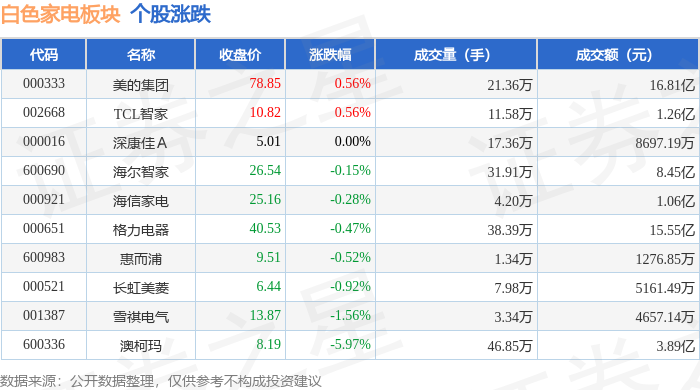
证券之星消息,12月30日白色家电板块较上一交易日上涨0.12%,美的集团领涨。当日上证指数报收于 3965.12,下跌0.0%。深证成指报收于13604.07,上涨0.49%。白色家电板块个股涨跌见下表: | 代码 | 名称 | 主力净流入(元) | 主力净占比 游资净流入 (元) | | 游资净占比 散户净流入 (元) | | 散户净占比 | | --- | --- | --- | --- | --- | --- | --- | --- | | 001387 | 雪祺电气 | -13.83万 | -0.30% | -156.71万 | -3.36% | 170.54万 | 3.66% | | 600983 | 惠而浦 | -53.67万 | -4.20% | 98.39万 | 7.71% | -44.73万 | -3.50% | | 002668 | TCL智家 | -88.87万 | -0.71% | 346.85万 | 2.76% | -257.98万 | -2.05% | | 000921 海信家电 | | -366.29万 | -3.47% | 673.84万 | 6.39% | -307.55万 ...

白色家电板块12月29日跌0.48%,澳柯玛领跌,主力资金净流入6074.62万元
Zheng Xing Xing Ye Ri Bao· 2025-12-29 09:06
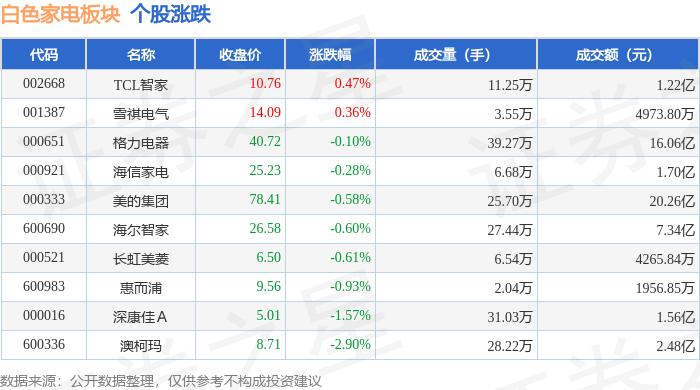
Market Overview - The white goods sector experienced a decline of 0.48% on December 29, with Aucma leading the drop [1] - The Shanghai Composite Index closed at 3965.28, up 0.04%, while the Shenzhen Component Index closed at 13537.1, down 0.49% [1] Stock Performance - TCL Smart Home (002668) closed at 10.76, up 0.47% with a trading volume of 112,500 shares and a transaction value of 122 million yuan [1] - Gree Electric Appliances (000651) closed at 40.72, down 0.10% with a trading volume of 392,700 shares and a transaction value of 1.606 billion yuan [1] - Midea Group (000333) closed at 78.41, down 0.58% with a trading volume of 257,000 shares and a transaction value of 2.026 billion yuan [1] - Haier Smart Home (600690) closed at 26.58, down 0.60% with a trading volume of 274,400 shares and a transaction value of 734 million yuan [1] - Aucma (600336) closed at 8.71, down 2.90% with a trading volume of 282,200 shares and a transaction value of 248 million yuan [1] Capital Flow - The white goods sector saw a net inflow of 60.7462 million yuan from institutional investors, while retail investors experienced a net outflow of 625.939 million yuan [1] - Gree Electric Appliances had a net inflow of 160 million yuan from institutional investors, but a net outflow of 58.1725 million yuan from retail investors [2] - Midea Group had a net inflow of 41.9801 million yuan from institutional investors, with a net outflow of 52.5536 million yuan from retail investors [2] - Haier Smart Home experienced a net outflow of 81.9545 million yuan from institutional investors, while retail investors had a net inflow of 9.8857 million yuan [2]


每周股票复盘:澳柯玛(600336)拟挂牌转让子公司股权
Sou Hu Cai Jing· 2025-12-27 20:00
Core Viewpoint - Aucma Co., Ltd. is undergoing significant corporate activities, including planned equity transfers and financial transactions, which may impact its market position and operational strategy. Company Announcements Summary - Aucma Co., Ltd. held its 20th meeting of the 9th Board of Directors on December 24, 2025, where several resolutions were passed, including an expected total of 1,104 million yuan for daily related transactions in 2026, pending shareholder approval [1][3] - The company plans to transfer 100% equity of its wholly-owned subsidiary, Qingdao Aucma Smart Cold Chain Co., Ltd., to Qingdao Aucma Commercial Appliances Co., Ltd. without compensation [1] - Aucma (Indonesia) Industrial Co., Ltd. intends to apply for a project loan not exceeding 200 million yuan for the construction of an intelligent manufacturing plant in Indonesia, with a loan term of no less than 5 years [1][3] - The company and its subsidiaries plan to conduct forward foreign exchange trading in 2026, with an amount not exceeding 10 million USD, aimed at hedging foreign exchange risks related to import and export activities [1][2] Upcoming Shareholder Meeting - Aucma Co., Ltd. will hold its first temporary shareholder meeting for 2026 on January 12, 2026, where it will review the expected daily related transactions and the public transfer of the controlling subsidiary's equity [2] - The meeting will utilize a combination of on-site and online voting, with specific provisions for related shareholders to abstain from voting [2]
白色家电板块12月26日涨0.04%,澳柯玛领涨,主力资金净流出2.18亿元
Zheng Xing Xing Ye Ri Bao· 2025-12-26 09:07
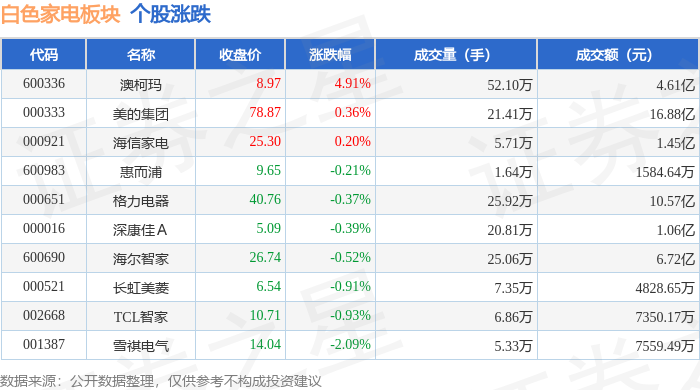
Market Overview - The white goods sector increased by 0.04% on December 26, with Aucma leading the gains [1] - The Shanghai Composite Index closed at 3963.68, up 0.1%, while the Shenzhen Component Index closed at 13603.89, up 0.54% [1] Stock Performance - Aucma (600336) closed at 8.97, up 4.91% with a trading volume of 521,000 shares and a turnover of 461 million yuan [1] - Midea Group (000333) closed at 78.87, up 0.36% with a trading volume of 214,100 shares and a turnover of 1.688 billion yuan [1] - Hisense Home Appliances (000921) closed at 25.30, up 0.20% with a trading volume of 57,100 shares and a turnover of 145 million yuan [1] - Whirlpool (600983) closed at 9.65, down 0.21% with a trading volume of 16,400 shares and a turnover of 15.846 million yuan [1] - Gree Electric (000651) closed at 40.76, down 0.37% with a trading volume of 259,200 shares and a turnover of 1.057 billion yuan [1] - Haier Smart Home (600690) closed at 26.74, down 0.52% with a trading volume of 250,600 shares and a turnover of 672 million yuan [1] Capital Flow - The white goods sector experienced a net outflow of 218 million yuan from institutional investors, while retail investors saw a net inflow of 60.15 million yuan [1] - Midea Group had a net inflow of 28.86 million yuan from institutional investors, but a net outflow of 41.76 million yuan from retail investors [2] - Aucma saw a net inflow of 5.70 million yuan from institutional investors, with a slight outflow from retail investors [2] - TCL Smart Home (002668) had a net inflow of 1.57 million yuan from institutional investors, while retail investors contributed a net inflow of 914,500 yuan [2] - Haier Smart Home experienced a significant net outflow of 1.05 billion yuan from institutional investors, but a net inflow of 536.78 million yuan from retail investors [2]


白色家电板块12月25日跌0.02%,澳柯玛领跌,主力资金净流出2.89亿元
Zheng Xing Xing Ye Ri Bao· 2025-12-25 09:08
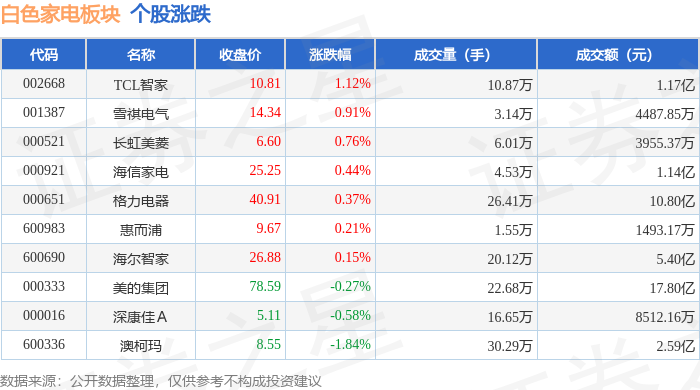
Core Viewpoint - The white goods sector experienced a slight decline of 0.02% on December 25, with Aucma leading the drop, while the Shanghai Composite Index rose by 0.47% and the Shenzhen Component Index increased by 0.33% [1] Group 1: Market Performance - The closing price for TCL Smart Home was 10.81, with an increase of 1.12% and a trading volume of 108,700 shares, amounting to 117 million yuan [1] - Snowball Electric closed at 14.34, up by 0.91%, with a trading volume of 31,400 shares [1] - Changhong Meiling's closing price was 6.60, reflecting a 0.76% increase with a trading volume of 60,100 shares [1] - Hisense Home Appliances closed at 25.25, up by 0.44%, with a trading volume of 45,300 shares [1] - Gree Electric Appliances closed at 40.91, increasing by 0.37% with a trading volume of 264,100 shares [1] - Whirlpool closed at 9.67, up by 0.21%, with a trading volume of 15,500 shares [1] - Haier Smart Home closed at 26.88, reflecting a 0.15% increase with a trading volume of 201,200 shares [1] - Midea Group closed at 78.59, down by 0.27%, with a trading volume of 226,800 shares [1] - Deep Konka A closed at 5.11, down by 0.58%, with a trading volume of 166,500 shares [1] - Aucma closed at 8.55, leading the decline with a drop of 1.84% and a trading volume of 302,900 shares [1] Group 2: Capital Flow - The white goods sector saw a net outflow of 289 million yuan from main funds, while retail investors contributed a net inflow of 228 million yuan [1] - TCL Smart Home experienced a net inflow of 1.38 million yuan from main funds, while retail investors had a net inflow of 589,560 yuan [2] - Changhong Meiling had a net inflow of 4.08 million yuan from main funds, but saw outflows from both retail and speculative funds [2] - Aucma faced a significant net outflow of 33.82 million yuan from main funds, while retail investors contributed a net inflow of 13.64 million yuan [2] - Gree Electric Appliances had a net outflow of 68.64 million yuan from main funds, with retail investors contributing a net inflow of 41.71 million yuan [2]

白色家电板块12月23日涨0.22%,美的集团领涨,主力资金净流出1.83亿元
Zheng Xing Xing Ye Ri Bao· 2025-12-23 09:01
Group 1 - The white goods sector increased by 0.22% compared to the previous trading day, with Midea Group leading the gains [1] - The Shanghai Composite Index closed at 3919.98, up 0.07%, while the Shenzhen Component Index closed at 13368.99, up 0.27% [1] Group 2 - The white goods sector experienced a net outflow of 183 million yuan from main funds, with retail funds seeing a net inflow of 232 million yuan [2] - Speculative funds had a net outflow of approximately 48.96 million yuan [2]

白色家电板块12月22日跌0.57%,澳柯玛领跌,主力资金净流出1.84亿元
Zheng Xing Xing Ye Ri Bao· 2025-12-22 09:03
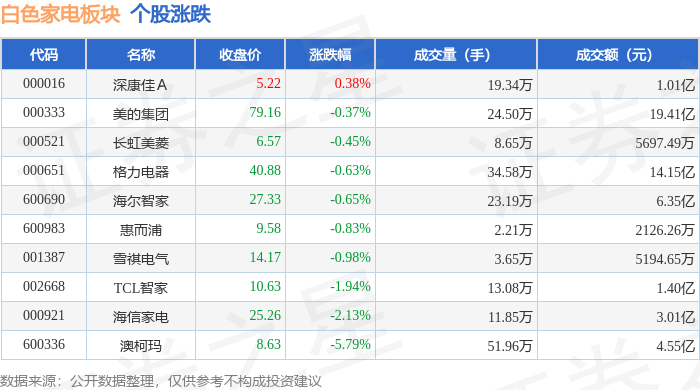
Core Viewpoint - The white goods sector experienced a decline of 0.57% on December 22, with Aucma leading the drop, while the overall Shanghai Composite Index rose by 0.69% and the Shenzhen Component Index increased by 1.47% [1] Group 1: Market Performance - The closing price for Midea Group was 79.16, down by 0.37%, with a trading volume of 245,000 shares and a transaction value of 1.94 billion yuan [1] - Gree Electric Appliances closed at 40.88, down by 0.63%, with a trading volume of 345,800 shares [1] - Haier Smart Home closed at 27.33, down by 0.65%, with a trading volume of 231,900 shares [1] - Aucma saw the largest decline at 5.79%, closing at 8.63, with a trading volume of 519,600 shares [1] Group 2: Capital Flow - The white goods sector had a net outflow of 184 million yuan from institutional investors, while retail investors saw a net inflow of 16.2 million yuan [1] - Haier Smart Home had a net inflow of 7.685 million yuan from institutional investors, but a net outflow of 5.353 million yuan from retail investors [2] - Midea Group experienced a significant net outflow of 136 million yuan from institutional investors, while retail investors had a net inflow of 74.33 million yuan [2] - Aucma faced a net outflow of 37.77 million yuan from institutional investors, but retail investors contributed a net inflow of 34.78 million yuan [2]
深度解析泉果刚登峰,为何这时更需要关注他?
Xin Lang Cai Jing· 2025-12-22 06:29
Core Viewpoint - The article emphasizes the importance of time in investment, highlighting the growth of a fund manager's credibility and trustworthiness over a longer career span [1][2]. Group 1: Background of the Fund Manager - The fund manager, Gang Dengfeng, has 16 years of experience in the securities industry and 11 years in investment management, evolving from a novice to a seasoned professional [2]. - Gang Dengfeng's early career was shaped by his exposure to value investing principles at Dongfang Securities, which laid a strong foundation for his investment philosophy [4][5]. - The investment philosophy of Gang Dengfeng is influenced by his early experiences and the quality of the team he worked with at Dongfang Securities [4][5]. Group 2: Investment Philosophy and Framework - Gang Dengfeng's investment framework is characterized by a focus on quality growth with a mid-level industry perspective, aiming for sustainable opportunities rather than speculative gains [8][31]. - The investment strategy prioritizes holding high-quality companies with strong financial metrics and competent management, leading to a low turnover rate in his portfolio [13][35]. - The concentration of holdings has increased over time, with the top ten holdings' concentration rising from 36.40% at the end of 2023 to 58.67% by the end of Q3 2025 [35]. Group 3: Performance Metrics - The fund managed by Gang Dengfeng, Quan Guo Si Yuan, has shown a net value growth rate of 32.28% over the past year, significantly outperforming the benchmark [21]. - The fund's turnover rates were recorded at 66.87% for 2023, 96.65% for 2024, and 115.48% for the first half of 2025, indicating a strategy focused on long-term holdings [31][32]. - The fund's maximum drawdown was -13.76% over the past year, compared to -21.04% for the CSI 300 index, demonstrating better risk management [16][37]. Group 4: Market Context and Future Outlook - The current market environment is seen as favorable for active equity funds, with a shift towards shareholder returns and dividends in the A-share market [19]. - The article suggests that the quality investment style may see a resurgence after a prolonged downturn, as high-quality companies are expected to perform better in a recovering economic environment [21]. - The increasing demand for equity investments among residents is noted, as traditional low-risk assets have become less attractive [19].