
酒类零售

Search documents
华致酒行(300755):抢抓即时消费需求增长完善业态协同 提质增效推改革蓄力未来
Xin Lang Cai Jing· 2025-08-20 08:35
Core Viewpoint - The company reported a significant decline in revenue and net profit for the first half of 2025, reflecting ongoing industry adjustments and increased inventory pressure, while also taking steps to improve operational quality and cash flow recovery [1][2]. Financial Performance - In H1 2025, the company achieved revenue of 3.949 billion yuan, a year-on-year decrease of 33.6% - The net profit attributable to shareholders was 56.21 million yuan, down 63.8% year-on-year - The net profit after deducting non-recurring items was 32.98 million yuan, a decline of 76.0% year-on-year - In Q2 2025, revenue was 1.098 billion yuan, a decrease of 39.4% year-on-year, with a net profit of -29.19 million yuan and a net profit after non-recurring items of -42.04 million yuan [1]. Industry Context - The industry is experiencing weak demand, leading to increased inventory pressure and a decline in prices, particularly for premium liquor, which has resulted in significant asset impairment for the company [1]. - The company reported an asset impairment provision of 55.77 million yuan in H1 2025, a substantial increase from 3.95 million yuan in H1 2024 and 13.33 million yuan in Q1 2025 [1]. Cost Management - The company’s comprehensive gross margin for H1 2025 was 9.7%, a decrease of 0.78 percentage points year-on-year, with Q2 gross margin at 7.9%, down 2.57 percentage points quarter-on-quarter [2]. - The company successfully reduced its expense ratios, with sales, management, and financial expense rates at 4.79%, 1.66%, and 0.50% respectively, leading to a total expense ratio of 6.95%, down 0.18 percentage points year-on-year [2]. Strategic Initiatives - The company is actively adjusting its store layout strategy and developing lightweight new products to enhance brand appeal, focusing on high-end dining and entertainment environments [3]. - The establishment of three main store formats—"Huazhi Wine House," "Huazhi Famous Wine Warehouse," and "Huazhi Preferred"—aims to capture the growing demand for instant consumption [3]. - A strategic partnership with Treasury Wine Estates has been established to exclusively distribute the Penfolds Koonunga Hill series, contributing to sales of 247 million yuan in H1 2025, an increase of 11.0% year-on-year [3]. Future Outlook - The company forecasts revenues of 8.034 billion yuan and 8.471 billion yuan for 2025 and 2026, representing year-on-year changes of -15.1% and +5.4% respectively - Expected net profits for 2025 and 2026 are projected at 72 million yuan and 125 million yuan, with year-on-year growth rates of +62.1% and +73.1% respectively [4].
古蔺县醉开心散酒铺(个体工商户)成立 注册资本1万人民币
Sou Hu Cai Jing· 2025-08-20 07:29
Group 1 - The establishment of Guzhong County Zui Kaixin Liquor Store, a sole proprietorship, has been registered with a legal representative named Xu Rongli and a registered capital of 10,000 RMB [1] - The business scope includes licensed projects such as liquor sales, tobacco retail, and food sales, as well as general projects like daily necessities sales and pre-packaged food sales [1] - The company is required to obtain relevant approvals from authorities for certain business activities, and it can operate independently within the scope of its business license for other activities [1]
机构风向标 | 华致酒行(300755)2025年二季度机构持仓风向标
Sou Hu Cai Jing· 2025-08-19 23:48
Group 1 - The core viewpoint of the news is that Huazhi Wine (300755.SZ) has reported a significant institutional ownership, with 10 institutional investors holding a total of 299 million shares, representing 71.67% of the total share capital as of August 19, 2025 [1] - The top ten institutional investors include Yunnan Rongrui High-tech Investment Management Co., Ltd., Tibet Rongrui Investment Co., Ltd., Huaze Group Co., Ltd., Hong Kong Central Clearing Limited, China Galaxy Securities Co., Ltd., and several others, with their combined holding ratio increasing by 0.65 percentage points compared to the previous quarter [1] - In the public fund sector, five new public funds have disclosed holdings this period, while two funds from the previous quarter have not been disclosed [1] Group 2 - From the foreign investment perspective, one foreign fund, Hong Kong Central Clearing Limited, has increased its holdings by 0.40% compared to the previous period [2]
华致酒行: 2025年半年度报告摘要
Zheng Quan Zhi Xing· 2025-08-19 16:22
Core Viewpoint - The financial performance of Huazhi Liquor Chain Management Co., Ltd. for the first half of 2025 shows a significant decline in revenue and net profit compared to the same period last year, indicating potential challenges in the company's operations and market conditions [1][5]. Financial Performance Summary - Operating revenue for the reporting period was approximately 3.95 billion yuan, a decrease of 33.55% from 5.94 billion yuan in the same period last year [1]. - Net profit attributable to shareholders of the listed company was approximately 56.21 million yuan, down 63.75% from 155.07 million yuan year-on-year [1]. - The net profit after deducting non-recurring gains and losses was not specified, but the overall financial health appears to be under pressure [1]. - The net cash flow from operating activities was approximately 116.59 million yuan, showing a significant improvement of 293.70% compared to a negative cash flow of 60.19 million yuan in the previous year [1]. - Basic and diluted earnings per share were both 0.13 yuan, a decrease of 65.79% from 0.38 yuan in the previous year [1]. - The weighted average return on net assets was 1.77%, down 2.36% from 4.13% in the previous year [1]. Asset and Equity Summary - Total assets at the end of the reporting period were approximately 5.62 billion yuan, a decrease of 20.98% from 7.11 billion yuan at the end of the previous year [1]. - Net assets attributable to shareholders of the listed company were approximately 3.18 billion yuan, reflecting a slight increase of 0.61% from 3.16 billion yuan [2]. Shareholder Structure - The largest shareholder, Yunnan Rongrui High-tech Investment Management Co., Ltd., holds 47.80% of the shares, followed by Tibet Rongrui Investment Co., Ltd. with 14.52% [2]. - The top ten shareholders include various entities, with the largest being non-state-owned legal persons [2][4].
华致酒行: 董事会决议公告
Zheng Quan Zhi Xing· 2025-08-19 16:22
Core Viewpoint - The company held its sixth board meeting, where several key resolutions were passed, including the approval of the 2025 semi-annual report, asset impairment provisions, guarantees for subsidiary credit applications, and revisions to governance policies [1][2][3][4][5][6] Group 1: Semi-Annual Report - The board approved the 2025 semi-annual report, confirming that the report's preparation complied with legal and regulatory requirements, accurately reflecting the company's actual situation without any false records or omissions [1][2] Group 2: Asset Impairment Provisions - The company conducted a comprehensive review and impairment testing of its assets as of June 30, 2025, resulting in a total impairment provision of 61.18 million yuan, which will be reflected in the 2025 semi-annual profit and loss statement [3][4] Group 3: Guarantees for Subsidiary - The board approved a guarantee for its wholly-owned subsidiary, Huazhi Chenxiang E-commerce Co., Ltd., to apply for a comprehensive credit line of up to 100 million yuan from Hangzhou Bank, with a term of 12 months [4][5] Group 4: Governance Policy Revisions - The company revised and formulated certain governance policies to optimize its governance structure and comply with the latest legal regulations, ensuring better operational standards [5][6]
华致酒行(300755) - 300755华致酒行投资者关系管理信息20250819
2025-08-19 14:30
Group 1: Market Challenges and Company Response - The liquor market is under pressure due to multiple factors, including industry cycle fluctuations and tightening macro policies, leading to increased operational challenges [2][3] - The company has actively responded to performance pressures by adjusting strategies, optimizing inventory structure, and promoting transformation [2][3] Group 2: Operational Achievements - Inventory reduction efforts have been successful, with inventory decreasing from CNY 3.259 billion to CNY 2.822 billion, resulting in a 293.7% year-on-year increase in operating cash flow [3] - The asset-liability ratio improved from 54.13% to 41.83%, enhancing the company's ability to withstand cyclical risks [3] Group 3: Cost Control Measures - The company implemented cost reduction strategies, achieving a 40.48% decrease in sales expenses and a 24.81% reduction in management expenses [4] Group 4: Business Development Strategies - The company focused on a customer-centric operational model, enhancing its marketing network through three main store formats: "Hua Zhi Wine Shop," "Hua Zhi Famous Wine Library," and "Hua Zhi Preferred" [5][6] - A service-oriented supply chain platform was established to improve efficiency and quality, catering to diverse consumer needs [6] Group 5: Instant Retail Initiatives - The company launched instant retail services through various platforms, significantly improving consumer shopping efficiency and satisfaction [7] - The integration of online and offline services allows for rapid delivery, meeting immediate consumer demands for social and business occasions [7] Group 6: Organizational and Talent Development - The company emphasized talent development and organizational restructuring to enhance operational efficiency, shifting focus from sales-centric to customer-centric approaches [8][9] Group 7: Financial Performance and Market Outlook - The company reported a significant increase in cash flow from operating activities, attributed to effective inventory management and supplier collaboration [10][11] - Despite a challenging market, the company aims to increase the sales proportion of famous wines while expanding the premium wine market [12][13]
华致酒行:关于为子公司申请综合授信提供担保的公告
Zheng Quan Ri Bao· 2025-08-19 13:43
Group 1 - The company announced that its wholly-owned subsidiary, Huazhi Chenxiang E-commerce Co., Ltd., plans to apply for a comprehensive credit line not exceeding RMB 100 million from Hangzhou Bank Beijing Branch, with a term of 12 months [2] - The credit line will be used for various financial services, including but not limited to working capital loans, bank bills, guarantees, and letters of credit, with the company providing a guarantee for the application, with a maximum guarantee amount of RMB 100 million [2] - As of the date of the announcement, the company's total guarantee balance for its subsidiary is RMB 416.84 million, accounting for 13.21% of the company's most recent audited net assets [2]

华致酒行:2025年半年度净利润约5621万元
Mei Ri Jing Ji Xin Wen· 2025-08-19 10:50
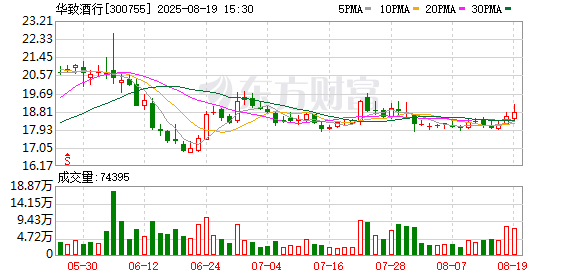
Core Viewpoint - Huazhi Wine's semi-annual performance report indicates a significant decline in both revenue and net profit for the first half of 2025 compared to the previous year [2] Financial Performance - The company's revenue for the first half of 2025 is approximately 3.949 billion yuan, representing a year-on-year decrease of 33.55% [2] - The net profit attributable to shareholders is around 56.21 million yuan, which is a year-on-year decrease of 63.75% [2] - Basic earnings per share stand at 0.13 yuan, reflecting a year-on-year decline of 65.79% [2]
华致酒行(300755.SZ):上半年净利润5620.55万元 同比下降63.75%
Ge Long Hui A P P· 2025-08-19 10:24
Core Insights - Huazhi Wine's revenue for the first half of 2025 was 3.949 billion yuan, representing a year-on-year decline of 33.55% [1] - The net profit attributable to shareholders was 56.2055 million yuan, down 63.75% year-on-year [1] - The net profit attributable to shareholders after deducting non-recurring gains and losses was 32.9805 million yuan, a decrease of 76.03% year-on-year [1] - Basic earnings per share were 0.13 yuan [1]
华致酒行:2025年上半年净利润5620.55万元,同比下降63.75%
Xin Lang Cai Jing· 2025-08-19 10:24
华致酒行公告,2025年上半年营业收入39.49亿元,同比下降33.55%。净利润5620.55万元,同比下降 63.75%。 ...