
黄酒

Search documents
每周股票复盘:古越龙山(600059)已回购2.0133%股份
Sou Hu Cai Jing· 2025-11-08 19:02
Core Points - The stock price of Guyue Longshan (600059) closed at 9.59 yuan on November 7, 2025, reflecting a 0.95% increase from the previous week's price of 9.5 yuan [1] - The company's total market capitalization is currently 8.742 billion yuan, ranking 8th out of 16 in the non-baijiu sector and 2140th out of 5166 in the A-share market [1] Company Announcements - Guyue Longshan has repurchased a total of 18.3521 million A-shares, accounting for 2.0133% of the company's total share capital [1] - The company announced a share repurchase plan on April 23, 2025, with a budget of no less than 200 million yuan and no more than 300 million yuan, with a maximum repurchase price of 12.83 yuan per share [1] - As of October 31, 2025, the total amount paid for the repurchased shares is 186.4041 million yuan (excluding transaction fees), with a maximum repurchase price of 10.50 yuan per share and a minimum price of 9.48 yuan per share [1]

会稽山(601579)深度报告:黄酒行业变革在望 双品牌战略+大单品成型助力公司加速赶超
Xin Lang Cai Jing· 2025-11-05 14:39
Core Viewpoint - The yellow wine industry in China is experiencing a structural turning point driven by five key forces: technological breakthroughs, brand value reassessment, channel reconstruction, policy empowerment, and generational change, leading to increased industry concentration and the emergence of leading players like Kuaijishan [1] Brand Perspective - Kuaijishan leverages its 280 years of brewing heritage, national secret-level techniques, and aged raw materials to build a quality foundation and historical assets as one of the "Eight Famous Wines" [1] - The company has established a dual-brand strategy with "Kuaijishan" and "Lanting," focusing on high-end and nationwide expansion, while also holding multiple brand resources for collaborative development [1] - The main brand "Kuaijishan" targets mainstream price upgrades and youth transformation, promoting the "1743" as a flagship product, while the high-end brand "Lanting" integrates cultural IP to establish a premium image [1][2] Product Perspective - The company is driving product structure optimization through category innovation, health upgrades, and youthful design [2] - Health-oriented products have been developed to meet modern low-sugar and low-burden consumption needs, while the "One Day One Smoke" sparkling yellow wine caters to younger consumers [2] - The company has implemented a dual strategy of price increases and premiumization to address cost pressures, resulting in a 31.3% year-on-year growth in mid-to-high-end wine sales revenue in 2024 [2] Channel Perspective - Kuaijishan has built a national network focused on distribution, with a three-tier market strategy to enhance core market management and explore emerging channels [3] - In 2024, the company achieved revenue of 983 million yuan in the Zhejiang region, significantly outperforming peers [3] - The rapid growth of online channels has led to a compound annual growth rate (CAGR) of over 50% for mid-to-high-end product e-commerce revenue [3] Future Outlook - The yellow wine market is expected to benefit from generational shifts and cultural changes reshaping alcohol consumption patterns, with potential to capture part of the social demand traditionally dominated by white spirits [4] - The company’s brand strength is anticipated to elevate the industry from a single-leader model to a collaborative development phase, promoting overall industry prosperity [4] - The yellow wine industry enjoys favorable tax policies, providing additional support for profit margins, with a clear path for profit improvement as the industry grows [4] Profit Forecast and Investment Recommendations - The company is positioned to benefit from the high-end, national, and youthful transformation of the yellow wine industry, with projected revenues of 1.882 billion yuan and 2.185 billion yuan for 2025 and 2026, respectively, reflecting year-on-year growth of 15.4% and 16.1% [5] - The expected net profit for the same years is projected at 215 million yuan and 232 million yuan, with year-on-year growth of 9.4% and 8.2% [5]

12天9板,大牛股最新公告
Zheng Quan Shi Bao· 2025-11-03 23:05
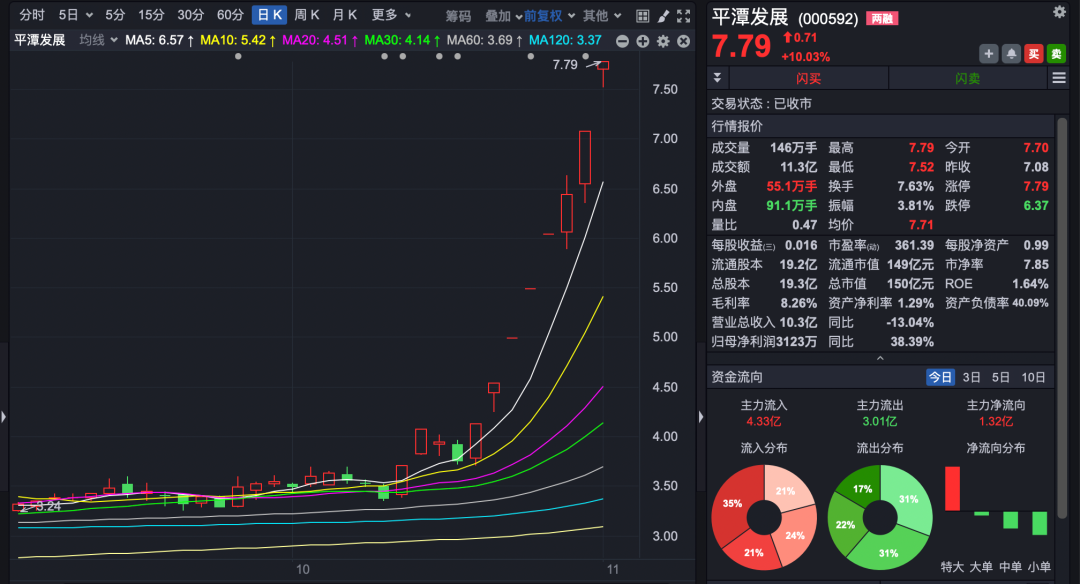
Group 1: Pingtan Development - Pingtan Development's stock price reached a nearly 9-year high, with a cumulative increase of over 130% in 12 trading days since October 17, including 9 trading days of limit-up [1][3] - The company reported that its main business includes afforestation, timber product processing and sales, and trade, with normal production and operation conditions [3] - As of November 3, 2025, the company's rolling price-to-earnings ratio was 361.39, significantly higher than the industry average, prompting a risk warning to investors [3] Group 2: Heff China - Heff China's stock price increased by over 60% from October 24 to November 3, with a cumulative rise of 61.23% over five consecutive trading days [4][6] - The company reported a net loss of 504.8 million yuan in Q3 2025, attributed to changes in the domestic macro environment and price reductions in the medical industry, leading to a decline in sales revenue and profit [6] - Heff China is implementing cost control measures, but short-term revenue declines are putting pressure on operating performance, indicating potential performance volatility risks [7] Group 3: ST Xinhua Jin - ST Xinhua Jin's stock price rose nearly 70% since mid-October, significantly outpacing the industry and market indices [7][9] - The company noted that its stock price increase is driven by market sentiment rather than fundamental changes, indicating a risk of rapid price declines [9] - ST Xinhua Jin is working to resolve non-operational fund occupation issues with its affiliate, which has led to risk warnings, and is seeking alternative funding methods to repay the occupied funds [9]


古越龙山:累计回购公司股份1835.21万股
Zheng Quan Ri Bao Zhi Sheng· 2025-11-03 12:09
Core Viewpoint - The company, Guyue Longshan, announced a share buyback plan, indicating a strategic move to enhance shareholder value and confidence in the company's future performance [1] Summary by Categories Company Actions - As of October 31, 2025, the company plans to repurchase 18.3521 million A-shares through the Shanghai Stock Exchange's centralized bidding system [1] - The repurchased shares will account for 2.0133% of the company's total share capital [1]
会稽山(601579):结构升级继续,整体仍处投入期
Changjiang Securities· 2025-11-03 10:46
Investment Rating - The investment rating for the company is "Buy" and is maintained [6] Core Views - The company achieved total revenue of 1.212 billion yuan in Q1-Q3 2025, representing a year-on-year increase of 14.12%. The net profit attributable to the parent company was 116 million yuan, up 3.23% year-on-year, while the net profit excluding non-recurring items was 108 million yuan, an increase of 8.28% year-on-year [2][4] - In Q3 2025, the company reported total revenue of 395 million yuan, a year-on-year increase of 21.09%. The net profit attributable to the parent company was 22.39 million yuan, up 2.47% year-on-year, while the net profit excluding non-recurring items was 18.64 million yuan, down 14.37% year-on-year [2][4] - The revenue growth in Q3 2025 accelerated compared to previous quarters, with mid-to-high-end yellow wine showing significant growth, achieving revenues of 230 million yuan and 78 million yuan respectively, with year-on-year growth rates of 62.47% and -42.19% [12] - The company's profitability slightly declined in Q3 2025 due to being in an investment phase, with the net profit margin decreasing by 1.03 percentage points to 5.67%. The gross margin improved by 2.84 percentage points to 53.24%, but the increase in expense ratios outpaced the gross margin improvement [12] - Looking ahead to Q4, the company is expected to maintain good revenue growth driven by year-end inventory preparations for the Spring Festival. In the medium to long term, the company's high-end and youth-oriented new products are expected to continue to gain traction, contributing to growth in markets outside the province [12] Financial Summary - For Q1-Q3 2025, the company reported total revenue of 1.212 billion yuan, with a gross profit of 650 million yuan, resulting in a gross margin of 53.24% [18] - The company forecasts earnings per share (EPS) of 0.45 yuan for 2025 and 0.55 yuan for 2026, corresponding to price-to-earnings (PE) ratios of 48 and 39 times respectively [12]
古越龙山(600059.SH):累计回购1835.21万股公司股份
Ge Long Hui A P P· 2025-11-03 09:44
Core Points - The company, Guyue Longshan (600059.SH), announced a share buyback program, having repurchased 18.3521 million A-shares as of October 31, 2025, which represents 2.0133% of its total share capital [1] - The shares were bought back through the Shanghai Stock Exchange trading system at a maximum price of RMB 10.50 per share and a minimum price of RMB 9.48 per share [1] - The total amount spent on the buyback was RMB 186 million, excluding transaction fees [1]
古越龙山:累计回购1835.21万股
Mei Ri Jing Ji Xin Wen· 2025-11-03 09:22
Summary of Key Points Core Viewpoint - Gu Yue Long Shan announced a share buyback program, indicating a strategic move to enhance shareholder value and confidence in the company's future prospects [1] Company Actions - The company has repurchased a total of 18.3521 million A-shares, which represents 2.0133% of its total share capital [1] - The shares were bought back through the Shanghai Stock Exchange via a centralized bidding process [1] - The highest purchase price was RMB 10.5 per share, while the lowest was RMB 9.48 per share, with a total expenditure of approximately RMB 186 million [1]
会稽山(601579):Q3营收保持高增,毛利率持续提升
HTSC· 2025-10-30 12:13
Investment Rating - The report maintains a "Buy" rating for the company with a target price of 24.75 RMB [6][4]. Core Insights - The company reported a total revenue of 1.212 billion RMB and a net profit attributable to the parent company of 116 million RMB for the first three quarters of 2025, representing year-on-year growth of 14.12% and 3.23% respectively [1]. - The gross profit margin has steadily increased, reaching 54.7% for the first three quarters of 2025, up 4.6 percentage points year-on-year [3]. - The company is focusing on high-end product development and has improved its marketing and management systems, which enhances operational momentum and profit release potential [1][4]. Revenue and Profitability - For Q3 2025, the company achieved a total revenue of 395 million RMB, a year-on-year increase of 21.09%, while the net profit attributable to the parent company was 22 million RMB, up 2.47% [1]. - The gross profit margin for Q3 2025 was 53.2%, an increase of 2.8 percentage points year-on-year [3]. - The company’s sales expenses increased by 7.2 percentage points to 27.6% for the first three quarters of 2025, indicating a more refined expense management approach [3]. Product Performance - The company’s core products, including Lan Ting and 1743, are expected to continue high growth, with Q3 2025 revenue for mid-to-high-end products increasing by 62.47% year-on-year [2]. - The company has a healthy inventory level and is actively cultivating consumer demand [2]. Market Expansion - The company is expanding its market presence, with revenue from Zhejiang, Jiangsu, and Shanghai regions showing positive growth [2]. - The number of distributors has increased, with 530 in Zhejiang and 1,403 in other regions as of Q3 2025, reflecting a strategic focus on market penetration [2]. Financial Forecast - The earnings per share (EPS) for 2025-2027 are projected to be 0.45, 0.55, and 0.71 RMB respectively, with a downward adjustment of 13% to 15% from previous forecasts [4]. - The company’s competitive landscape is improving, and the high-end product strategy is progressing smoothly, with operational momentum expected to continue [4].
会稽山前三季度营收净利双增 高端化、年轻化双轮驱动业绩增长
Zheng Quan Ri Bao Wang· 2025-10-30 11:45
Core Viewpoint - Kuaijishan Shaoxing Wine Co., Ltd. reported strong financial performance for the first three quarters of 2025, with a focus on brand innovation and market expansion targeting younger consumers and high-end segments [1][2]. Financial Performance - For the first three quarters of 2025, the company achieved operating revenue of 1.212 billion yuan, a year-on-year increase of 14.12% [1]. - The net profit attributable to shareholders for the same period was 116 million yuan, reflecting a year-on-year growth of 3.23% [1]. - In the third quarter alone, the company recorded operating revenue of 395 million yuan, up 21.09% year-on-year [1]. - The net profit attributable to shareholders in the third quarter was approximately 22.39 million yuan, marking a year-on-year increase of 2.47% [1]. Sales Breakdown - From January to September 2025, the sales revenue of mid-to-high-end yellow wine reached 751 million yuan, a year-on-year increase of 19.64% [1]. - Sales revenue from ordinary yellow wine was 273 million yuan, showing a decline of 16.01% year-on-year [1]. - Other alcoholic beverages generated sales revenue of 150 million yuan, with a significant year-on-year increase of 109.2% [1]. Brand Strategy - The company is committed to innovation while preserving tradition, focusing on rejuvenating its brand image and targeting younger demographics [1]. - The "Kuaijishan Refreshing Wine" brand has engaged in cross-industry collaborations, such as partnering with top influencers on Douyin, to effectively reach younger consumers and reshape perceptions of yellow wine [1]. - In the high-end market, Kuaijishan is developing the "Lanting Elegant Banquet" cultural IP and implementing various strategies to enhance brand recognition and customer loyalty through experiential marketing [2].
会稽山(601579):高端化与年轻化战略成效显著 渠道端回款积极
Xin Lang Cai Jing· 2025-10-30 08:29
Core Insights - The company reported a revenue of 1.212 billion yuan for the first three quarters of 2025, representing a year-on-year increase of 14.1% [1] - The net profit attributable to shareholders for the same period was 116 million yuan, up 3.2% year-on-year, while the net profit excluding non-recurring items was 108 million yuan, reflecting an 8.3% increase [1] Revenue Breakdown - In Q3 2025, the company achieved a revenue of 395 million yuan, which is a 21.1% increase year-on-year [1] - The revenue from high-end yellow wine, ordinary yellow wine, and other wines in Q3 2025 was 230 million, 78 million, and 79 million yuan respectively, with year-on-year changes of +62.5%, -42.2%, and +186.4% [2] - By sales channel in Q3 2025, direct sales, wholesale agency, and international sales generated revenues of 106 million, 279 million, and 2 million yuan respectively, with year-on-year changes of +95.7%, +12.8%, and -15.9% [2] - Revenue by region in Q3 2025 showed Zhejiang at 180 million yuan (+14.0%), Jiangsu at 32 million yuan (-19.9%), Shanghai at 82 million yuan (+85.0%), other domestic regions at 91 million yuan (+53.2%), and international sales at 2 million yuan (-15.9%) [2] Profitability and Expenses - The gross profit margin for Q3 2025 was 53.2%, an increase of 2.84 percentage points year-on-year [3] - The expense ratios for sales, management, R&D, and financial costs in Q3 2025 were 30.2%, 8.0%, 2.4%, and -0.2% respectively, with year-on-year changes of +6.84, -0.93, -2.40, and +0.58 percentage points [3] - The net profit margin attributable to shareholders for Q3 2025 was 5.7%, a decrease of 1.03 percentage points year-on-year [3] Future Outlook - The company is expected to benefit from the ongoing trends of high-end, national, and youth-oriented development in the yellow wine industry, with projected revenues of 1.882 billion and 2.185 billion yuan for 2025 and 2026, respectively, reflecting year-on-year growth rates of 15.4% and 16.1% [3] - The net profit attributable to shareholders is forecasted to be 215 million and 232 million yuan for 2025 and 2026, with year-on-year growth rates of 9.4% and 8.2% [3]