
铁路运输

Search documents
12306应该可以做得更好
Xin Lang Cai Jing· 2026-02-26 18:39
Group 1 - The core issue highlighted is the inadequacy of the 12306 ticketing system, particularly in handling the automatic fulfillment of standby orders, which can lead to significant inconveniences for passengers [1][2] - A specific incident involving a passenger who missed a train due to a late-night notification of a successful standby order illustrates the need for improved notification and fulfillment processes [1][2] - The railway department has acknowledged the need for ongoing optimization of the standby ticketing strategy and notification methods to enhance service quality for travelers [1] Group 2 - The incident reflects a broader demand for a more intelligent and personalized ticketing system that can analyze and flag unreasonable travel itineraries, thereby preventing potential issues for passengers [2] - The evolution of ticketing from paper to electronic formats and the shift from offline to online purchasing methods demonstrate the ongoing technological advancements in the railway sector [3] - There is a belief that with the integration of big data and artificial intelligence, the 12306 system can become more efficient and user-friendly, ultimately improving the travel experience [3]
春节假期中老铁路发送跨境旅客同比增长41.8%
Zheng Quan Ri Bao Wang· 2026-02-26 14:05
Core Insights - The article highlights the significant increase in cross-border tourism along the China-Laos Railway during the Spring Festival holiday, with a total of 12,900 cross-border travelers, marking a substantial growth of 41.8% compared to the previous year [1] Group 1: Cross-Border Travel Statistics - Inbound travelers exceeded 6,300, reflecting a year-on-year increase of 52.7% [1] - Outbound travelers reached 6,500, showing a year-on-year growth of 32.5% [1] Group 2: Railway Impact and Popularity - Since the opening of the China-Laos Railway, over 700,000 travelers from 124 countries and regions have utilized the service for cross-border travel [1] - The railway connects popular tourist destinations such as Kunming, Xishuangbanna, Luang Prabang, and Vientiane, featuring more than 560 tourist attractions, thus providing diverse travel options [1] - The China-Laos Railway has established itself as a key route for cross-border tourism [1]
春运以来中老铁路国际客货运输两旺
Sou Hu Cai Jing· 2026-02-26 11:48
Core Insights - The international freight and passenger transport via the China-Laos Railway has shown strong growth since the Spring Festival of 2026, with a total import and export value of 1.65 billion yuan, marking an 81.3% year-on-year increase [1] - The customs authority has implemented tailored clearance service plans to meet the growing demand for international transport, enhancing efficiency and ensuring smooth operations during peak travel periods [2][4] Group 1: Freight Transport - The total import and export value through the China-Laos Railway reached 1.65 billion yuan, with exports primarily consisting of electromechanical products, steel, and general merchandise, while imports mainly included tropical fruits and iron ore [1] - The volume of imported ASEAN fruits during the Spring Festival period increased by 17.63%, significantly supporting the domestic market supply [2] Group 2: Passenger Transport - A total of 98 international tourist trains were monitored, with 31,200 inbound and outbound passengers, reflecting a year-on-year increase of 7.7% and 31.3% respectively [1] Group 3: Customs and Clearance Services - The customs authority has introduced a "green channel" for perishable agricultural products and urgent medical needs for travelers, utilizing advanced non-intrusive inspection equipment to enhance the efficiency of cargo and personnel checks [2] - The customs department aims to improve regulatory efficiency through the use of smart inspection devices and by promoting facilitation models such as "railway fast passage" and "advance declaration" [4]


粤港澳大湾区开行新年首趟冷链海铁联运班列
Xin Lang Cai Jing· 2026-02-26 11:28
Core Viewpoint - The launch of the first cold chain sea-rail intermodal train from the Guangdong-Hong Kong-Macao Greater Bay Area to Jiangxi marks a significant development in cold chain logistics, enhancing connectivity and efficiency in the region [1] Group 1: Logistics Development - A cold chain train loaded with imported juice from Brazil departed from Nansha Port South Station in Guangzhou on February 26 at 15:30 [1] - The train is expected to arrive at Jiangxi Ganzhou International Port within one day, indicating a swift logistics operation [1] - This initiative establishes a new "road-to-rail" cold chain logistics channel between the Greater Bay Area and Jiangxi, improving supply chain efficiency [1]
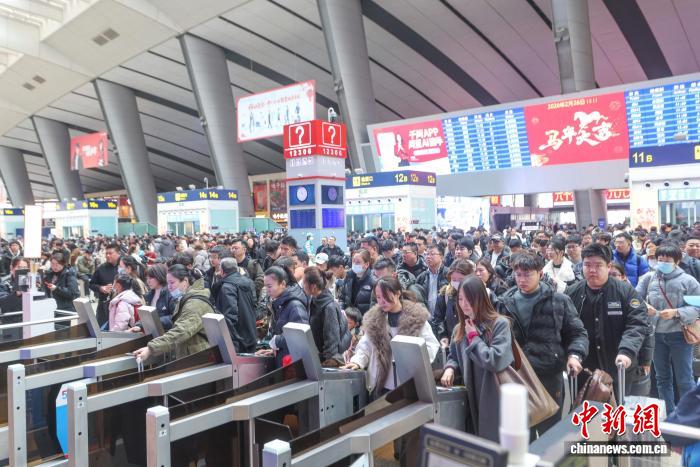
全国铁路发送旅客连续6天超1500万人次
Zhong Guo Xin Wen Wang· 2026-02-26 11:26
Core Insights - The national railway system in China has been sending over 15 million passengers daily for six consecutive days, with a peak of 17.01 million passengers on February 25 [1][3]. Group 1: Passenger Volume and Trends - On February 26, the railway is expected to send 15.65 million passengers, with 1,080 additional trains planned to accommodate the high volume [3]. - A total of 376 million train tickets have been pre-sold for the Spring Festival travel period as of 8 AM on February 26 [3]. Group 2: Operational Measures - Various railway departments are implementing multiple measures to handle the peak return passenger flow, including increasing transport capacity and ensuring passenger convenience [3][4]. - Specific railway companies, such as Taiyuan and Wuhan, are adding numerous trains to popular routes to facilitate passenger travel [3][4].
中欧班列“东通道”今年通行量突破1000列
Zhong Guo Xin Wen Wang· 2026-02-26 08:38
Core Insights - The China-Europe Railway Express "Eastern Corridor" has surpassed 1,000 trains this year, with a total of 1,034 trains and 105,170 TEUs transported, marking year-on-year increases of 48.4% and 43.2% respectively, achieving this milestone 26 days earlier than last year [1][3]. Group 1: Operational Efficiency - The Eastern Corridor consists of three major railway ports: Manzhouli, Suifenhe, and Tongjiang, with 27 stable operating routes connecting to 14 countries including Poland, Germany, and the Netherlands, linking over 60 cities in China [3]. - The China Railway Harbin Group has prioritized the operation of the China-Europe trains, utilizing a "digital port" intelligent system to enhance collaboration with customs and border inspection departments, optimizing processes to reduce customs clearance time to under 30 minutes, resulting in a nearly 10% improvement in overall transportation efficiency [3][4]. Group 2: Cargo Volume and Growth - Manzhouli Station has played a crucial role as a cross-border logistics hub, achieving an import and export cargo volume of 3.5088 million tons by February 25, with a year-on-year increase of 191,600 tons, representing a growth rate of 5.8% [3]. - During the Spring Festival period, Suifenhe Station focused on key imports such as coal, iron concentrate, and timber, leveraging the brand advantage of the China-Europe trains to enhance efficiency in processing import/export documentation and transshipment operations, resulting in over 178,000 tons of cargo handled in just nine days [3]. Group 3: Future Potential - The Tongjiang North Station has effectively monitored export train dynamics, ensuring smooth outbound passage, with 37 export trains and 33,000 tons operated by February 25, reflecting increases of 236.4% and 312.5% year-on-year respectively [4]. - The ongoing expansion project of the Jiamusi to Tongjiang railway is expected to triple the throughput capacity of the Tongjiang railway port, further unlocking the transportation potential of the China-Europe Railway Express Eastern Corridor [4].

新春走基层|雨棚机器人:房顶检修的科技范儿
Zhong Guo Jing Ying Bao· 2026-02-26 06:46
Core Viewpoint - The introduction of the rain shed inspection robot by China Railway Nanchang Bureau Group marks a significant advancement in the intelligent maintenance of railway facilities, enhancing safety and efficiency during the Spring Festival travel rush [1][2]. Group 1: Technological Advancements - The rain shed inspection robot autonomously navigates and scans the rain shed, allowing for flexible inspections without the limitations of traditional manual checks [2]. - This technology reduces the risks associated with high-altitude manual inspections, decreases labor costs, and improves inspection efficiency and accuracy [2]. - The robot creates a "health record" for the rain shed, enabling data accumulation and trend analysis to predict potential failures and shift from reactive repairs to proactive maintenance [2]. Group 2: Collaborative Innovation - The successful development of the robot involved collaboration between young university students and experienced workers, showcasing the blend of practical experience and theoretical knowledge [2][3]. - The team also developed a rain shed safety monitoring system that uses high-definition cameras for remote monitoring, successfully identifying and addressing safety hazards in real-time [3]. Group 3: Material and Platform Development - The research team has invested in developing new materials, such as a special mortar, to address safety issues related to the platform's surface, significantly improving repair quality [3]. - An intelligent maintenance platform has been created to streamline the management of equipment inspections and repairs, enhancing efficiency and accuracy in record-keeping and task management [4].

春运第25天,全社会跨区域人员流动量预计超2.2亿人次
Xin Lang Cai Jing· 2026-02-26 06:17
Core Insights - The overall inter-regional mobility of people is expected to reach 22,194 million trips on February 26, showing a month-on-month decrease of 3.8% but a year-on-year increase of 5.2% compared to the same period in 2025 [1] Transportation Sector Summary - **Railway Passenger Volume**: Expected to be 15.65 million trips, with a month-on-month decrease of 8% and a year-on-year increase of 9.8% compared to 2025 [1] - **Highway Mobility**: Estimated at 20,286 million trips, down 3.4% month-on-month, but up 4.8% year-on-year compared to 2025. This includes: - **Public Transport Volume**: Expected to be 3.238 million trips, down 2.2% month-on-month, with a year-on-year increase of 4.7% compared to 2025 [1] - **Non-commercial Vehicle Trips**: Estimated at 17,048 million trips, down 3.6% month-on-month, with a year-on-year increase of 4.8% compared to 2025 [1] - **Waterway Passenger Volume**: Expected to be 840,000 trips, down 14.2% month-on-month, but up 19.5% year-on-year compared to 2025 [1] - **Aviation Passenger Volume**: Estimated at 2.59 million trips, down 1.7% month-on-month, with a year-on-year increase of 10% compared to 2025 [1] - **Overall Railway Passenger Volume**: Expected to be 17.014 million trips, down 6% month-on-month, with a year-on-year increase of 12.4% compared to 2025 [1] - **Highway Mobility (Revised)**: Estimated at 20,996 million trips, down 4.8% month-on-month, with a year-on-year increase of 4.8% compared to 2025. This includes: - **Public Transport Volume (Revised)**: Expected to be 3.312 million trips, up 0.9% month-on-month, with a year-on-year increase of 4.9% compared to 2025 [1] - **Non-commercial Vehicle Trips (Revised)**: Estimated at 17,684 million trips, down 5.8% month-on-month, with a year-on-year increase of 4.7% compared to 2025 [1] - **Waterway Passenger Volume (Revised)**: Expected to be 979,000 trips, down 8.8% month-on-month, with a year-on-year increase of 20.2% compared to 2025 [1] - **Aviation Passenger Volume (Revised)**: Estimated at 2.636 million trips, down 0.2% month-on-month, with a year-on-year increase of 8.8% compared to 2025 [1]
连续6天超1500万人次 铁路部门多措并举应对返程客流高峰
Xin Lang Cai Jing· 2026-02-26 06:17
Core Viewpoint - The national railway system in China is experiencing a significant increase in passenger traffic during the Spring Festival travel season, with measures in place to ensure safety and efficiency in transportation [1][2]. Group 1: Passenger Traffic - On February 25, the national railway sent 17.014 million passengers, maintaining over 15 million for six consecutive days [1] - On February 26, the railway is expected to send 15.65 million passengers, with 1,080 additional trains planned [1] - A total of 376 million train tickets have been pre-sold for the Spring Festival travel period as of 8 AM on the current day [1] Group 2: Operational Measures - Various railway departments are implementing multiple strategies to handle the peak return passenger flow, increasing capacity and ensuring convenience for travelers [1] - Specific measures include adding trains in various directions, such as 15 additional trains by the Taiyuan Bureau and 170 by the Wuhan Bureau [1] - The Urumqi Bureau has added 36 trains and implemented double-heading for 18 high-speed trains to manage the increased demand [2] Group 3: Passenger Guidance - The railway department advises travelers to stay informed about service information and weather conditions due to high passenger volumes at certain stations [2] - Passengers are encouraged to confirm travel details and allow sufficient time for boarding, adhering to regulations regarding personal items and ticket information [2]
春运第25天 全社会跨区域人员流动量预计超2.2亿人次
Xin Lang Cai Jing· 2026-02-26 06:17
Core Insights - The overall cross-regional population flow is expected to reach 22,194 million trips on February 26, showing a month-on-month decrease of 3.8% but a year-on-year increase of 5.2% compared to the same period in 2025 [1] Transportation Sector Summary Railway - Railway passenger volume is projected at 15.65 million trips, reflecting a month-on-month decline of 8% but a year-on-year increase of 9.8% compared to 2025 [1] Road - Road transportation, including both commercial and non-commercial passenger traffic, is expected to account for 20,286 million trips, with a month-on-month decrease of 3.4% and a year-on-year increase of 4.8% compared to 2025 [1] - Within road transport, commercial passenger volume is estimated at 3.238 million trips, showing a month-on-month decline of 2.2% but a year-on-year increase of 4.7% compared to 2025 [1] - Non-commercial passenger traffic on highways and national roads is expected to be 17.048 million trips, with a month-on-month decrease of 3.6% and a year-on-year increase of 4.8% compared to 2025 [1] Waterway - Waterway passenger volume is anticipated to be 840,000 trips, reflecting a month-on-month decline of 14.2% but a year-on-year increase of 19.5% compared to 2025 [1] Civil Aviation - Civil aviation passenger volume is projected at 2.59 million trips, with a month-on-month decrease of 1.7% and a year-on-year increase of 10% compared to 2025 [1]